
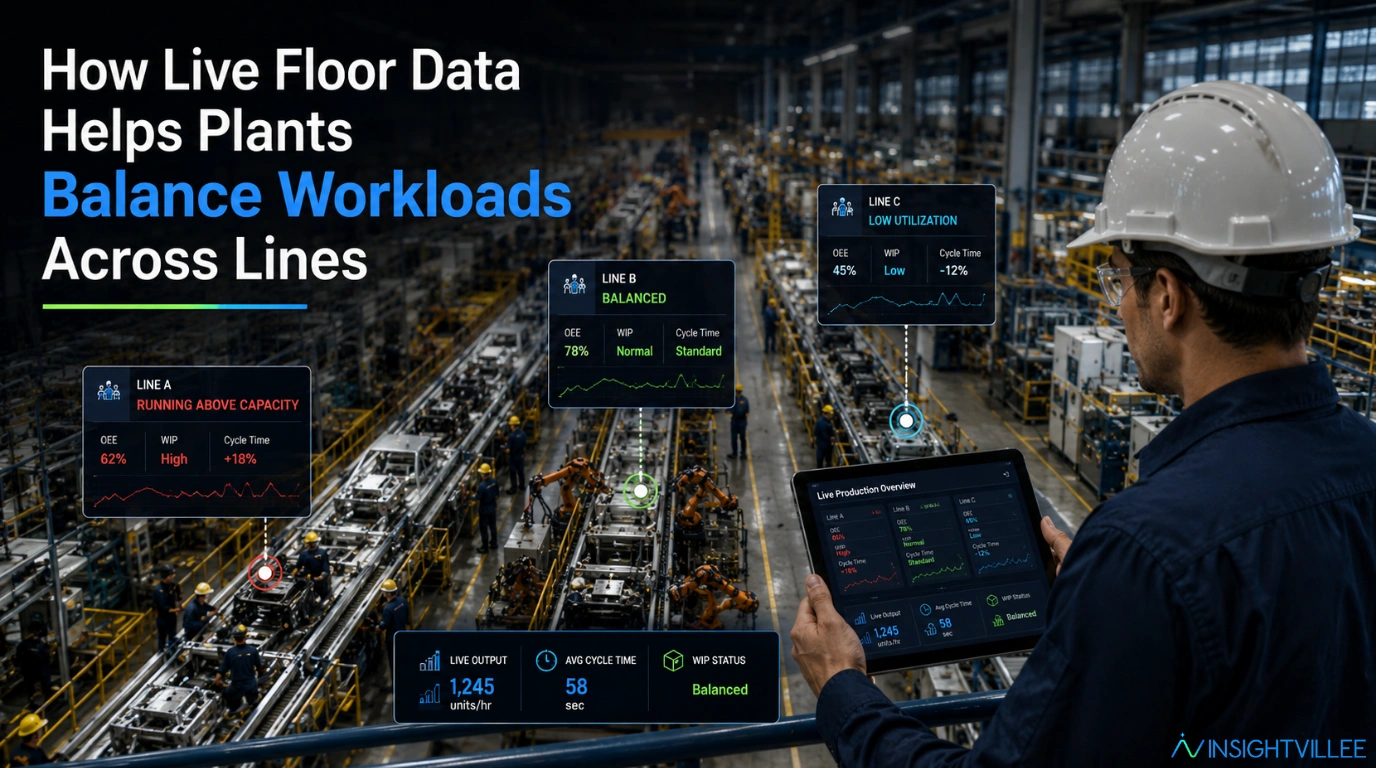
How Live Floor Data Helps Plants Balance Workloads Across Lines
Live floor data helps plants balance workloads across lines because it shows what is happening on each line while production is still running.
In many large plants, one line is overloaded while another line has spare capacity. One line may be behind plan. Another may be waiting for material. A third may be running slow because of repeated stoppages. If leaders see this only at shift end, the chance to balance the workload is already gone.
The problem is not that plants do not plan. The problem is that shop floor conditions change faster than static plans.
Siemens reported that unplanned downtime costs the world’s 500 largest companies 11% of annual revenue, equal to about $1.4 trillion [Siemens, 2024]. The exact impact differs by plant and industry, but the lesson is clear. Plants need visibility while losses are forming, not after the shift is over.
What Is Live Floor Data in Manufacturing?
Live floor data in manufacturing is real-time information from machines, lines, operators, production systems, and shop floor activities that shows what is happening right now.
It includes machine status, production output, downtime, cycle time, line speed, WIP, operator availability, changeover status, material availability, and maintenance condition.
The goal is simple. Leaders should know what is happening on the floor now, not what happened after the shift ended.
ISO 22400 defines KPIs used in manufacturing operations management, including their formulas, units, time behaviour, and user groups [ISO, 2014]. This matters because floor data manufacturing becomes useful only when it is measured clearly and consistently.
5 reasons static production plans fail on the shop floor
What Does Workload Balancing Across Lines Mean?
Workload balancing means distributing production work across lines, machines, and shifts so the plant avoids overload, idle capacity, and bottlenecks.
In simple terms, production line balancing means making sure work is spread properly.
A balanced workload keeps production moving smoothly. One line should not carry too much pressure while another line is underused. One machine should not become the reason the full schedule gets delayed.
For example, if Line 1 is running behind plan but Line 2 has available capacity, the plant may shift work, manpower, or sequence. But this is only possible if teams can see the gap early.
Why Does Workload Balancing Matter in Manufacturing Plants?
Workload balancing matters because poor balance affects output, delivery timelines, manpower planning, machine utilisation, production cost, and daily execution.
If one line is overloaded, it may face more downtime, quality issues, operator fatigue, and maintenance stress. If another line is underused, the plant loses available capacity.
Deloitte noted that manufacturers continue to face supply chain risks, possible delays, disruptions, and elevated costs [Deloitte, 2025]. Under this pressure, poor workload balance can quickly affect customer commitments.
This is why workload balancing manufacturing is not only a planning topic. It is a daily execution issue for Plant Heads and Operations Directors.
When Do Workload Imbalances Usually Happen?
Workload imbalances usually happen when demand, machines, material, manpower, changeovers, maintenance, or floor conditions change after the production plan is created.
Imbalance can happen during sudden demand changes. It can happen during machine breakdowns. It can happen when one line takes longer during changeover. It can happen when manpower is short or material is delayed.
A common situation is simple. The plan says three lines will run normally. But one line faces repeated stoppages, another line waits for material, and another finishes early. Without live visibility, the imbalance is noticed too late.
This is what causes workload imbalance across production lines. The plan is fixed, but the floor keeps changing.
Why Do Static Production Plans Fail to Balance Workloads?
Static production plans fail to balance workloads because they are made before production starts, while actual line status, manpower, material, and machine conditions keep changing during the shift.
Static plans depend on expected capacity, planned manpower, standard cycle times, and assumed material availability.
But the shop floor changes during the day. A machine slows down. One line faces repeated stoppages. Material arrives late. Changeover takes longer than expected. A maintenance issue appears.
Without live floor data, planners continue following a plan that no longer matches reality.
This is why some production lines run overloaded while others sit idle is a common question in large plants. The answer is usually delayed visibility.
How Does Live Floor Data Help Balance Workloads Across Lines?
Live floor data helps balance workloads by showing which lines are overloaded, which lines have spare capacity, and where supervisors need to act before delays become bigger.
It shows whether production is ahead or behind plan. It shows line speed, cycle time, stoppages, WIP, and available capacity. It helps supervisors identify bottlenecks early.
For example, if Line 3 is falling behind because of frequent micro-stoppages, supervisors can move manpower, change sequence, or shift part of the workload to another line if possible.
This is how to balance production workloads across multiple lines. Do not wait for the final output report. Watch the live line condition and act while there is still time.
how cross-plant benchmarking helps leaders find hidden performance gaps
What Live Floor Data Should Plants Track for Workload Balancing?
Plants should track output, machine status, cycle time, line speed, downtime, WIP, changeover progress, manpower, material availability, target versus actual, and line capacity utilisation.
Useful live data includes:
Line-wise production output.
Machine status and availability.
Cycle time and line speed.
Downtime and stoppage reasons.
Work-in-progress, or WIP.
Changeover progress.
Manpower availability.
Material availability.
Production target versus actual output.
Capacity utilization by line.
Line utilisation manufacturing should be reviewed during the shift, not only at the end of the day. This helps teams correct workload imbalance before output loss becomes final.
How Does AI-Driven Intelligence Improve Workload Balancing?
AI-driven intelligence improves workload balancing by comparing live demand, capacity, machine health, manpower, and production progress together to show where bottlenecks may appear.
The value is not the term. The value is better timing.
If one line is likely to fall behind, the plant should know early. If one machine is creating repeated small stoppages, the plant should know before the full schedule slips.
This is production line balancing with real-time floor data. It helps planners move from manual replanning to continuous production adjustment.
Insightvillee supports smart production planning, OEE monitoring, predictive maintenance, and multi-plant intelligence. It connects machines, lines, ERP, MES, SCADA, PLCs, sensors, and CMMS into one real-time intelligence layer.
What Does Better Workload Balancing Look Like in a Smart Factory?
Better workload balancing looks like one live view of planned output, actual output, line capacity, bottlenecks, machine status, and shift progress across all lines.
A smart factory should show where each line stands against plan. It should alert teams when a line falls behind. It should show spare capacity on other lines. It should help production, maintenance, quality, and planning teams work from the same picture.
This is how live data improves workload distribution in Indian factories. Teams stop debating whose report is correct. They start acting on the same live floor picture.
smart factory operations what one intelligence layer changes for manufacturers
Better workload balance also supports safety. Overloaded lines and rushed movement can increase floor risk, which is why safety compliance cannot depend on end-of-shift checklists matters for large plants.
What Are the Best Practices for Using Live Floor Data to Balance Workloads?
The best practice is to start with critical lines, standardise line-wise KPIs, connect production constraints, and review workload balance during the shift.
Plant teams should start with the lines that affect delivery most.
Standardise line-wise KPIs. Track output, downtime, cycle time, capacity utilisation, material status, manpower, and changeover time. Set alerts for bottlenecks, downtime, and capacity gaps.
Connect production, maintenance, material, and manpower data. Review workload balance during the shift, not only after it.
This answers how to track line utilisation in real time in manufacturing. Start with live output versus plan and line capacity utilisation by shift.
Use live data to support supervisors, not replace their judgement.
Conclusion
Live floor data helps plants balance workloads because it shows overloaded lines, idle capacity, bottlenecks, and production delays while they are happening.
Workload imbalance usually happens because the shop floor changes faster than static plans.
When leaders see live floor conditions, they can adjust work, manpower, material movement, and production sequence faster. This improves machine utilisation, output, delivery reliability, and production efficiency.
The future of workload planning is real-time, connected, and action-focused.
Insightvillee supports this shift as a transformation partner for large-scale manufacturers. Its smart production planning and multi-plant intelligence capabilities help leaders move from delayed reports to live production control, with go-live in 6 weeks and ROI within 6 to 9 months in relevant deployments.
Key Takeaways
- Live floor data helps plants see workload imbalance during production, not after the shift ends.
- Workload balancing improves output, machine utilisation, delivery reliability, and production flow.
- Static plans fail when machines, material, manpower, and floor conditions change.
- Plants should track output, downtime, cycle time, WIP, manpower, material, and capacity utilisation by line.
- Better workload balancing needs live visibility, standard KPIs, and faster action during the shift.