
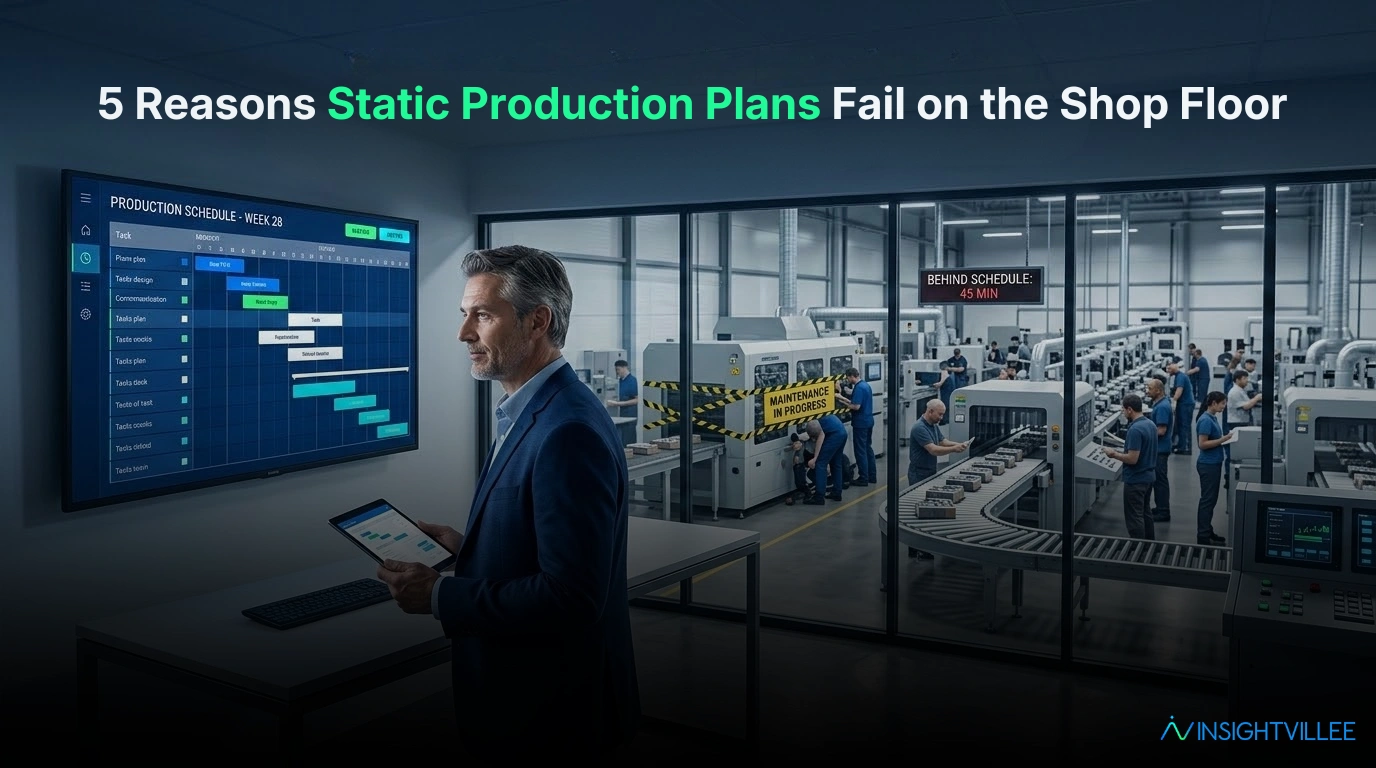
5 Reasons Static Production Plans Fail on the Shop Floor
Static production plans may look accurate during planning, but they often fail once real shop floor conditions start changing. A fixed plan cannot respond quickly to machine downtime, material shortages, urgent order changes, quality issues, or shift-level execution gaps.
In a large plant, the plan may be ready before the shift begins. But by mid-shift, one machine may be down, one material may be short, one customer order may become urgent, and one line may start producing rework. The plan is still the same. The floor is not.
Siemens reported that unplanned downtime costs the world’s 500 largest companies 11% of annual revenue, equal to about $1.4 trillion [Siemens, 2024]. The exact impact differs by plant and industry, but the pressure is clear. Planning accuracy matters only when the plan can survive floor reality.
What Is a Static Production Plan?
A static production plan is a fixed schedule made before production starts. It is based on expected demand, machine capacity, material availability, and manpower, but it does not adjust automatically when conditions change.
In simple terms, a static production plan tells teams what should happen during the shift, day, or week. It may define which product will run on which line, which material will be used, which order will be completed first, and what output is expected.
This is common in production planning. Planning teams prepare the schedule using ERP data, Excel sheets, previous shift reports, and inputs from production, stores, quality, and maintenance.
The problem starts when real conditions change after the plan is released. A machine may slow down. A material may not reach the line. A quality hold may block output. The plan remains fixed, but execution becomes different.
how live floor data helps plants balance workloads across lines
Why Static Production Plans Fail on the Shop Floor
Static production plans fail on the shop floor because they depend on assumptions, while real production depends on live machine status, material movement, quality results, order priority, and shift execution.
This is the simplest answer to why static production plans fail in manufacturing. The plan is made at one point in time. The shop floor changes every hour.
Deloitte noted that manufacturers continue to face supply chain risks, delays, disruptions, and elevated costs [Deloitte, 2025]. This makes fixed planning harder because material availability, order priority, and production commitments can change quickly.
In Indian plants, a common issue is that planning teams work with system data while supervisors deal with floor reality. This creates shop floor planning gaps in Indian factories. The planning sheet may show capacity available, but the line may already be waiting for material, manpower, or quality clearance.
What Are the 5 Reasons Static Production Plans Fail on the Shop Floor?
Static production plans usually fail because they are built on assumptions, not live shop floor conditions. Five common reasons create the biggest gap between the plan and actual production.
Static production plans usually fail because they are built on assumptions, not live shop floor conditions. The five common reasons are:
- Machine status changes after the plan is created
- Material shortages are discovered too late
- Urgent orders disrupt the planned sequence
- Quality issues and rework change actual capacity
- Labor and shift constraints affect execution
This is also the practical answer to why production planning fails on the shop floor. The plan may be correct when it is made, but it becomes weak when new problems appear during execution.
Reason 1: Machine Status Changes After the Plan Is Created
Machine status changes break static plans because planned capacity no longer matches actual capacity. A machine that looked available during planning may become the reason output falls during production.
A planner may schedule a line for 10,000 units based on rated capacity. But during the shift, the machine may slow down, stop repeatedly, or need maintenance attention. The schedule still assumes full output. The line cannot deliver it.
NIST found that manufacturers using more preventive and predictive maintenance had 52.7% less unplanned downtime and 78.5% fewer defects than plants relying more heavily on reactive maintenance [NIST, 2021].
This matters because machine health is not only a maintenance issue. It directly affects manufacturing planning and delivery confidence.
Reason 2: Material Shortages Are Discovered Too Late
Material shortages break static plans because production stops after the shortage reaches the line. By then, the waiting time is already lost.
A plan may assume that raw materials, packaging materials, bought-out parts, labels, tools, and consumables are available. But the system stock may not reflect floor-ready stock. Material may be under quality check, blocked in stores, short in quantity, or not moved to the line.
This is one of the common production scheduling problems in manufacturing. The plan says the order can run. The floor discovers the material gap too late.
Material visibility also affects waste and stock accuracy. Plants trying to improve material control should also review 6 waste reporting gaps that hide material loss in manufacturing plants
Reason 3: Urgent Orders Disrupt the Planned Sequence
Urgent orders break static plans because the planned sequence must change, but teams may not know the full impact on capacity, material, manpower, and dispatch.
Every large plant receives urgent orders. A key customer escalates. Export dispatch moves forward. A high-priority SKU needs immediate production. A downstream unit asks for faster supply.
The problem is not the urgent order. The problem is changing the sequence without live visibility.
McKinsey reported that supply chain leaders continue to face disruption and risk exposure across supply networks [McKinsey, 2024]. This means plants need faster replanning, not only better planning.
When planners cannot see current line load, material readiness, WIP, and quality holds, one urgent order can disturb several other orders.
Reason 4: Quality Issues and Rework Change Actual Capacity
Quality issues and rework break static plans because they reduce usable capacity. The line may still be running, but part of the time is spent correcting earlier problems.
A static plan usually assumes first-pass quality. But the floor may face rework, rejection, quality holds, repacking, retesting, or batch correction.
This changes actual capacity. A line that was planned for fresh production may spend part of the shift correcting defects. A quality hold may block finished goods. A batch may need extra processing before release.
This is why dynamic production planning for large-scale manufacturing must include live quality status. Rework is not only a quality loss. It is also a planning loss.
Reason 5: Labor and Shift Constraints Affect Execution
Labor and shift constraints break static plans because output depends on who is available, who is trained, and how well work is handed over between shifts.
A plan may assume full manpower. The floor may have absenteeism, skill gaps, new operators, supervisor shortage, or poor shift handover.
One trained operator may be absent. One line may need a senior technician. One shift may lose time because the previous shift did not report a machine issue clearly.
These are common limitations of manual production scheduling in plants. Manual planning often captures machine capacity better than human execution constraints.
Safety and compliance work also affects execution. When checks are delayed or missed, line flow can suffer. This is why plants should understand why safety compliance cannot depend on end-of-shift checklists
How Static Plans Affect Output, OEE, and Delivery Timelines
Static plans affect output, OEE, and delivery timelines by creating a gap between planned production and actual floor performance. This leads to missed targets, overtime, delayed dispatch, and lower reliability.
OEE drops when actual production does not match the plan. Availability drops when machines stop. Performance drops when lines run slow. Quality drops when rework or rejection increases.
This answers why production schedules do not work on the floor. They fail because they are not connected to the real reasons output is changing during the shift.
For Plant Heads, the issue is not only missed production. It is a loss of confidence. If the same plan keeps changing every day, teams stop trusting the planning process.
How Real-Time Production Visibility Helps Teams Adjust Faster
Real-time production visibility helps teams adjust faster by showing live machine status, material readiness, quality holds, manpower gaps, and line performance before the loss becomes final.
This is what real-time production planning is in manufacturing. It means planning does not stop when the schedule is released. The plan keeps adjusting based on what is actually happening on the floor.
For example, if Line 2 slows down, teams can shift workload. If material is delayed, they can change sequence. If quality blocks one batch, they can protect another order. If a machine shows risk, maintenance can act before downtime grows.
Insightvillee connects machines, lines, ERP, MES, SCADA, PLCs, sensors, and CMMS into one real-time intelligence layer. Its smart production planning capability helps teams balance demand, capacity, and live constraints.
smart factory operations what one intelligence layer changes for manufacturers
What Manufacturers Should Do Instead of Relying Only on Static Plans
Manufacturers should keep static plans as a base, but support them with live execution visibility, clear ownership, faster replanning, and real-time tracking of constraints.
Static planning is not wrong. It is incomplete.
Plant Heads should ask five practical questions:
- Which machines changed status after the plan was released?
- Which materials caused waiting time or sequence changes?
- Which urgent orders disrupted production scheduling?
- Which quality issues reduced actual capacity?
- Which labor gaps affected shift output?
This is how to improve production scheduling in large manufacturing plants. Do not only check whether the plan was made. Check whether the plan stayed connected to floor reality.
Final Thoughts: Static Plans Need Real-Time Execution Support
Static plans need real-time execution support because the shop floor changes faster than fixed schedules. Better planning comes from connecting schedules with live floor conditions and faster decisions.
Large plants will still need production planning, manufacturing planning, shop floor planning, and production scheduling. But these activities cannot depend only on static sheets and delayed reports.
The real shift is how to move from static to dynamic production planning. Plants need to see what is happening now, understand what it means for output, and act before the loss becomes permanent.
Insightvillee supports this shift as a transformation partner for large-scale manufacturers. With go-live in 6 weeks and ROI within 6 to 9 months, it helps leaders move from delayed planning updates to real-time production decisions.
Key Takeaways
- Static production plans fail because they are created before real shop floor changes happen.
- The five main causes are machine changes, material shortages, urgent orders, rework, and labor constraints.
- The main gap is not planning effort. It is a lack of live execution visibility.
- Real-time production planning for large plants helps teams adjust before output is lost.
- Dynamic planning works best when production, machine, material, quality, and shift data are connected.