
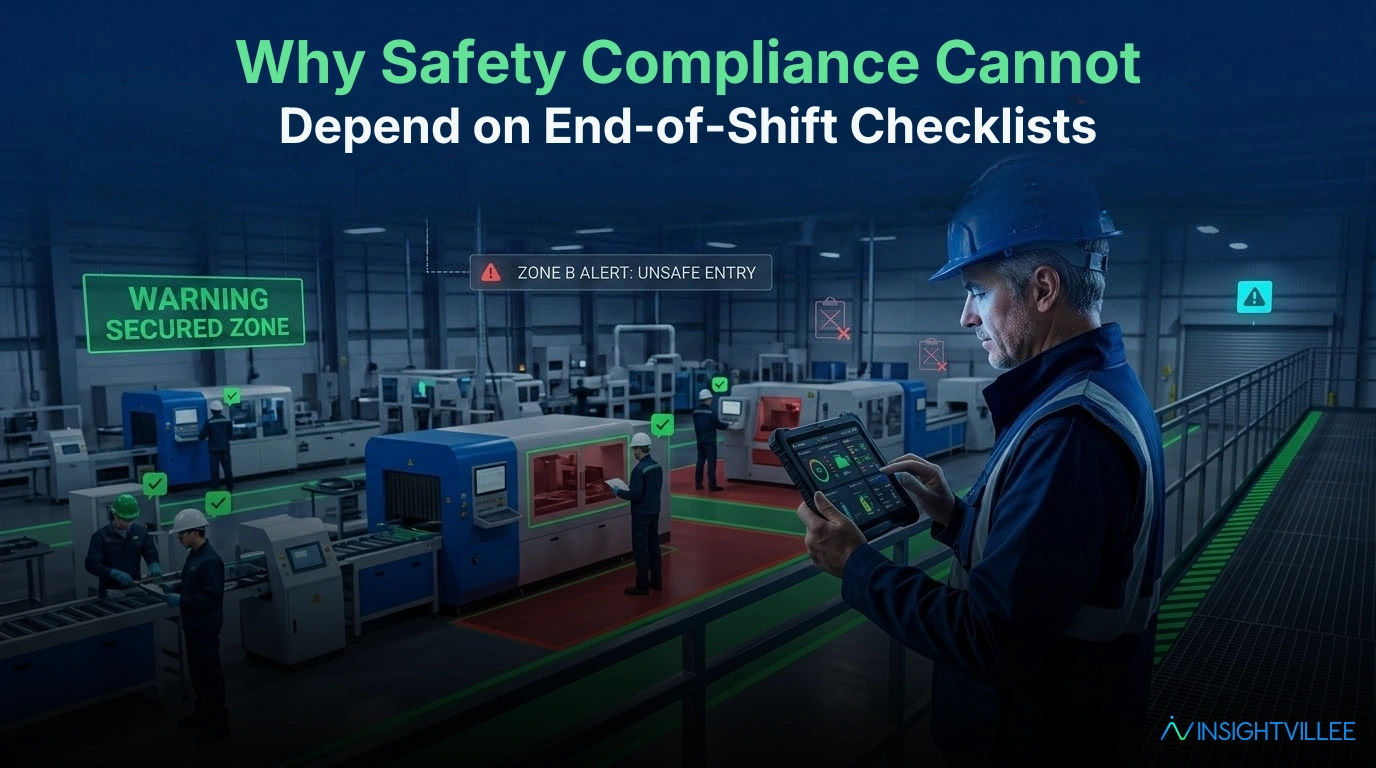
Why Safety Compliance Cannot Depend on End-of-Shift Checklists
Safety compliance manufacturing cannot depend on end-of-shift checklists because safety risks happen during the shift, not after it ends.
A worker enters a restricted zone without the right PPE. A forklift moves through a busy pathway. A maintenance activity starts near a running machine. A near miss happens during peak dispatch pressure. If the plant records these risks only at shift end, the danger has already happened.
End-of-shift checklists are useful for records. They are not enough for live safety control.
The International Labour Organization estimates that nearly three million workers die every year because of work-related accidents and diseases [ILO, 2023]. For large plants, this makes safety compliance a live operating responsibility, not only an audit activity.
What Is Safety Compliance in Manufacturing?
Safety compliance in manufacturing means following required safety rules, controls, records, and actions to protect workers, prevent incidents, and stay audit-ready during daily plant operations.
It includes PPE usage, machine guarding, zone control, permit-to-work checks, incident reporting, near-miss tracking, emergency readiness, and corrective action closure.
The main goal is not only to pass audits. The real goal is to prevent unsafe conditions before they become incidents.
ISO 45001 defines an occupational health and safety management system as a framework to manage risks and improve safety performance [ISO, 2018]. In plant language, this means safety must be planned, monitored, reviewed, and improved continuously.
Good safety compliance manufacturing is not just documentation. It is daily control on the floor.
Why Do Plants Use End-of-Shift Safety Checklists for Safety Compliance?
Plants use end-of-shift safety checklists because they are simple, familiar, easy to assign, and useful for creating audit records after a shift is complete.
Most plants use checklists because they fit traditional workflows. A supervisor checks PPE, housekeeping, machine guards, fire points, tools, incidents, and near misses. The record is signed and filed.
This helps during audits. It also helps management review what was observed during the shift.
In many Indian factories, safety checklists manufacturing processes are still paper-based or Excel-based. This works when the goal is recordkeeping. It becomes weak when the goal is real-time prevention.
how real-time zone alerts help prevent safety incidents in manufacturing plants
The problem is timing. A checklist completed at 6 pm cannot stop a risk that happened at 2 pm.
Why Are End-of-Shift Checklists Not Enough for Safety Compliance?
End-of-shift checklists are not enough for safety compliance because they capture safety issues after the event, depend on human memory, and do not show live risk during production.
This is why end-of-shift safety checklists fail in manufacturing. They record what someone noticed. They do not continuously show what is happening.
A supervisor may be managing output pressure, manpower gaps, breakdowns, dispatch delays, and safety checks at the same time. It is not practical to expect one person to watch every zone, every worker, and every risk point during the full shift.
OSHA states that identifying and assessing hazards should be a proactive, ongoing process in an effective safety program [OSHA, 2016]. A shift-end checklist is not ongoing. It is delayed.
A checklist can confirm that something was recorded. It cannot prevent a live risk.
When Do Safety Compliance Risks Actually Happen on the Shop Floor?
Safety compliance risks happen during live operations, especially during production runs, changeovers, maintenance work, material movement, and high-pressure shifts.
Safety risks are active events. They do not wait for the end of the shift.
During production, operators may take shortcuts to meet output targets. During changeover, machine guards may be opened. During maintenance, teams may work near moving parts or stored energy. During material movement, forklifts, cranes, and people may cross the same area.
This is where plant safety monitoring becomes important. Leaders need to know where risks are happening while operations are running.
A common issue in large plants is that unsafe behaviour repeats during specific times: changeover, lunch break, night shift, or dispatch rush. If the plant sees this only in a late report, corrective action also becomes late.
5 reasons static production plans fail on the shop floor
Safety risk often increases when production pressure increases.
What Problems Come From Depending Only on Safety Compliance Checklists?
Depending only on safety compliance checklists creates delayed reporting, missed unsafe conditions, weak accountability, incomplete records, and slow corrective action.
The biggest problem is delay. If a PPE violation, zone breach, unsafe movement, or near miss is recorded late, the plant loses the chance to act early.
The second problem is memory. Near misses are often forgotten if no injury happens. A small slip, unsafe entry, or blocked walkway may not enter the checklist unless someone reports it.
The third problem is weak accountability. If a risk is recorded but no owner is assigned, no action may happen.
This creates safety monitoring gaps in Indian manufacturing plants. The plant has records, but leadership does not get a live picture of risk.
For multi-location companies, delayed reporting becomes even more serious because leadership depends on standard reports from many sites. 6 multi-plant reporting problems that slow down operations leaders
What Should Safety Compliance Depend on Instead of End-of-Shift Checklists?
Safety compliance should depend on real-time visibility, live alerts, digital incident logging, corrective action tracking, and connected safety data across machines, zones, shifts, and people.
Checklists should remain as proof. They should not be the only control method.
Large plants need to know when a safety condition is changing. Is a worker entering a restricted zone? Is PPE missing in a high-risk area? Is a near miss repeating near the same line? Is corrective action still open after the same issue was raised?
This is where real-time safety compliance tracking for manufacturing becomes useful. It helps teams move from late confirmation to live control.
The India Occupational Safety, Health and Working Conditions Code, 2020 consolidates laws related to occupational safety, health, and working conditions [India Code, 2020]. For plant leaders, the message is clear. Safety records must be strong, but prevention must happen before records are reviewed.
How Does AI-Driven Intelligence Improve Safety Compliance?
AI-driven intelligence improves safety compliance by identifying repeated risk patterns, connecting safety events with shift and machine conditions, and helping teams act before small risks become serious incidents.
The value is not the technology term. The value is faster safety action.
For example, if zone violations repeat near one material movement area during the night shift, the system should help the team see the pattern. If PPE non-compliance rises during a specific production line restart, the plant should know it before an incident happens.
This is how factory safety automation should work. It should not only create reports. It should help teams see risk patterns and act faster.
Insightvillee’s safety and compliance automation supports this by monitoring PPE compliance, zone alerts, and incident tracking. It also connects safety visibility with plant operations so the right person can act at the right time.
smart factory operations what one intelligence layer changes for manufacturers
What Are the Best Practices for Moving Beyond End-of-Shift Safety Compliance Checklists?
The best practice is to keep checklists for documentation, but support them with live safety monitoring, clear ownership, faster escalation, and closure tracking.
Plant Heads can start with five practical actions.
First, identify the highest-risk zones. Start with machine areas, forklift paths, chemical handling areas, maintenance zones, and loading bays.
Second, track live safety signals in these areas. Do not try to monitor everything on day one.
Third, assign one owner for every critical safety alert. If no one owns it, no one closes it.
Fourth, track closure time. Safety action is not complete until the issue is fixed.
Fifth, review repeat patterns by line, shift, zone, and activity.
This is how to improve safety monitoring in large plants. Start with the areas where one missed safety action can create the biggest risk.
Conclusion
End-of-shift checklists are useful records, but they cannot be the foundation of safety compliance because live risks need live action.
Large plants cannot depend only on manual observation, memory, and shift-end reporting. Safety risks happen while people, machines, materials, and vehicles are moving.
The limitations of manual safety checklists in factories become clear during pressure situations. A missed checklist entry may hide an unsafe pattern. A delayed report may slow corrective action. A repeated near miss may stay invisible until something serious happens.
The future of safety compliance is real-time. Plants need continuous visibility, faster alerts, digital records, and connected safety data.
Insightvillee supports this shift as a transformation partner for large-scale manufacturers. It helps plant leaders move from late safety reporting to live operational control.
Key Takeaways
- Safety compliance cannot depend only on end-of-shift checklists because risks happen during live operations.
- Checklists are useful for records, but weak for prevention.
- The main gaps are delayed reporting, missed unsafe conditions, weak accountability, and slow corrective action.
- Real-time safety visibility helps teams act before risks become incidents.
- Large plants should keep checklists, but support them with live monitoring, alerts, and closure tracking.