
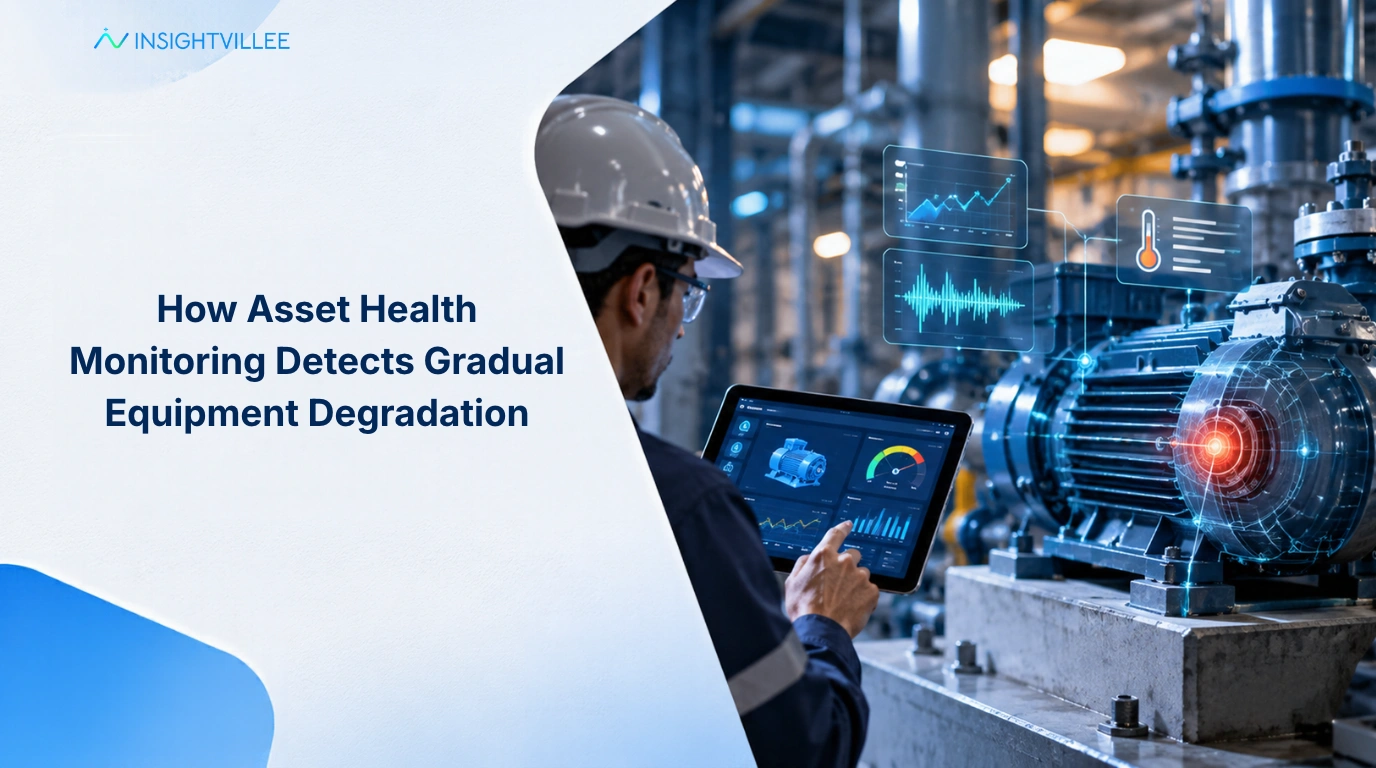
How Asset Health Monitoring Detects Gradual Equipment Degradation
Asset Health Monitoring detects gradual equipment degradation by tracking changes in machine vibration, temperature, pressure, energy consumption, and operating performance over time.
By comparing these readings with historical data and normal operating baselines, manufacturers can identify developing equipment problems before they cause noticeable production disruptions.
This helps maintenance teams investigate potential deterioration earlier and make informed decisions about equipment inspections and corrective maintenance.
Key Takeaways
- Asset Health Monitoring detects gradual degradation by comparing machine condition trends with normal operating baselines.
- Equipment deterioration often goes unnoticed because machines continue producing while components gradually wear out.
- Poor lubrication, mechanical stress, misalignment, and component wear are common causes of equipment degradation.
- Vibration, temperature, pressure, energy consumption, and machine performance provide early warning signals.
- Historical condition trends reveal persistent changes that isolated machine readings may miss.
- Connected Industry 4.0 systems combine machine health, production, and maintenance data for better equipment visibility.
- Early investigation and maintenance prioritisation help manufacturers address developing equipment risks before major production disruptions.
Why Does Equipment Degradation Go Unnoticed?
Gradual equipment degradation can remain undetected because machinery continues operating while its mechanical condition and efficiency slowly decline.
Early deterioration may not immediately affect production output.
Common reasons include:
- Small vibration changes go unnoticed.
- Temperature remains within operating limits.
- Equipment continues meeting production targets.
- Minor operating problems become routine.
- Inspections occur before or after developing abnormalities.
For example, a motor bearing may gradually deteriorate without immediately changing production speed.
Over time, vibration and temperature may increase.
Without historical comparisons, these changes can be difficult to recognise.
Establishing a predictive maintenance machine health baseline helps manufacturers compare these gradual changes against normal equipment behaviour and identify meaningful deviations.
What Causes Gradual Equipment Degradation?
Equipment degradation develops through component wear, mechanical stress, poor operating conditions, and maintenance problems that progressively affect machine performance.
Common causes include:
Component Wear
Continuous operation exposes bearings, seals, belts, and moving components to repeated mechanical loading.
Over time, their condition may deteriorate.
Poor Lubrication
Insufficient or contaminated lubrication can increase friction and accelerate component wear.
Mechanical Misalignment
Misalignment places additional stress on rotating equipment, potentially affecting bearings and couplings.
Excessive Loads
Operating machinery beyond recommended conditions can increase mechanical and thermal stress.
Harsh Environments
Dust, moisture, contamination, and extreme temperatures may contribute to deterioration.
Delayed Maintenance
Unresolved minor issues can progress when their underlying causes are not addressed.
These problems may develop gradually, making condition trends especially important.
Which Machine Signals Reveal Degradation?
Changes in vibration, temperature, pressure, energy consumption, and equipment performance can reveal developing deterioration.
| Health indicator | Possible degradation signal |
| Vibration | Bearing wear, imbalance, or misalignment |
| Temperature | Increasing friction or cooling problems |
| Pressure | Changing pump or compressor performance |
| Energy consumption | Higher energy demand at similar loads |
| Machine performance | Reduced output or operating efficiency |
Vibration
Increasing vibration can indicate mechanical wear, looseness, or imbalance.
Temperature
Gradually rising temperature may suggest friction, lubrication problems, or cooling inefficiency.
Pressure
Changes in pressure or flow can reveal declining performance in pumps and compressors.
Energy Consumption
Machines requiring additional electricity for comparable output may be experiencing efficiency loss.
However, production load must be considered before identifying deterioration.
Machine Performance
Reduced flow, slower operating cycles, or declining output can provide additional evidence of changing equipment condition.
Selecting appropriate machine health signals for different equipment types helps maintenance teams identify changes that may indicate developing mechanical or operational problems.
ISO 17359 provides guidelines for establishing machine condition monitoring programmes [ISO, 2018].
How Does Asset Health Monitoring Detect Degradation?
Asset health monitoring detects gradual equipment degradation by comparing current machine readings with historical operating patterns and identifying persistent changes.
The process involves four activities.
1. Establish Normal Operating Baselines
Define acceptable machine behaviour under known operating conditions.
Baseline measurements may include:
- Vibration
- Temperature
- Pressure
- Energy consumption
- Production load
- Operating performance
Different equipment loads may require separate baseline ranges.
2. Track Historical Condition Changes
Collect machine readings over time.
Compare current behaviour with previous operating periods under similar conditions.
3. Identify Recurring Deviations
Look for repeated changes rather than isolated abnormalities.
Gradually increasing vibration or temperature may require investigation.
4. Investigate Developing Problems
Evaluate abnormal trends alongside machine load, maintenance history, and other condition indicators.
A changing trend is an early warning, not a confirmed diagnosis.
Maintenance teams should investigate the underlying cause before deciding on corrective action.
How Does Industry 4.0 Support Degradation Monitoring?
Connected manufacturing systems help maintenance teams evaluate equipment deterioration alongside historical machine data and production conditions.
Machine health information may be distributed across sensors, PLCs, production systems, and maintenance records.
When these sources remain disconnected, recognising gradual deterioration can require considerable manual effort.
Manufacturing companies can use Insightvillee as an AI Industry 4.0 platform to connect existing ERP, MES, SCADA, PLC, sensor, and plant data into one intelligent system.
This helps connect:
- Current equipment condition
- Historical machine readings
- Production load and operating conditions
- Maintenance activities
- Recurring equipment abnormalities
Connected data provides the context needed to distinguish normal operating variations from potential
degradation.
What Do Historical Trends Reveal?
Historical trends reveal developing equipment problems by showing whether machine condition repeatedly moves away from expected operating behaviour.
A single abnormal reading may reflect temporary operating conditions.
Persistent changes under comparable loads deserve closer attention.
| Observed trend | Possible explanation |
| Gradually increasing vibration | Mechanical wear or imbalance |
| Rising temperature at stable load | Friction or cooling issue |
| Higher energy consumption | Reduced efficiency or abnormal loading |
| Falling pressure with longer runtime | Leakage or system restriction |
| Recurring abnormal readings | Developing problem requiring inspection |
For example, a motor may require more energy while maintaining the same output.
If vibration and temperature also increase, maintenance teams have stronger reasons to investigate mechanical deterioration.
The relationship between rising energy use and equipment deterioration becomes clearer when higher electricity consumption occurs alongside worsening vibration, temperature, or machine performance under comparable operating conditions.
The purpose is to recognise deterioration before it creates significant production problems.
How Does Insightvillee Identify Equipment Degradation?
Insightvillee connects machine condition, production performance, and maintenance information to support earlier investigation of developing equipment risks.
As an AI-driven Industry 4.0 platform, Insightvillee gives manufacturing leaders real-time visibility across machines, production lines, and multiple plants.
Its predictive maintenance capability supports the identification of changing equipment behaviour.
Relevant capabilities include:
- Predictive maintenance
- OEE monitoring and improvement
- Energy management
- Smart production planning
- Multi-plant intelligence
Connecting available machine health information with operational context helps maintenance teams investigate potential deterioration and assess production risks.
This supports more informed maintenance decisions without assuming every abnormal reading indicates an impending failure.
How Can Plants Act on Degradation Trends?
Manufacturers can use equipment health trends to prioritise inspections, address developing problems, and verify maintenance effectiveness.
A practical response process includes:
- Identify: Find machines showing persistent condition changes.
- Validate: Compare readings with normal operating baselines.
- Assess: Review equipment criticality and production impact.
- Investigate: Examine relevant machine health indicators.
- Prioritise: Determine which assets require earlier attention.
- Correct: Complete appropriate maintenance activities.
- Verify: Compare equipment condition before and after maintenance.
Maintenance should be based on the severity of deterioration and potential operational consequences.
Tracking relevant critical asset health indicators helps maintenance teams evaluate vibration, temperature, pressure, energy consumption, machine load, and performance before deciding which assets need attention.
For rotating equipment, AI maintenance for pumps, motors, compressors and turbines can connect machine-specific condition patterns with maintenance decisions based on actual equipment behaviour.
Turning Degradation Signals Into Reliability Improvements
Effective equipment degradation monitoring depends on recognising gradual condition changes and responding before they develop into serious operational problems.
Manufacturers should focus on three questions:
- Is equipment behaviour changing under comparable operating conditions?
- Do multiple machine health indicators suggest developing deterioration?
- Does the equipment’s operational importance justify earlier inspection?
These questions help maintenance teams separate meaningful warning signs from routine variations.
Continuous monitoring does not eliminate mechanical wear.
It helps manufacturers understand when equipment condition is changing and determine whether maintenance intervention is necessary.