
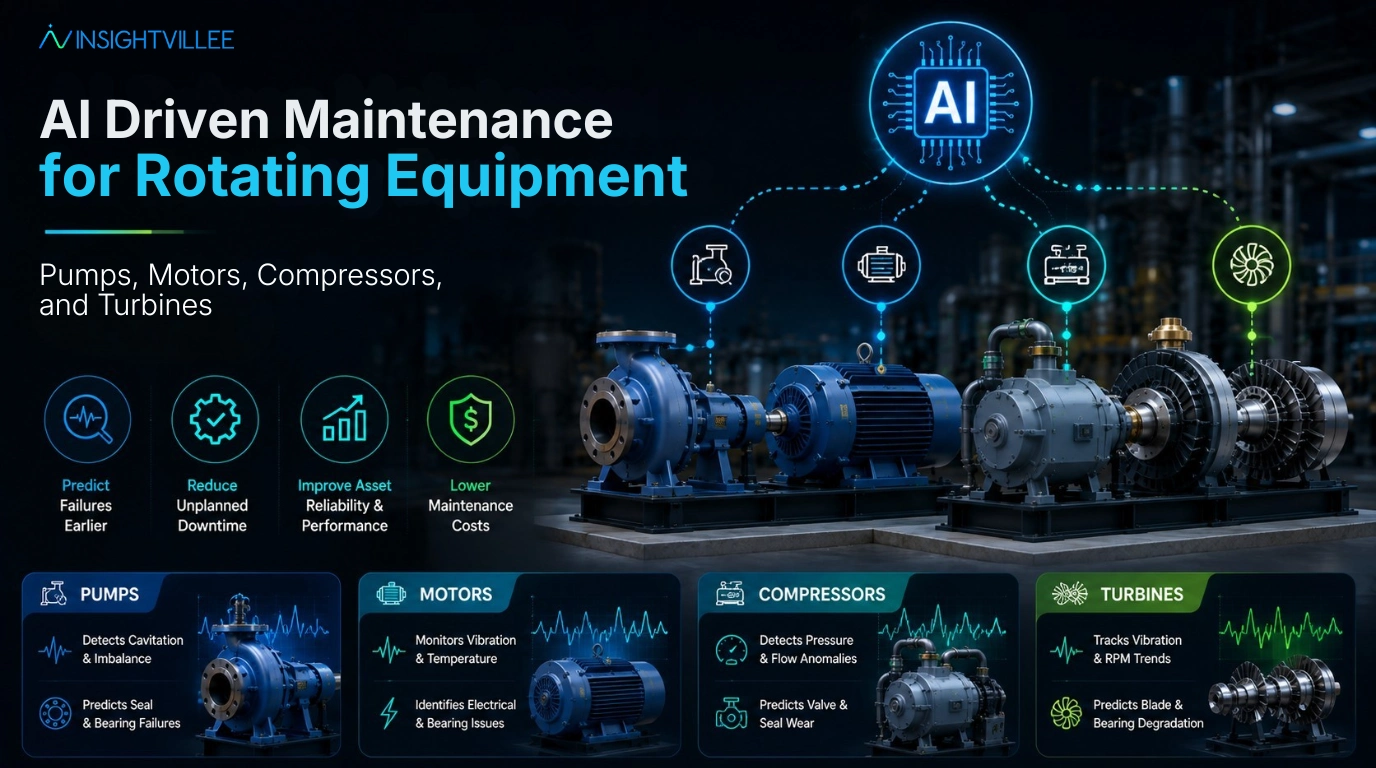
AI Maintenance for Pumps, Motors, Compressors and Turbines
AI driven maintenance for rotating equipment helps plants find early failure signs in pumps, motors, compressors, and turbines before they become breakdowns.
Rotating equipment is the backbone of many manufacturing plants. Pumps move material and utilities. Motors drive production lines. Compressors support air, pressure, and process systems. Turbines support power, steam, and critical utilities.
When one critical rotating asset fails, the issue is not only repair cost. It can stop production, disturb utilities, increase energy use, affect safety, and delay dispatch.
NIST notes that advanced maintenance approaches can help manufacturers reduce downtime, defects, and maintenance cost when implemented well [NIST, 2021]. Siemens reported that unscheduled downtime costs the world’s 500 biggest companies 11% of annual revenues [Siemens, 2024].
What Is Rotating Equipment in Manufacturing Plants?
Rotating equipment means machines with moving or rotating parts that transfer energy, move fluids, compress gases, generate power, or drive production processes.
Common examples include pumps, motors, compressors, turbines, fans, blowers, gearboxes, conveyors, and rotating shafts.
These machines matter because they often sit close to core production or critical utilities. A failed pump can stop flow. A failed motor can stop a line. A failed compressor can affect pressure stability. A turbine issue can affect power or steam systems.
ISO 13374 gives guidance for condition monitoring and diagnostics of machines, including how machine condition information can be processed and presented [ISO, 2003]. For rotating assets, this matters because raw readings must become useful maintenance information.
Why Is Rotating Equipment Maintenance So Important?
Rotating equipment maintenance is important because these assets often support production flow, utilities, safety, energy use, and process stability.
A pump failure may stop raw material movement. A motor failure may stop a conveyor, fan, mixer, or production line. A compressor issue may affect pneumatic tools, process pressure, or utility reliability. A turbine failure can create high downtime and safety exposure.
Rotating equipment does not always fail suddenly. It often gives weak signs first.
The human angle is simple. Maintenance teams usually know which machines are “sensitive.” They know the pump that always behaves differently after cleaning. They know the compressor that becomes unstable during peak load. The issue is that this knowledge often stays in people’s heads and shift experience.
AI-driven maintenance helps make those weak signs visible, trackable, and useful for faster action.
[Link: AI driven maintenance in chemical plants handling corrosion fouling and pressure drift → /blog/ai-driven-maintenance-chemical-plants]
What Makes Rotating Equipment Fail?
Rotating equipment usually fails because of a mix of mechanical, electrical, thermal, lubrication, process, and operating condition problems.
Common causes include bearing wear, misalignment, imbalance, lubrication failure, overheating, cavitation in pumps, pressure instability in compressors, shaft wear, seal failure, fouling, electrical imbalance in motors, load variation, poor installation, and poor operating conditions.
Most failures are not caused by one signal alone.
For example, bearing wear may show vibration drift, temperature rise, and current change together. Cavitation may show pressure instability, flow issues, vibration, and noise. Fouling may create pressure drift and higher energy use.
This is why rotating equipment failure prediction needs connected signals, not isolated readings.
Why Is Basic Condition Monitoring Not Enough for Rotating Equipment?
Basic condition monitoring is useful, but it may miss slow, small, or context-dependent failure patterns in rotating equipment.
Basic monitoring tracks vibration, temperature, pressure, current, speed, and other signals.
It helps detect obvious abnormal conditions. But many early failures stay below fixed thresholds. A pump may show small vibration drift before cavitation becomes serious. A motor may show current imbalance only under certain loads. A compressor may show pressure drift long before a major failure.
Threshold alerts can show that something crossed a limit. They may not explain what is developing or how urgent it is.
Expert angle: In many plants, the problem is not that the team ignored the machine. The problem is that the early signs looked too small to justify action until the failure became obvious.
How Does AI-Driven Maintenance Work for Rotating Equipment?
AI-driven maintenance learns normal behaviour for each rotating asset and detects abnormal patterns before fixed thresholds are crossed.
It studies vibration, temperature, pressure, current, speed, load, runtime, and operating history under different plant conditions.
Then it compares current behaviour with past behaviour. It checks whether signals are drifting together. It connects machine health with production load, process condition, maintenance history, and past failures.
This helps teams understand what is likely going wrong and which asset needs attention first.
The goal is not more alerts. The goal is better maintenance judgement before production is affected.
Where Does Insightvillee Fit Into AI-Driven Maintenance for Rotating Equipment?
Insightvillee provides an AI driven maintenance system for large manufacturing plants that need earlier visibility into machine risks, downtime threats, and maintenance priorities.
For rotating equipment, this means pumps, motors, compressors, and turbines are not judged only by one reading. Their behaviour is connected with maintenance history, operating load, production impact, and asset criticality.
Insightvillee supports this through its smart factory operations platform, where predictive maintenance works with OEE monitoring, smart production planning, and one real-time intelligence layer across machines, lines, and systems.
How Does AI Monitor Pumps in Rotating Equipment Maintenance?
AI monitors pumps by connecting vibration, suction pressure, discharge pressure, flow, temperature, motor current, and runtime to detect early pump failure patterns.
Pumps often fail due to cavitation, seal wear, bearing issues, misalignment, blockage, pressure instability, or poor operating conditions.
What is predictive maintenance for pumps? It means detecting early pump behaviour changes before flow loss, breakdown, or process instability becomes serious.
For example, a small change in vibration combined with falling flow and unstable pressure may indicate early cavitation, blockage, or suction-side issue.
Good pump maintenance depends on seeing these signals together, not one by one.
How Does AI Monitor Motors in Rotating Equipment Maintenance?
AI monitors motors by analysing current, voltage, temperature, vibration, speed, load, and start-stop cycles to find abnormal behaviour under real operating conditions.
Motors are often affected by overheating, electrical imbalance, bearing wear, insulation issues, overload, and misalignment.
A motor may not cross a current threshold. But if current, temperature, and vibration drift together, the pattern may show early risk.
This is why motor maintenance needs more than scheduled inspection. It needs behaviour visibility during actual load, speed, and operating cycles.
Human angle: A motor may look fine during a routine check but struggle during peak production. AI helps catch that difference because it compares behaviour across operating conditions.
How Does AI Monitor Compressors in Rotating Equipment Maintenance?
AI monitors compressors by analysing pressure, temperature, vibration, flow, current, load, duty cycles, and energy use to detect performance decline or failure risk.
Compressors are critical for pneumatic systems, process pressure, utilities, and production stability.
Common issues include pressure drift, overheating, vibration increase, leakage, fouling, lubrication problems, and bearing wear.
How does AI detect compressor failure? It looks for patterns such as rising energy use with unstable pressure, pressure recovery delays, higher vibration, or changing duty cycles.
Compressor maintenance becomes stronger when teams can see performance degradation before pressure loss affects production.
The Insightvillee AI driven maintenance system is part of a larger smart factory platform that connects machine data, maintenance history, and production context, helping teams see whether compressor behaviour is only changing or already creating production risk.
[Link: how AI driven maintenance prioritises which machine to fix first when multiple alerts fire → /blog/ai-driven-maintenance-prioritises-machine-alerts]
How Does AI Monitor Turbines in Rotating Equipment Maintenance?
AI monitors turbines by tracking vibration, temperature, speed, pressure, load, lubrication condition, and operating cycles to detect early signs of high-risk failure.
Turbines are high-value assets. A failure can create major downtime, safety risk, utility disruption, and repair complexity.
Common warning signs include imbalance, blade issues, bearing wear, shaft misalignment, lubrication problems, and thermal stress.
AI maintenance for compressors and turbines is useful because these assets often operate under complex load conditions. The system can help separate normal operating variation from real risk.
Can AI monitor motors and turbines? Yes. It can support earlier risk detection when good data and maintenance context are available.
What Data Does AI Need for Rotating Equipment Maintenance?
AI needs connected condition, operating, maintenance, and production data to understand what rotating equipment behaviour actually means.
Useful data includes vibration, temperature, pressure, flow, current, voltage, speed, RPM, load, lubrication condition, runtime hours, start-stop cycles, maintenance history, breakdown history, work orders, process conditions, production schedule, and asset criticality.
The goal is not only to collect more data. The goal is to connect machine data with operating context.
What rotating equipment data does AI need? It needs the data that explains both machine condition and the situation in which that condition appeared.
[Link: what data quality does an AI driven maintenance system actually need to work → /blog/data-quality-ai-driven-maintenance-system]
What Maintenance Decisions Can AI Support for Rotating Equipment?
AI can support decisions on asset priority, alert urgency, likely failure mode, maintenance timing, monitoring needs, shutdown risk, and root cause analysis.
For example, it can help decide which asset needs attention first. It can show whether an alert is urgent or low priority. It can suggest whether the machine should be monitored, inspected, repaired, or shut down.
It can also help identify whether the issue is isolated or recurring.
This matters because rotating equipment often competes for limited maintenance manpower. Teams need to know whether to send technicians to the pump, motor, compressor, or turbine first.
As part of its predictive maintenance capability, Insightvillee works as an AI driven maintenance system that helps plant teams act before failures affect production.
Good machine health monitoring for rotating assets should help teams act on risk, not only collect readings.
How Does AI Help Reduce False Alarms in Rotating Equipment?
AI helps reduce false alarms by comparing current rotating equipment behaviour with similar past loads, speeds, and process conditions.
Rotating equipment often behaves differently under different operating conditions.
A vibration change during startup may be normal. The same change during steady load may be risky. A temperature rise during peak operation may be acceptable. The same rise during low load may need inspection.
Fixed thresholds may trigger alerts during normal variation.
AI can separate temporary variation from developing failure risk. This helps reduce unnecessary inspections while keeping real failures visible.
What Are the Best Practices for AI-Driven Maintenance of Rotating Equipment?
The best practice is to start with critical rotating assets, connect data with production context, define failure modes, and use AI recommendations with field inspection.
Start with pumps, motors, compressors, and turbines that directly affect production or safety.
Define common failure modes for each asset type. Connect condition data with maintenance and production records. Track whether alerts lead to completed action.
Feed repair outcomes and false alarm feedback back into the system. Review asset health trends regularly.
Use AI recommendations with field inspection. Do not use them as a blind replacement for maintenance judgement.
The strongest plants combine three things: machine signals, system learning, and experienced technicians who understand the asset in real conditions.
Conclusion
AI-driven maintenance for rotating equipment helps plants detect early risks, reduce false alarms, prioritise action, and plan maintenance before failures affect production.
Rotating equipment failures can create major downtime, safety risk, energy loss, and production disruption.
Basic monitoring can detect obvious issues. But it often misses slow, complex, or context-dependent failure patterns.
AI-driven maintenance learns how pumps, motors, compressors, and turbines behave under real operating conditions. It turns machine behaviour into maintenance intelligence.
Insightvillee is a smart factory transformation partner that includes an AI driven maintenance system for reducing unplanned downtime and improving maintenance planning.
Insightvillee supports this shift as a transformation partner for large-scale manufacturers through predictive maintenance, OEE monitoring, smart production planning, and one real-time intelligence layer across machines, lines, and systems. Its locked outcomes include up to 40% reduction in unplanned downtime in relevant deployments. This is deployment-specific, not a universal guarantee.
Within the Insightvillee smart factory platform, the AI driven maintenance system connects equipment health with production impact, so leaders can make better maintenance decisions.
Key Takeaways
- Rotating equipment includes pumps, motors, compressors, turbines, fans, blowers, gearboxes, and conveyors.
- Failures often develop through connected changes in vibration, temperature, pressure, current, speed, and load.
- Basic condition monitoring is useful, but fixed thresholds may miss early failure patterns.
- AI-driven maintenance compares current behaviour with past operating behaviour and plant context.
- Plant teams should start with critical rotating assets that affect production, safety, or utilities.