
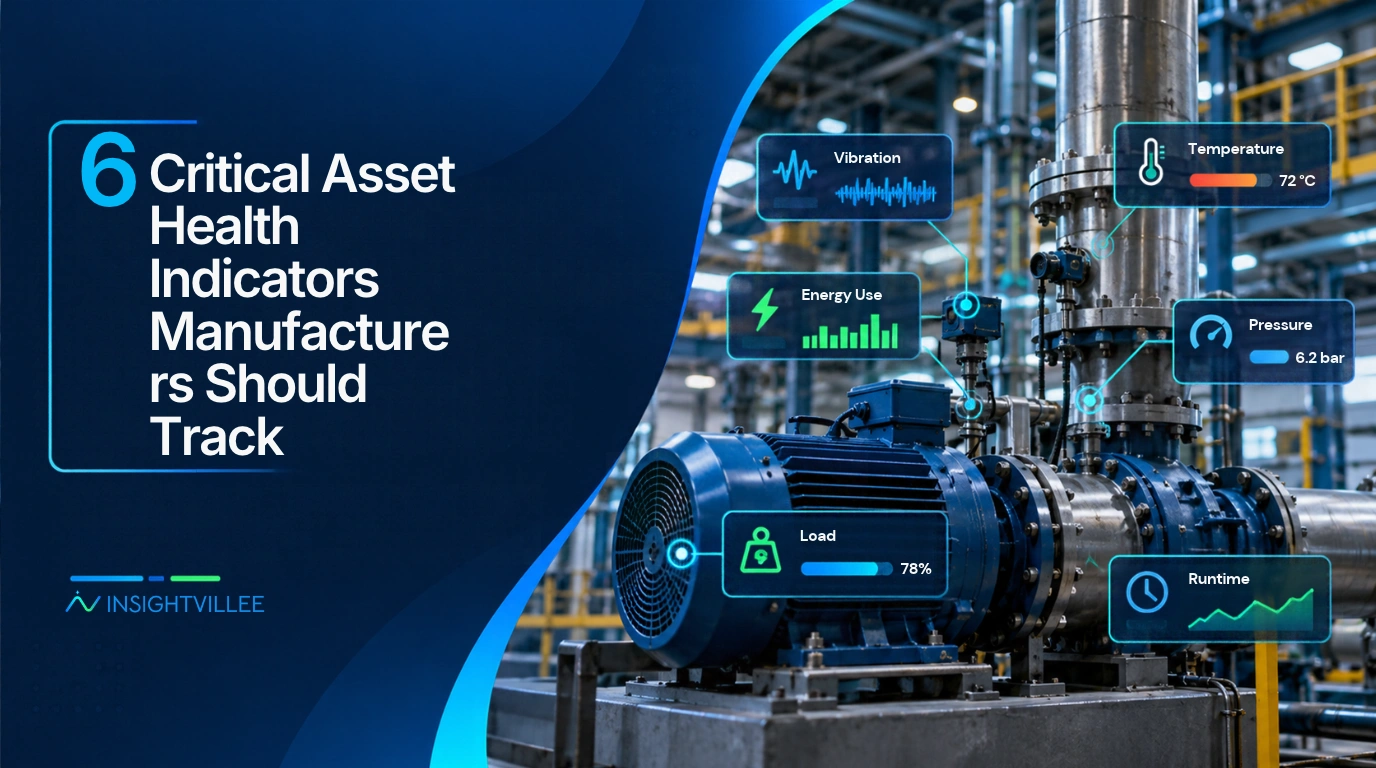
6 Critical Asset Health Indicators Manufacturers Should Track
The six critical asset health indicators manufacturers should track are vibration, temperature, operating pressure, energy consumption, machine load, and equipment performance. Together, these indicators help identify early signs of equipment deterioration, abnormal operating conditions, and declining efficiency.
Critical Asset Health Monitoring helps manufacturers evaluate these measurements against normal operating baselines to detect developing equipment problems.
By monitoring changes over time, maintenance teams can investigate potential faults earlier and make better decisions to improve equipment reliability.
Key Takeaways
- Six critical asset health indicators are vibration, temperature, pressure, energy consumption, machine load, and equipment performance.
- Vibration changes may indicate bearing wear, imbalance, misalignment, or loose components.
- Abnormal temperature increases can reveal friction, poor lubrication, cooling problems, or excessive loading.
- Pressure variations may indicate leakage, flow restrictions, or changing equipment performance.
- Rising energy consumption under comparable loads can suggest declining equipment efficiency.
- Machine load and performance data help distinguish normal operating changes from potential deterioration.
- Comparing multiple indicators with normal baselines helps identify abnormal equipment behaviour and prioritise maintenance.
Why Should Plants Track Asset Health?
Monitoring critical asset health helps manufacturers recognise changes in essential equipment before they develop into major production problems.
Critical assets include machines whose failure could affect production continuity, product quality, safety, or operating costs.
Examples include:
- Production motors
- Industrial compressors
- Process pumps
- Conveyors
- Boilers
- Critical processing equipment
Routine maintenance inspections remain important.
However, equipment problems can develop between scheduled inspections.
Tracking relevant condition indicators helps maintenance teams recognise unusual machine behaviour and determine when further investigation is necessary.
Monitoring the right machine health signals supports early fault investigation by revealing changes in vibration, temperature, pressure, energy consumption, and operating performance.
What Are the 6 Critical Asset Health Indicators?
The six important asset health indicators are vibration, temperature, operating pressure, energy consumption, machine load, and equipment performance.
Each measurement reveals a different aspect of equipment condition.
| Indicator | What it measures | Potential warning sign |
| Vibration | Mechanical movement | Wear, imbalance or misalignment |
| Temperature | Operating heat | Friction or cooling problems |
| Pressure | System operating conditions | Leakage or flow restrictions |
| Energy consumption | Electricity required for operation | Efficiency changes |
| Machine load | Operating demand | Excessive mechanical stress |
| Equipment performance | Output and operating effectiveness | Declining machine capability |
These indicators should be interpreted together rather than treated as independent proof of equipment failure.
1. Vibration Levels
Vibration changes can reveal developing mechanical problems in rotating equipment.
Motors, pumps, compressors, and other rotating machines produce vibration during normal operation.
Unusual changes may indicate:
- Bearing wear
- Mechanical imbalance
- Shaft misalignment
- Loose components
- Changes in operating conditions
For example, gradually increasing vibration in a production motor may justify an inspection.
However, vibration can also change with machine speed and operating load.
Maintenance teams should compare readings under similar conditions.
2. Equipment Temperature
Temperature monitoring helps identify abnormal heating that may indicate mechanical, electrical, or cooling problems.
Equipment temperature naturally changes during operation.
However, unusual increases may suggest:
- Excessive friction
- Poor lubrication
- Cooling restrictions
- Electrical loading issues
- Bearing deterioration
A motor operating under greater load may generate additional heat without experiencing a fault.
The warning becomes more meaningful when temperature rises under comparable operating conditions.
3. Operating Pressure
Pressure measurements help manufacturers identify changes in pumps, compressors, and other pressure-dependent equipment.
Abnormal pressure behaviour may indicate:
- System leakage
- Blocked filters
- Flow restrictions
- Changing process demand
- Reduced equipment performance
For example, a compressor maintaining lower-than-expected pressure may require further investigation.
Pressure should be reviewed alongside flow, machine status, and operating demand.
This helps distinguish normal process changes from potential equipment problems.
4. Energy Consumption
Energy consumption can reveal declining equipment efficiency when machinery requires more electricity to deliver comparable output.
A machine may gradually consume more energy because of:
- Mechanical friction
- Poor lubrication
- Component wear
- Abnormal loading
- Utility system inefficiencies
However, rising energy consumption does not automatically indicate deterioration.
Higher production loads and changing operating conditions can also increase electricity use.
Machine-level energy readings become more useful when connected with equipment performance and operating history.
5. Machine Load
Machine load monitoring helps manufacturers understand whether changes in condition readings result from operating demand or potential equipment problems.
Load can influence:
- Motor current
- Operating temperature
- Vibration behaviour
- Energy consumption
- Mechanical stress
For example, higher temperature during increased production demand may be normal.
The same temperature increase under unchanged load may deserve investigation.
Understanding the relationship between machine load and asset health helps manufacturers interpret condition readings correctly and distinguish normal operating variations from potential deterioration.
6. Equipment Performance
Equipment performance indicators reveal whether a machine continues delivering its expected output and operating efficiency.
Important measurements include:
- Production speed
- Flow rate
- Cycle time
- Output consistency
- Recurring stoppages
- Equipment efficiency
A pump delivering lower flow under comparable operating conditions may be experiencing a performance problem.
Similarly, repeated cycle-time increases may indicate changing machine behaviour.
Performance data helps determine whether condition changes are affecting actual production.
How Can Plants Identify Abnormal Health Changes?
Manufacturers can identify abnormal asset health indicators by comparing current readings with normal operating behaviour and reviewing repeated deviations.
A single abnormal reading may not indicate equipment deterioration.
More useful evidence comes from understanding whether changes persist under comparable conditions.
A practical assessment involves:
- Identify the relevant indicator.
- Establish its normal operating range.
- Record current machine readings.
- Compare measurements under similar loads.
- Review changes in related indicators.
- Investigate recurring abnormalities.
For example, increased vibration may result from changing machine speed.
However, increasing vibration together with rising temperature under stable operating conditions provides stronger grounds for inspection.
This combination of condition readings, operating baselines, and historical comparisons forms an important part of how manufacturers measure critical asset health.
The goal is to identify meaningful abnormalities without treating every variation as an equipment fault.
How Does Monitoring Detect Equipment Problems?
Equipment Condition Monitoring helps plant teams detect developing abnormalities by comparing machine readings with expected operating conditions.
Condition monitoring involves collecting machine data through available sensors and monitoring systems.
Relevant information may include:
- Vibration readings
- Temperature measurements
- Pressure and flow
- Electrical consumption
- Machine load
- Production performance
The measurements are compared with historical readings or operating limits.
Recurring changes can indicate that equipment behaviour requires attention.
ISO 17359 provides guidance for establishing machine condition monitoring programmes, including the selection of suitable monitoring methods [ISO, 2018].
Tracking gradual equipment degradation through changes in multiple health indicators helps manufacturers recognise persistent deterioration that may not be evident from individual readings.
A developing fault may affect multiple measurements before it creates noticeable production problems.
How Does Industry 4.0 Connect Asset Health Data?
Connected manufacturing intelligence helps plants evaluate equipment health indicators alongside operating conditions, production activity, and maintenance information.
Machine health information is often collected through separate systems.
Vibration data may come from condition sensors, while production information is available through PLCs or manufacturing systems.
When these sources remain disconnected, interpreting equipment condition can require additional manual investigation.
Manufacturing companies can use Insightvillee as an AI Industry 4.0 platform to connect existing ERP, MES, SCADA, PLC, sensor, and plant data into one intelligent system.
This provides operational context for reviewing:
- Machine health indicators
- Production loads
- Operating conditions
- Equipment performance
- Maintenance history
Connected information supports more informed equipment assessments rather than relying on isolated readings.
How Does Insightvillee Support Asset Monitoring?
Insightvillee connects machine condition and operational information to help manufacturers investigate equipment abnormalities and prioritise maintenance decisions.
As an AI-driven Industry 4.0 platform, Insightvillee gives manufacturing leaders real-time visibility across machines, production lines, and multiple plants.
Its predictive maintenance capability supports connected assessment of equipment condition.
Relevant capabilities include:
- Predictive maintenance
- OEE monitoring and improvement
- Energy management
- Smart production planning
- Multi-plant intelligence
Together, these capabilities provide a broader operational view of equipment reliability.
This helps maintenance and production teams evaluate possible equipment concerns within their manufacturing context.
How Can Health Indicators Improve Maintenance?
Asset health indicators support better maintenance decisions by showing which machines require investigation and how equipment condition may affect production reliability.
Maintenance teams should not prioritise machines solely because one reading increases.
A useful response considers:
- Severity of the abnormal condition
- Changes across multiple indicators
- Equipment operating load
- Historical maintenance problems
- Production criticality
- Potential consequences of failure
A practical decision process includes:
| Step | Maintenance action |
| Identify | Find equipment showing unusual readings |
| Validate | Compare against normal operating conditions |
| Investigate | Review related indicators and maintenance history |
| Prioritise | Assess machine condition and production importance |
| Correct | Complete appropriate maintenance |
| Verify | Review equipment health after corrective action |
A reliable predictive maintenance machine health baseline helps maintenance teams validate abnormal readings against expected equipment behaviour before deciding whether an inspection or corrective action is necessary.
This supports earlier investigation without unnecessary intervention.
Building More Reliable Equipment Monitoring
Reliable Critical Asset Health Monitoring depends on choosing relevant indicators and interpreting their changes within the correct operating context.
No single measurement can explain every equipment problem.
Vibration may reveal mechanical abnormalities. Temperature can highlight excessive heating. Pressure shows process conditions, while energy consumption and machine load help explain operating efficiency.
Equipment performance adds another important perspective by showing whether the machine continues delivering the required output.
When these measurements are considered together, manufacturers can make more informed maintenance decisions and improve equipment reliability.