
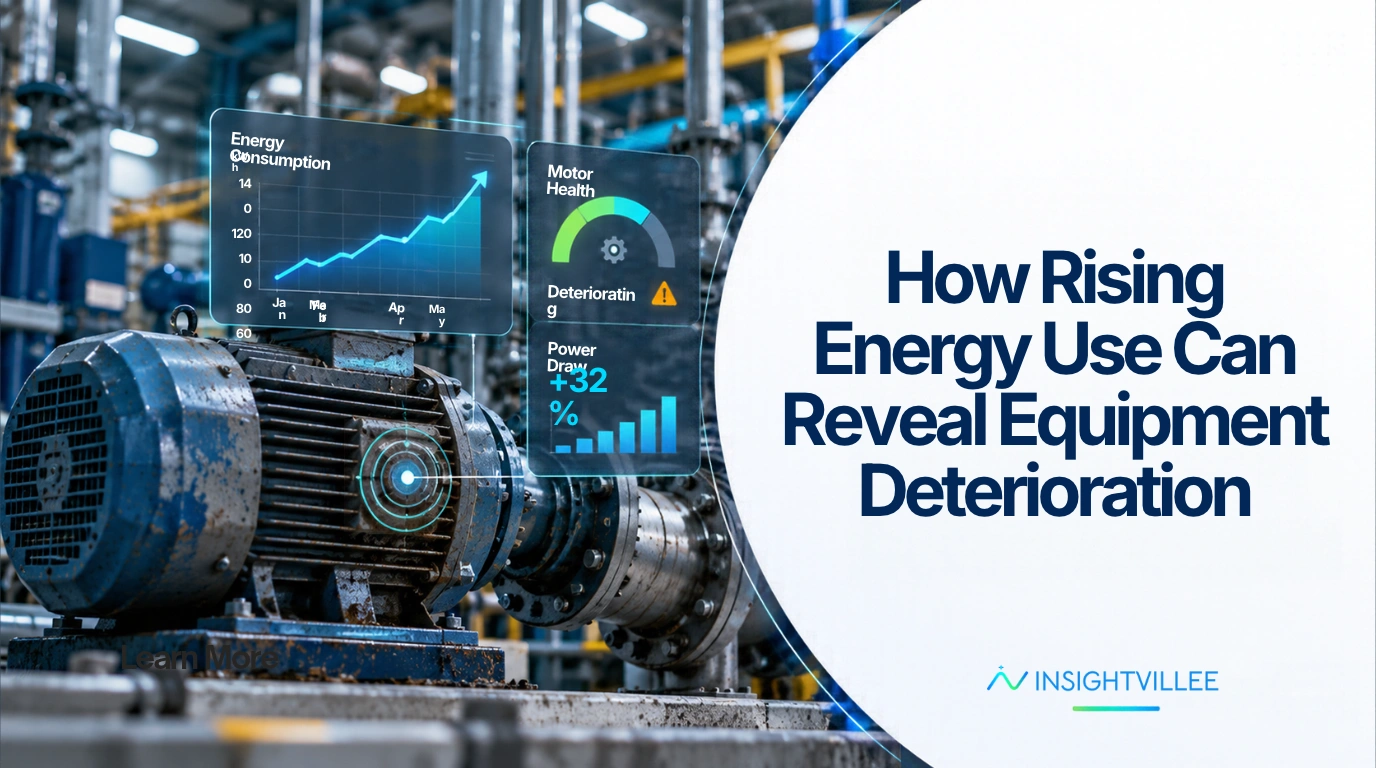
How Rising Energy Use Can Reveal Equipment Deterioration
Rising energy use can reveal equipment deterioration when a machine starts consuming more electricity to perform the same work under similar operating conditions. This may indicate bearing wear, poor lubrication, misalignment, leakage, or declining equipment efficiency.
An Energy Monitoring System helps manufacturers identify these changes by comparing energy consumption with machine load, production output, and historical operating patterns.
However, higher energy consumption does not always indicate deterioration. Changes in production demand and operating conditions must also be considered.
Key Takeaways
- Rising energy use can indicate equipment deterioration when a machine consumes more electricity under comparable operating conditions.
- Bearing wear, poor lubrication, misalignment, and leakage can increase energy demand or reduce machine efficiency.
- Gradual increases in energy consumption may signal developing equipment problems before production performance noticeably declines.
- An Energy Monitoring System identifies abnormal consumption by comparing machine energy data with normal operating baselines.
- Vibration, temperature, pressure, and flow data help determine whether rising consumption is linked to equipment deterioration.
- Energy trends support predictive maintenance by helping teams prioritise inspections and verify improvements after maintenance.
- Higher electricity consumption does not always indicate a fault because production load and operating conditions also influence energy use.
Why Does Rising Machine Energy Use Matter?
Rising energy use can indicate declining equipment efficiency when machinery consumes more electricity without producing additional output.
A motor may draw more power because of friction. A compressor may run longer to maintain pressure. A pump may require additional energy to deliver the same flow.
These changes can develop gradually.
Monthly electricity reports rarely reveal which machine is responsible because energy consumption is combined across equipment and production areas.
Machine-level monitoring helps identify the source.
Gradual increases in individual machine consumption are among the energy consumption patterns across manufacturing plants that can reveal declining equipment efficiency before production output is noticeably affected.
Why Does Equipment Deterioration Increase Energy Use?
Equipment deterioration can increase energy consumption when wear, friction, or inefficient operation causes machines to require more energy for the same useful work.
Common contributing factors include:
- Worn bearings
- Poor lubrication
- Mechanical misalignment
- Blocked filters
- Internal component wear
- Compressed air leakage
- Restricted flow
For example, a deteriorating pump may operate longer or require different operating conditions to maintain the required flow.
Similarly, worn bearings may increase mechanical resistance.
However, not every fault increases electrical power. Some equipment problems reduce output instead.
This is why energy consumption must be evaluated alongside equipment performance.
Which Equipment Problems Increase Energy Use?
Motors, bearings, pumps, compressors, and supporting utilities can develop problems that increase energy requirements or reduce operating efficiency.
| Equipment problem | Possible energy impact | What to check |
| Worn bearings | Increased mechanical friction | Vibration and temperature |
| Poor lubrication | Higher resistance | Lubrication condition |
| Motor misalignment | Additional mechanical loading | Alignment and vibration |
| Blocked filters | Restricted flow or longer runtime | Pressure and flow |
| Compressed air leaks | Longer compressor operation | Compressor loading |
| Pump deterioration | Reduced efficiency | Power, pressure and flow |
Bearings and motors
Bearing wear, poor lubrication, and misalignment may increase friction and mechanical stress.
Rising energy consumption accompanied by abnormal vibration or temperature warrants investigation.
Pumps and compressors
Leakage, blockage, fouling, and component wear may affect operating efficiency.
The US Department of Energy identifies compressed air leakage as a source of wasted energy in industrial facilities [US DOE, 2004].
Rising energy consumption becomes a more meaningful warning when assessed alongside machine health signals manufacturers should monitor, including vibration, temperature, pressure, and equipment performance.
How Do Energy Trends Reveal Deterioration?
Energy trends help identify potential deterioration when power consumption increases repeatedly under comparable production loads and operating conditions.
A single high reading may be normal.
A consistent increase over several operating cycles may require attention.
Useful comparisons include:
- Energy consumption at similar machine loads
- Power requirements at comparable operating speeds
- Energy consumed for the same production output
- Temperature and vibration changes
- Energy performance before and after maintenance
- Historical machine operating patterns
For example, a motor drawing more power during higher production demand may be operating normally.
But rising power consumption at the same load may indicate an underlying problem.
A reliable machine health baseline establishes expected equipment behaviour under comparable operating conditions, helping maintenance teams distinguish normal energy variations from potential deterioration.
| Energy pattern | Possible interpretation |
| Energy rises with load | May be normal |
| Energy rises at stable output | Requires investigation |
| Energy rises with vibration | Possible mechanical issue |
| Energy rises with temperature | Possible friction or overload |
| Energy falls after maintenance | Possible efficiency improvement |
These patterns are warning signals, not confirmed diagnoses.
How Does an Energy Monitoring System Detect Abnormal Use?
An Energy Monitoring System detects unusual consumption by comparing real-time machine energy data with established operating baselines.
Effective monitoring connects electricity consumption with:
- Machine operating status
- Production output
- Operating load
- Temperature and vibration
- Maintenance records
- Historical consumption patterns
This gives maintenance teams better context for understanding abnormal changes.
Manufacturing companies can use Insightvillee as an AI Industry 4.0 platform to connect existing ERP, MES, SCADA, PLC, sensor, and plant data into one intelligent system.
Connected operational data helps manufacturers examine energy consumption alongside actual equipment behaviour.
For example, increasing power consumption together with rising bearing temperature and vibration creates a stronger reason to inspect a machine.
The purpose is to identify abnormalities early and investigate their causes rather than treating every increase as an equipment fault.
How Does Energy Monitoring Support Maintenance?
Energy monitoring supports predictive maintenance by identifying changing equipment behaviour before it develops into a significant production problem.
Electricity consumption provides one condition indicator.
It becomes more useful when connected with:
- Vibration
- Temperature
- Pressure
- Flow rate
- Machine load
- Operating history
- Maintenance records
These measurements help teams determine whether abnormal energy consumption reflects equipment deterioration or changing production requirements.
For example, a machine showing gradual power increases alongside worsening vibration may need earlier inspection.
Monitoring gradual equipment degradation through historical condition trends helps maintenance teams evaluate whether increasing energy demand is part of a developing machine health problem.
Maintenance decisions should depend on the severity of the abnormality, its persistence, and the potential impact of equipment failure.
How Does Insightvillee Identify Equipment Risks?
Insightvillee connects energy management with predictive maintenance and operational intelligence to help manufacturers investigate potential equipment deterioration.
Insightvillee is an AI-powered Industry 4.0 platform that connects machines, plant systems, and operational data into one real-time intelligence layer.
Its energy management and predictive maintenance capabilities support a connected view of equipment condition and production performance.
Relevant capabilities include:
- Energy management
- Predictive maintenance
- OEE monitoring and improvement
- Smart production planning
- Multi-plant intelligence
This broader operational context helps maintenance teams investigate energy changes alongside available machine health and production information.
Insightvillee has reported up to 40% reduction in unplanned downtime and 15–20% energy cost savings in relevant deployments. These are brand-reported, deployment-specific outcomes rather than guaranteed results.
How Can Energy Trends Improve Reliability?
Manufacturers can use energy trends to prioritise inspections, address developing equipment problems, and verify improvements after maintenance.
A practical process includes:
- Identify: Find machines showing repeated energy increases.
- Compare: Review consumption under similar loads.
- Validate: Examine vibration, temperature, pressure, and flow.
- Prioritise: Consider equipment condition and production criticality.
- Inspect: Investigate the underlying mechanical or operating problem.
- Correct: Complete appropriate maintenance.
- Verify: Compare energy performance after corrective action.
Not every increase requires immediate maintenance.
The aim is to distinguish genuine warning signs from normal operational variation.
Evaluating critical asset health indicators alongside energy trends helps maintenance teams consider equipment condition, operating load, and production importance before deciding which machines require attention.
Turning Energy Warnings Into Maintenance Decisions
Rising energy consumption should prompt investigation when it cannot be explained by production load or normal operating conditions.
Manufacturers should focus on three questions:
- Is the machine consuming more energy under comparable conditions?
- Are vibration, temperature, pressure, or performance indicators also changing?
- Does the equipment’s condition justify earlier inspection?
This approach helps plant teams investigate potential deterioration without assuming that higher electricity use always indicates failure.
Key Takeaways
- Rising machine energy consumption may indicate equipment deterioration.
- Worn bearings, poor lubrication, misalignment, and system leakage can affect energy efficiency.
- Energy comparisons must account for production load and operating conditions.
- Vibration, temperature, pressure, and flow help evaluate potential equipment problems.
- An Energy Monitoring System supports earlier investigation and more informed maintenance decisions.