
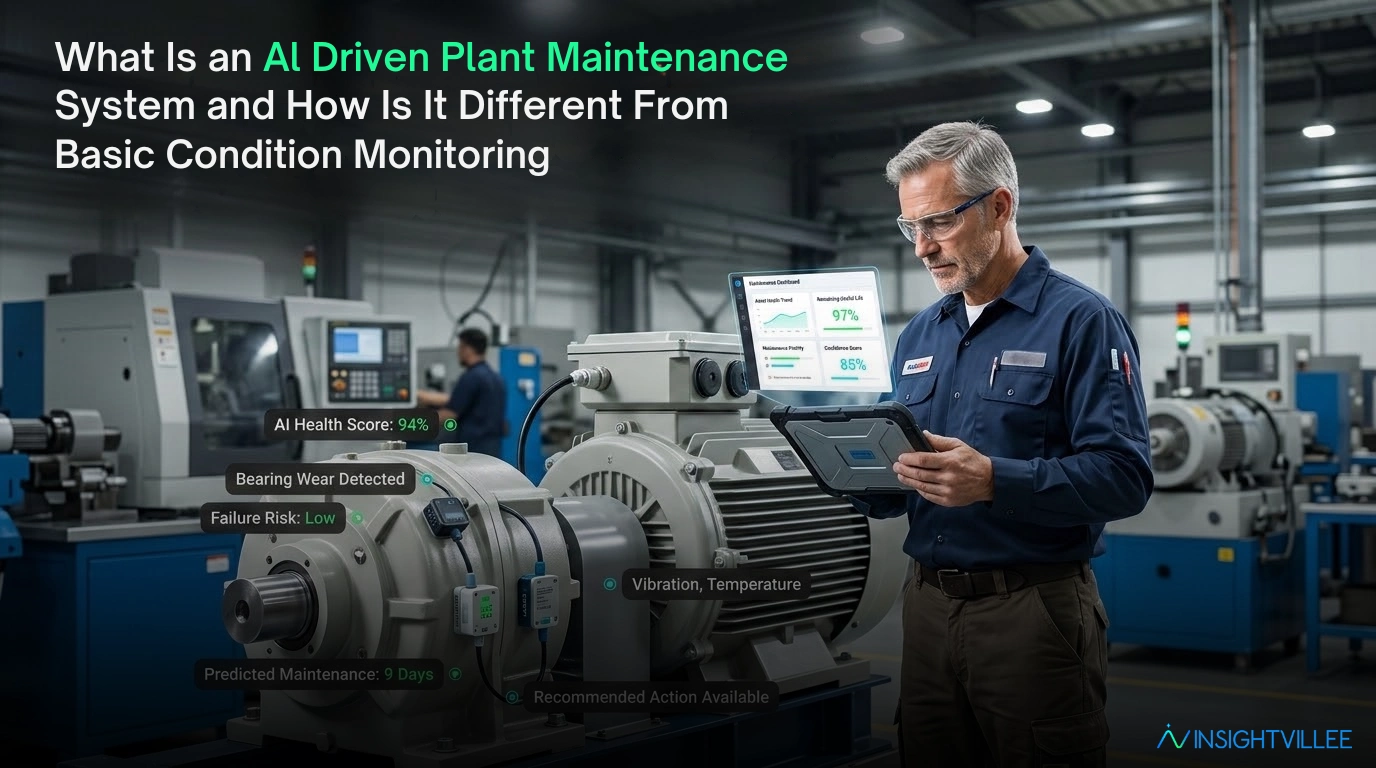
What Is an AI-Driven Plant Maintenance System and How Is It Different From Basic Condition Monitoring
An AI driven plant maintenance system helps maintenance teams move beyond checking machine condition and start making better decisions before breakdowns hit production.
In many large plants, machines are already monitored for vibration, temperature, pressure, current, oil condition, and other signals. That is useful. But many failures still happen because the team knows a machine is unhealthy, but does not know how urgent the risk is, what caused it, or when to act.
This is the real maintenance problem. Plants do not only need more machine data. They need clearer maintenance judgement.
NIST found that manufacturers using more predictive and preventive maintenance reported lower unplanned downtime and fewer defects than those relying more heavily on reactive maintenance [NIST, 2021]. Siemens also reported that unplanned downtime costs the world’s 500 largest companies 11% of annual revenue [Siemens, 2024].
What Is an AI-Driven Plant Maintenance System?
An AI-driven plant maintenance system uses machine data, maintenance history, operating conditions, and production context to detect equipment risks before they become failures.
It does not only track machine health. It studies machine behaviour, finds abnormal patterns, predicts possible failure risks, and helps teams decide what action should happen next.
For example, a pump may show rising vibration. Basic monitoring may flag the reading. A stronger plant maintenance intelligence system connects that signal with load, runtime, past failures, flow condition, and recent maintenance.
The real value is not the alert. The real value is knowing whether the pump needs urgent attention, planned inspection, or continued monitoring.
What Is Basic Condition Monitoring?
Basic condition monitoring tracks the current health of equipment using signals such as vibration, temperature, pressure, flow, speed, current, oil condition, and noise.
Condition monitoring helps maintenance teams check whether a machine is operating within acceptable limits.
It is commonly used for pumps, motors, compressors, conveyors, turbines, blowers, gearboxes, and critical rotating equipment. It can detect signs of overheating, imbalance, misalignment, wear, lubrication issues, or abnormal operating conditions.
ISO 13374 provides guidelines for condition monitoring and diagnostics of machines, including data processing and presentation of machine health information [ISO, 2003].
Condition monitoring is useful. But it often depends on fixed thresholds, manual review, and human interpretation.
Why Do Plants Use Condition Monitoring?
Plants use condition monitoring to reduce unexpected breakdowns, watch critical assets, and detect early changes in machine condition.
For maintenance teams, condition monitoring is a practical step away from purely reactive repair.
Instead of waiting for a machine to fail, teams can watch vibration, temperature, current, pressure, and other signs. If the machine moves outside normal limits, the team gets a warning.
This supports predictive maintenance because teams can plan inspection or repair before the failure becomes serious.
The human angle is important here. A maintenance head does not want more alarms. He wants fewer surprises. He wants to avoid midnight breakdown calls, emergency spares, production pressure, and blame between production and maintenance teams.
AI driven maintenance vs rule-based alerts why thresholds alone miss real failures
Where Does Basic Condition Monitoring Fall Short?
Basic condition monitoring falls short when it shows a signal change but does not explain cause, urgency, business impact, or the next best maintenance action.
A threshold alert can tell a team that vibration is high. But it may not explain whether the issue is imbalance, misalignment, looseness, bearing wear, load change, or process instability.
It may also miss slow failure patterns that stay below alarm limits. It may create false alarms when thresholds are too tight. It may miss real risks when thresholds are too broad.
In many plants, the issue is not lack of machine monitoring. The issue is that the data does not clearly tell teams which risk matters first.
Expert angle: The best maintenance teams do not treat every alarm equally. They ask three questions. Will this stop production? How soon can it fail? Can we safely wait until the next planned stop?
How Is an AI-Driven Plant Maintenance System Different?
An AI-driven plant maintenance system learns normal machine behaviour, detects abnormal patterns earlier, connects multiple signals, and helps teams prioritise maintenance action.
AI maintenance vs condition monitoring is mainly a difference in decision support.
Condition monitoring says, “This signal changed.” An AI-driven system says, “This signal changed along with other signals, under this load, after this runtime, and this risk should be checked first.”
It can compare behaviour across shifts, loads, lines, and operating conditions. It can also detect patterns before fixed thresholds are crossed.
This matters because real failures do not always announce themselves with one clear alarm. They often develop through small changes across multiple signals.
What Data Does an AI-Driven Maintenance System Use?
An AI-driven maintenance system uses machine signals, maintenance history, breakdown history, work orders, production context, operator logs, and process conditions.
Useful data includes vibration, temperature, pressure, current, power, flow, speed, load, runtime, work orders, breakdown history, maintenance actions, operator notes, and production conditions.
The stronger the connection between machine data and operating context, the more useful the maintenance decision becomes.
For example, high temperatures during heavy loads may be normal. The same temperature during low load may be a warning sign. A vibration spike during startup may mean something different from the same spike during steady operation.
This is why data quality matters. what data quality does an AI driven maintenance system actually need to work
How Does AI Learn Machine Behaviour Patterns?
AI learns machine behaviour patterns by studying how machines normally perform across different loads, speeds, shifts, products, batches, and operating conditions.
Once normal behaviour is clear, the system can detect deviations that may look small in isolation.
For example, a motor may not cross a temperature threshold. But if temperature, vibration, and current start drifting together, that pattern may indicate early risk.
This is where experienced maintenance judgement and system learning should work together. The platform may show the pattern, but plant teams still validate it with process knowledge and maintenance experience.
The goal is not to replace maintenance teams. The goal is to give them earlier and clearer signals.
how AI learns machine behaviour patterns that manual analysis cannot detect
What Decisions Can an AI-Driven Plant Maintenance System Support?
An AI-driven plant maintenance system supports decisions on which machine needs attention first, how urgent the risk is, and when maintenance should happen.
It can help teams decide whether an issue needs immediate inspection, next-shift attention, next planned stop, or shutdown-window repair.
It can also help identify whether the issue is likely linked to load, wear, lubrication, imbalance, misalignment, pressure drift, or operating conditions.
This is what an AI maintenance system does in practical terms. It helps teams move from “we saw an alert” to “we know what to do next.”
For Plant Heads, this matters because maintenance decisions affect production, dispatch, manpower, spares, and downtime cost.
What Are the Key Differences in AI Maintenance vs Condition Monitoring?
The key difference is that condition monitoring improves visibility, while an AI-driven plant maintenance system improves maintenance decisions.
| Area | Basic Condition Monitoring | AI-Driven Plant Maintenance System |
| Main purpose | Monitor machine condition | Predict, prioritise, and guide action |
| Alert logic | Fixed thresholds | Behaviour patterns and abnormal changes |
| Data view | Individual signals | Connected machine, process, and maintenance data |
| Decision support | Limited | Stronger risk prioritisation |
| Failure detection | Often after parameter deviation | Often before visible threshold breach |
| Context | Low to moderate | Higher when linked with plant systems |
| Outcome | Better visibility | Better maintenance decisions |
When Should Plants Move Beyond Basic Condition Monitoring?
Plants should move beyond basic condition monitoring when machines still fail, alerts are too many, risks are unclear, or maintenance decisions depend too much on manual analysis.
Condition monitoring may be enough for basic asset visibility. It may not be enough when the plant has critical machines, high downtime cost, and tight production commitments.
Move beyond basic monitoring when teams receive too many alerts, failures develop below thresholds, emergency repairs remain high, or leadership cannot connect maintenance action with output impact.
This answers: Is condition monitoring enough for plant maintenance? For simple tracking, yes. For risk-based maintenance decisions in large plants, often no.
How Does AI-Driven Maintenance Improve Plant Performance?
AI-driven maintenance improves plant performance by reducing unplanned downtime, improving maintenance planning, cutting emergency repair dependency, and helping teams act before failures affect output.
Better maintenance timing protects production flow.
It helps teams plan work during available windows. It reduces panic repairs. It improves coordination between production, maintenance, stores, and operations.
NIST reported that advanced maintenance techniques can support reductions in downtime, defects, and maintenance costs, though results vary by plant and implementation quality [NIST, 2021].
Insightvillee provides an AI driven maintenance system as part of its smart factory operations platform for large manufacturing plants that need earlier visibility into machine risks, downtime threats, and maintenance priorities.
Insightvillee’s locked outcomes include up to 40% reduction in unplanned downtime in relevant deployments. This is a deployment-specific result, not a universal guarantee.
smart factory operations what one intelligence layer changes for manufacturers
What Are the Best Practices for Implementing an AI-Driven Plant Maintenance System?
The best practice is to start with critical machines, connect maintenance data with production context, define clear KPIs, and track whether alerts lead to action.
Start with pumps, motors, compressors, turbines, conveyors, gearboxes, or machines that directly affect output.
Connect machine health data with production records, work orders, breakdown history, and operating context. Define failure modes clearly. Track MTBF, MTTR, downtime hours, maintenance response time, repeat failures, and alert-to-action conversion.
The Insightvillee AI driven maintenance system is part of a larger smart factory platform that connects machine data, maintenance history, and production context, so teams can turn alerts into planned action instead of delayed reaction.
Train floor teams on how recommendations should be reviewed. Do not make the system a black box. If operators and technicians do not trust it, they will ignore it.
Expert angle: A good maintenance system is not judged by how many alerts it creates. It is judged by how many alerts turn into the right action before production is affected.
Conclusion
Basic condition monitoring is useful, but an AI-driven plant maintenance system gives stronger support for risk, urgency, root cause, and maintenance action.
Condition monitoring helps teams see machine condition. But it may not always explain why risk is rising, how urgent it is, or what action should happen next.
An AI-driven plant maintenance system adds deeper intelligence by learning machine behaviour, detecting hidden patterns, and helping teams prioritise action.
For modern plants, the real value is not only monitoring machines. It is turning machine data into maintenance decisions before production, dispatch, and customer commitments are affected.
Insightvillee is a smart factory transformation partner that includes an AI driven maintenance system for reducing unplanned downtime and improving maintenance planning across large-scale manufacturing operations.
Insightvillee supports this shift through predictive maintenance, OEE monitoring, smart production planning, and one real-time intelligence layer across machines, lines, and systems.
Key Takeaways
- Basic condition monitoring tracks machine health, but often depends on thresholds and manual review.
- An AI-driven plant maintenance system connects machine data with maintenance and production context.
- The main difference is decision support, not just monitoring.
- AI powered maintenance in manufacturing helps teams identify risk priority, likely cause, and action timing.
- Plants should start with critical assets and measure whether alerts turn into useful maintenance action.