
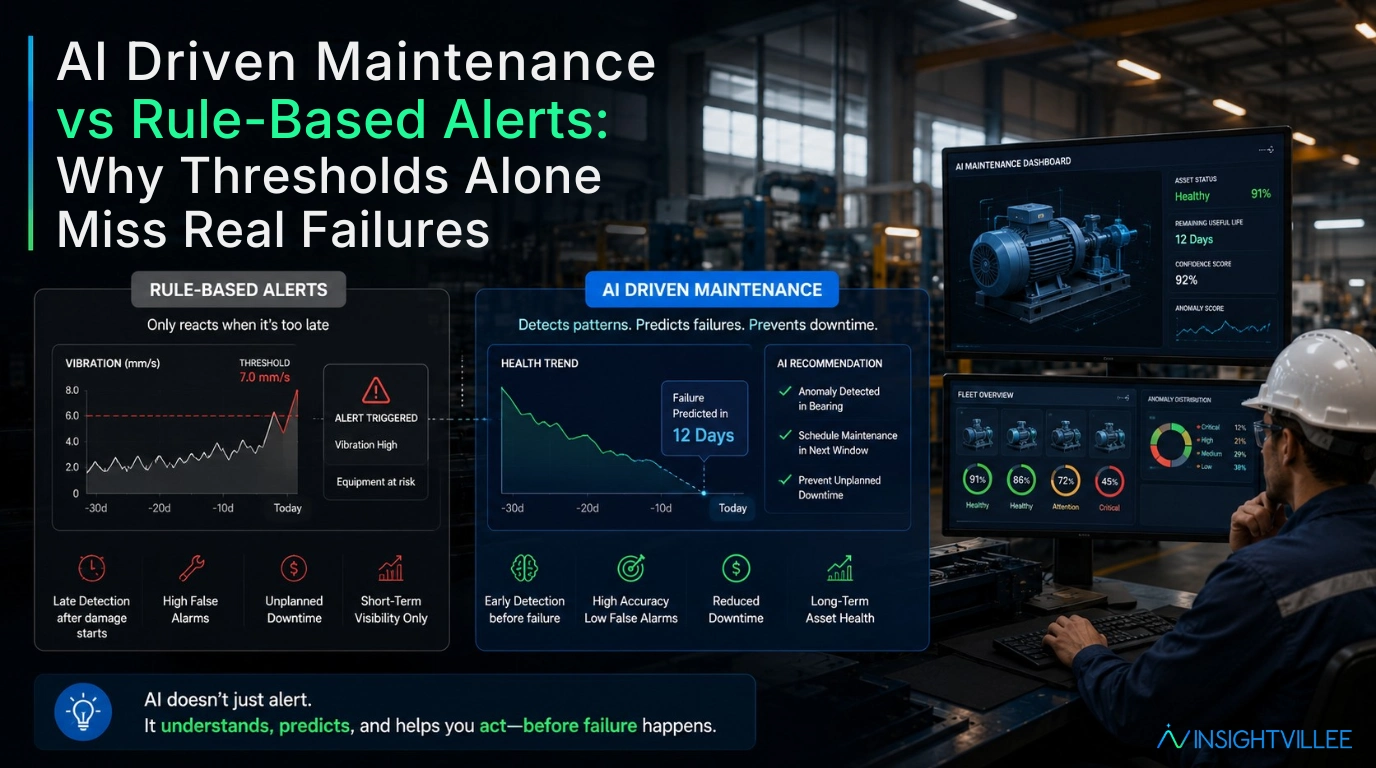
AI-Driven Maintenance vs Rule-Based Alerts: Why Thresholds Alone Miss Real Failures
AI driven maintenance vs rule based alerts is not only a technical comparison. It is a plant-floor decision about whether teams want more alarms or better failure judgement.
Many plants still depend on rule-based alerts to monitor machine health. These alerts trigger when vibration, temperature, pressure, current, or another signal crosses a fixed limit.
That is useful for obvious problems. But real failures do not always cross a neat line. Some failures grow slowly. Some appear only under load. Some stay hidden because every reading looks “normal” on its own.
NIST found that manufacturers using more predictive and preventive maintenance reported lower unplanned downtime and fewer defects than plants relying more on reactive maintenance [NIST, 2021]. Siemens also reported that unplanned downtime costs the world’s 500 largest companies 11% of annual revenue [Siemens, 2024].
What Are Rule-Based Maintenance Alerts?
Rule-based maintenance alerts are alerts triggered when machine data crosses a fixed limit set by the plant, equipment maker, or maintenance team.
For example, if motor temperature crosses 80°C or vibration crosses a fixed value, the system sends an alert.
Rule-based alerts are simple. Maintenance teams understand them quickly. They are useful when there is a clear operating limit that must not be crossed.
ISO 13374 gives guidance for condition monitoring and diagnostics of machines, including how machine condition information can be processed and presented [ISO, 2003].
The weakness is simple. A rule only works when the right limit is set. If the limit is wrong, the alert will also be weak.
What Is AI-Driven Maintenance?
AI-driven maintenance studies machine behaviour, operating history, sensor signals, and maintenance records to find failure risks before they become breakdowns.
It does not only ask, “Did this value cross the limit?”
It asks, “Is this machine behaving differently from its normal pattern?”
That difference matters. A pump may be within vibration limits but still show a slow change in vibration, current, and flow. A motor may be below temperature limit but behave differently under the same load compared to last month.
This is the value of AI maintenance. It helps teams see weak signals before they become visible failures.
Why Do Plants Use Rule-Based Alerts?
Plants use rule-based alerts because they are easy to set up, easy to explain, and useful for detecting clear abnormal conditions.
They work well for basic machine monitoring. If pressure drops below a safe level, an alert helps. If temperature crosses a dangerous level, an alert helps. If current rises sharply, the team should know.
Rule-based alerts are often the first step in moving away from manual checks. They help teams monitor pumps, motors, compressors, gearboxes, conveyors, turbines, and other critical equipment.
Expert angle: Rule-based alerts are not useless. The problem starts when plants treat thresholds as full failure intelligence. A threshold can say “limit crossed.” It cannot always say “failure is developing.”
Why Do Thresholds Alone Miss Real Machine Failures?
Threshold alerts miss real failures because many failures develop through small behaviour changes before any single value crosses a fixed limit.
A machine can be unhealthy even when every reading is still inside the accepted range.
For example, vibration may rise slightly. Temperature may rise slightly. Current may drift slightly. Each signal may look safe alone. But together, they may show a developing bearing issue, lubrication problem, or load-related stress.
This is why threshold alerts miss machine failures. They often look at one signal at a time. Real failures often develop across many signals together.
The human angle is clear. A senior maintenance engineer may sense that “something is not right” even before an alarm comes. AI-driven maintenance tries to bring that pattern judgement into daily monitoring.
When Do Rule-Based Alerts Usually Fail?
Rule-based alerts usually fail when machine behaviour changes slowly, load changes often, or early failure signs remain below alarm limits.
They also fail when thresholds are copied from generic standards instead of actual plant conditions.
The same motor may behave differently during high load, low load, startup, shutdown, night shift, or different product runs. A fixed threshold may not understand this difference.
If the threshold is too tight, teams get too many alarms. If it is too broad, genuine risks are missed.
This is where plant teams lose trust. When alerts keep crying wolf, supervisors stop treating them seriously. When alerts stay silent before a real breakdown, leadership starts questioning the full monitoring system.
What Types of Failures Can Threshold Alerts Miss?
Threshold alerts can miss early bearing wear, gradual misalignment, lubrication degradation, cavitation, fouling, pressure drift, current imbalance, and repeated small abnormalities.
These failures rarely appear as one sudden clean event.
A bearing may wear slowly. A pump may cavitate only during certain flow conditions. A compressor may show pressure drift over days. A motor may show current imbalance during specific load patterns.
This is why failure detection should not depend only on fixed numbers.
On the floor, breakdowns often look sudden to leadership, but not to the machine. The machine usually gives small signs earlier. The problem is whether the plant can read those signs in time.
Why Does Machine Context Matter More Than Fixed Limits?
Machine context matters because the same reading can be normal in one operating condition and risky in another.
A vibration value may be normal at full load but abnormal at low load. A temperature rise may be acceptable during peak output but risky during light running. A pressure change may be harmless in one process but a sign of fouling in another.
Without context, rule-based alerts can overreact or underreact.
Maintenance intelligence improves when machine data is connected with production load, runtime, process conditions, shift behaviour, and maintenance history.
This is the foundation of machine failure prediction beyond thresholds.
How Does AI-Driven Maintenance Detect What Thresholds Miss?
AI-driven maintenance detects what thresholds miss by learning normal behaviour and finding changes across multiple signals before a fixed limit is crossed.
It studies how a machine behaves during different loads, speeds, shifts, products, batches, and process conditions.
Then it identifies when the machine begins to move away from normal behaviour.
For example, a motor may not cross a temperature threshold. But if temperature, vibration, and current drift together, the pattern may show early risk.
This supports AI based failure detection in manufacturing because the system looks at relationships, not only individual readings.
how AI learns machine behaviour patterns that manual analysis cannot detect
What Are the Key Differences in AI-Driven Maintenance vs Rule-Based Alerts?
The main difference is that rule-based alerts detect limit breaches, while AI-driven maintenance detects behaviour changes and supports better risk decisions.
| Area | Rule-Based Alerts | AI-Driven Maintenance |
| Alert logic | Fixed thresholds | Behaviour patterns |
| Data view | One signal at a time | Connected machine signals |
| Context | Limited | Load, speed, shift, process, and history |
| Failure detection | After limit breach | Often before visible limit breach |
| False alarms | Can be high | Reduced when patterns are learned well |
| Decision support | Basic alert | Risk priority and action guidance |
| Best use | Clear operating limits | Complex failure risks |
How is AI maintenance better than rule-based alerts? It gives stronger context, earlier warning, and better risk priority.
Why Do Threshold Alerts Create False Alarms and Missed Alarms?
Threshold alerts create false alarms when limits are too tight and missed alarms when limits are too loose. Both problems reduce trust in maintenance alerts.
False alarms create alert fatigue. Teams start ignoring alerts because too many do not lead to real action.
Missed alarms create a different problem. A machine fails even though the system showed no warning. After that, teams may stop trusting the monitoring setup.
This is one reason plants struggle to convert predictive alerts into completed maintenance action.
how AI driven maintenance reduces false alarm rates without missing real failures
Expert angle: An alert is useful only if the team believes it, understands it, and acts on it. Otherwise, it becomes another dashboard number.
How Does AI Help Prioritise Real Failure Risks?
AI helps prioritise real failure risks by separating normal variation from meaningful abnormal behaviour and ranking risks by urgency, asset criticality, and production impact.
Not every alert needs the same response.
Some machines can wait until the next planned stop. Some need inspection in the next shift. Some need immediate attention because failure will stop a critical line.
An intelligent maintenance alert system should help teams decide which machine needs action first.
This matters for Plant Heads because maintenance priority is not only a technical decision. It affects output, dispatch, manpower, spares, and downtime cost.
Should Plants Replace Rule-Based Alerts Completely?
Plants should not always replace rule-based alerts completely. The better approach is to use thresholds for hard limits and AI-driven maintenance for behaviour-based failure detection.
Rule-based alerts are still useful for safety limits, compliance limits, and clear operating boundaries.
For example, pressure, temperature, or speed limits may still need fixed alerts. These limits are important for safe operation.
AI-driven maintenance works best when it adds intelligence above basic monitoring. The goal is not to remove rules. The goal is to avoid depending only on them.
Can AI detect failures before thresholds are crossed? Yes, in many cases it can detect behaviour changes earlier, but results depend on data quality, machine condition, and how well the system is deployed.
What Are the Best Practices for Moving Beyond Threshold-Based Maintenance?
The best practice is to keep fixed thresholds for critical limits, add pattern-based failure detection, connect machine data with plant context, and track alert-to-action closure.
Start with critical machines where downtime has the highest cost.
Connect vibration, temperature, current, pressure, load, runtime, maintenance history, and production data. Review false alarms and missed alarms regularly.
Train maintenance teams to understand why an alert was triggered. Do not make the system a black box. If teams do not trust the alert, they will not act.
Track one practical metric: how many alerts became completed before production was affected?
5 reasons predictive alerts alone do not stop production loss
Conclusion
Rule-based alerts are useful, but thresholds alone are not enough for modern plant maintenance because real failures are often slow, connected, and context-dependent.
Thresholds can detect obvious abnormal conditions. But they often miss early, complex, or load-specific failure patterns.
AI-driven maintenance improves failure detection by learning machine behaviour, connecting signals, reducing false alarms, and prioritising real risks.
For large plants, the real value is not just alerts. It is better to make maintenance decisions before failures affect production.
Insightvillee provides an AI driven maintenance system as part of its smart factory operations platform for large manufacturing plants that need earlier visibility into machine risks, downtime threats, and maintenance priorities.
Insightvillee supports this shift as a transformation partner for large-scale manufacturers through predictive maintenance, OEE monitoring, and one real-time intelligence layer across machines, lines, and systems. Its locked outcomes include up to 40% reduction in unplanned downtime in relevant deployments. This is deployment-specific, not a universal guarantee.
The AI driven maintenance system inside Insightvillee helps maintenance teams prioritise risks, reduce avoidable breakdowns, and plan action before production is affected.
Key Takeaways
- Rule-based alerts are useful for clear operating limits.
- Threshold alerts can miss slow, connected, or context-dependent failures.
- AI-driven maintenance studies behaviour patterns across machine signals and operating conditions.
- False alarms and missed alarms reduce team trust in maintenance alerts.
- The best model is often hybrid: thresholds for hard limits and AI-driven maintenance for early failure patterns.