
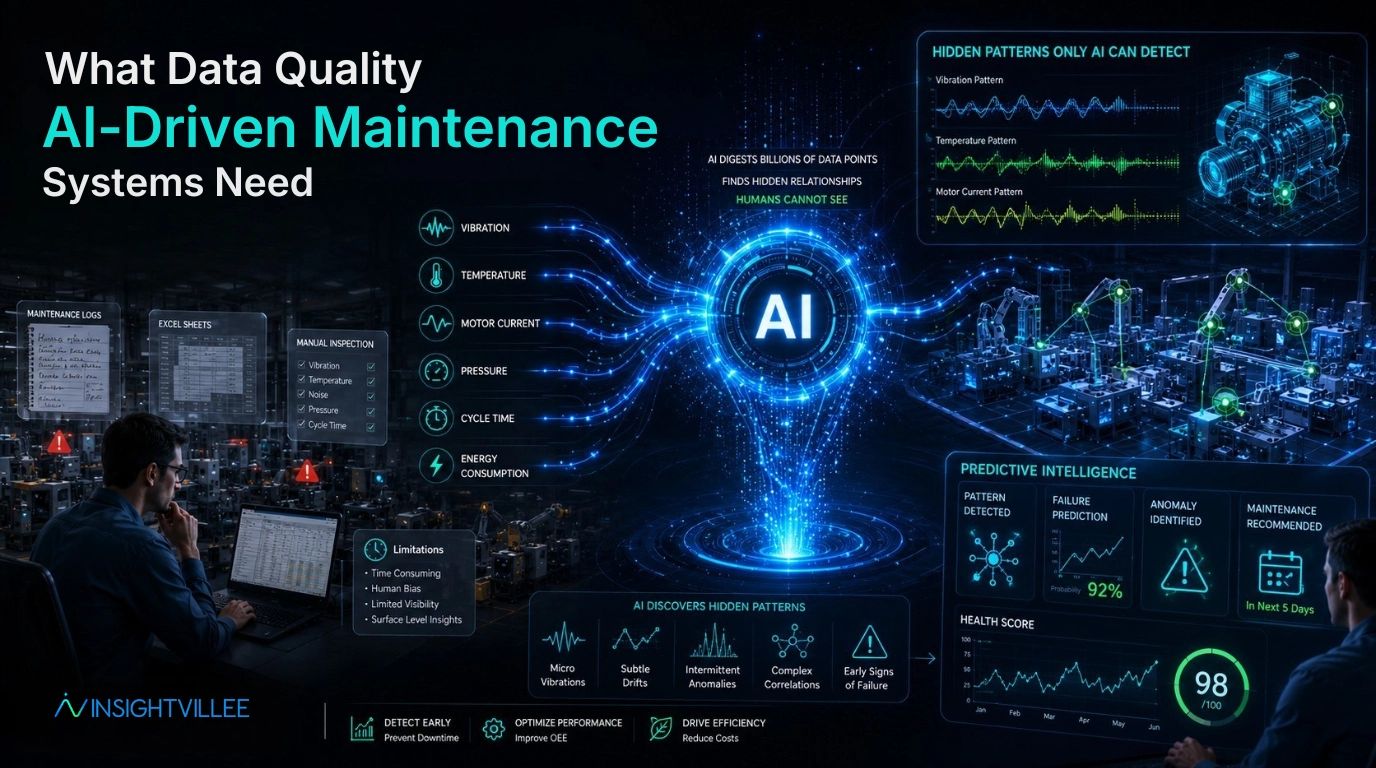
What Data Quality AI-Driven Maintenance Systems Need for Work
Data quality decides whether an AI-driven maintenance system gives useful maintenance decisions or creates more alerts that floor teams do not trust.
Many plants assume they need perfect data before starting. That is not true. Waiting for perfect data can delay improvement for years. But using poor data is also risky. It can create false alerts, missed failure signals, weak predictions, and low confidence from maintenance teams.
The real question is not, “Do we have enough data?” The better question is, “Is our data good enough to support reliable maintenance decisions?”
NIST notes that advanced maintenance approaches can help manufacturers reduce downtime, defects, and maintenance cost when implemented well [NIST, 2021]. ISO 13374 gives guidance for condition monitoring and diagnostics of machines, including processing and presentation of machine condition information [ISO, 2003].
What Is Data Quality in AI-Driven Maintenance?
Data quality in AI-driven maintenance means machine data is reliable, complete, consistent, time-aligned, and useful enough to support maintenance decision-making.
It is not only about clean sensor readings.
It also includes correct timestamps, asset mapping, operating context, maintenance history, failure records, work order details, and alert outcome feedback.
Good data helps the system understand how machines normally behave and when that behaviour starts changing.
On the floor, “bad data” does not look like a data problem. It looks like a wrong alert, a confused technician, a delayed repair, or a supervisor saying, “This system is not practical.”
Why Does Data Quality Matter for AI-Driven Maintenance?
Data quality matters because AI maintenance learns from the data it receives, and weak data can lead to weak alerts, wrong priorities, and low team trust.
If the data is noisy, incomplete, wrongly labelled, or disconnected from plant context, the system may learn the wrong pattern.
This can lead to false alarms, missed failures, poor priority ranking, and weak confidence from floor teams.
In practice, many maintenance projects struggle not because the idea is weak. They struggle because plant data is not structured for maintenance decisions.
This is where [Link: how AI learns machine behaviour patterns that manual analysis cannot detect → /blog/ai-learns-machine-behaviour-patterns] becomes useful. Pattern learning depends on the quality of the data behind it.
What Data Does an AI-Driven Maintenance System Need?
An AI-driven maintenance system needs sensor data, machine runtime, maintenance history, breakdown records, work orders, production conditions, asset criticality, and inspection outcomes.
Useful data includes vibration, temperature, pressure, current, flow, speed, load, runtime hours, start-stop cycles, breakdown records, work orders, failure modes, production conditions, shift data, process parameters, asset criticality, operator observations, and inspection outcomes.
What data does AI maintenance need? It needs both machine health data and plant context.
Machine data tells what changed. Maintenance data tells what action happened. Production context tells whether the change happened under load, during a batch, after changeover, or before downtime.
Where Does Insightvillee Fit Into AI Maintenance Data Quality?
Insightvillee provides an AI driven maintenance system for large manufacturing plants that need earlier visibility into machine risks, downtime threats, and maintenance priorities.
For data quality, this means machine data cannot stay disconnected from maintenance records, production conditions, work orders, and alert outcomes. The data has to explain what changed, when it changed, and what action followed.
Insightvillee supports this through its smart factory operations platform, where predictive maintenance works with OEE monitoring, smart production planning, and one real-time intelligence layer across machines, lines, and systems.
Does AI-Driven Maintenance Need Perfect Data?
AI-driven maintenance does not need perfect data to begin, but it does need data that is consistent and trustworthy enough for teams to act on.
Many plants can start with partial data from critical machines.
The first step does not need to cover every asset, every line, and every failure mode. A practical starting point is better than waiting years for a perfect setup.
Does AI maintenance need clean data? Yes, but “clean” does not mean perfect. It means the data should be clear enough to identify normal behaviour, meaningful changes, and useful maintenance actions.
A maintenance head does not need a perfect report. He needs a recommendation that is reliable enough to send a technician with confidence.
What Are the Most Important Data Quality Requirements?
The most important data quality requirements are accurate sensor readings, consistent sampling, correct timestamps, asset mapping, clear failure labels, maintenance history, and alert outcome feedback.
These are the basic foundations:
- Accurate sensor readings.
- Consistent sampling frequency.
- Correct timestamps.
- Proper asset mapping.
- Clear machine hierarchy.
- Reliable failure labels.
- Maintenance action history.
- Production and process context.
- Low missing-data gaps.
- Clear alert outcome feedback.
These requirements help the system separate real failure risk from normal operating variation.
Why Is Timestamp Accuracy Critical for Data Quality?
Timestamp accuracy is critical because AI maintenance must know when each machine signal, production event, and maintenance action happened.
If vibration, temperature, pressure, production, and maintenance data are not aligned by time, the system may connect the wrong events.
For example, a temperature spike after maintenance means something different from a temperature spike before a breakdown. A vibration change during startup means something different from the same change during steady operation.
Poor timestamp alignment weakens root cause analysis and prediction accuracy.
Human angle: On the floor, timing is everything. A signal before failure is a warning. The same signal after repair may be the result. If the time is wrong, the meaning is wrong.
The Insightvillee AI driven maintenance system is part of a larger smart factory platform that connects machine data, maintenance history, and production context, so timestamp accuracy helps teams understand whether a signal came before risk, during operation, or after maintenance action.
Why Does Asset Mapping Matter for Data Quality?
Asset mapping matters because every data point must be linked to the correct machine, line, area, and plant.
If a vibration sensor is mapped to the wrong motor, the system learns the wrong relationship.
If a work order is attached to the wrong pump, failure history becomes misleading.
If duplicate machine names exist across lines or plants, reports become confusing.
A clean asset hierarchy is one of the most important steps before scaling AI maintenance. It is also one of the most ignored.
For rotating assets, this becomes even more important because pumps, motors, compressors, and turbines often share similar tags across areas. [Link: AI driven maintenance for rotating equipment pumps motors compressors and turbines → /blog/ai-driven-maintenance-rotating-equipment]
How Much Historical Data Is Needed for AI-Driven Maintenance?
The amount of historical data needed depends on machine type, failure frequency, operating variation, sensor quality, and whether breakdown outcomes are recorded clearly.
How much data is needed for predictive maintenance? There is no single fixed number that applies to every plant.
The system can begin learning normal machine behaviour from recent operating data. But deeper failure prediction improves when it also has breakdown history, maintenance actions, confirmed failure modes, and operating context.
In many plants, the first phase focuses on detecting abnormal behaviour. Failure prediction improves as more months of plant data and action feedback become available.
This is why [Link: how an AI driven maintenance system improves with every month of plant data → /blog/ai-driven-maintenance-improves-with-plant-data] is important for long-term maintenance maturity.
What Data Quality Problems Commonly Hurt AI Maintenance?
Common data quality problems include missing sensor readings, noisy data, wrong asset tags, duplicate machine names, inconsistent units, poor timestamps, weak work orders, and disconnected systems.
The most common issues are:
Missing sensor readings.
Noisy sensor data.
Wrong asset tags.
Duplicate machine names.
Inconsistent units.
Poor timestamp alignment.
Manual work orders with incomplete details.
Failure records without root cause.
Maintenance actions not updated after completion.
Data stored across disconnected systems.
One of the most common problems in plants is not that data is unavailable. It is that machine data, maintenance data, and production data exist separately and do not explain each other.
How Does Poor Data Quality Affect AI Maintenance Results?
Poor data quality affects AI maintenance by increasing false alarms, missing early failure signals, weakening priority ranking, reducing root cause visibility, and lowering operator trust.
When teams do not trust the data, they will not trust the recommendation built from that data.
Poor data can cause more false alarms. It can also hide early warning signs. It may rank the wrong machine as urgent. It may miss the real cause of failure.
It also makes ROI harder to prove because teams cannot clearly show which alerts became useful maintenance action.
As part of its predictive maintenance capability, Insightvillee works as an AI driven maintenance system that helps plant teams act before failures affect production, but that action depends on trusted machine data, clean asset mapping, and clear maintenance outcomes.
What makes machine data useful for AI? It becomes useful when teams can connect the signal, machine, operating condition, maintenance action, and outcome.
How Can Plants Improve Data Quality Before AI Maintenance?
Plants can improve data quality by starting with critical machines, standardising asset names, fixing timestamps, validating sensors, and connecting machine data with maintenance records.
Start with critical machines first.
Standardise asset names and tags. Fix timestamp alignment across systems. Validate sensor installation and calibration. Connect machine data with work orders and breakdown records.
Capture maintenance actions clearly. Record whether alerts were true, false, or useful. Create standard failure categories. Review data gaps during early deployment.
Clean data for AI driven maintenance is built step by step. It does not happen through one big cleanup exercise.
What Is Good Enough Data for Starting AI-Driven Maintenance?
Good enough data is consistent, time-aligned, machine-specific, and connected to operating context for critical assets where downtime impact is high.
A plant does not need to start with every asset.
The best starting point is usually a small set of machines with reliable sensor data, clear asset ownership, visible downtime impact, and measurable maintenance outcomes.
Good enough data should help the team answer four questions:
Which machine changed?
When did it change?
What was the machine doing at that time?
What action happened after the alert?
If the plant can answer these questions, it has a practical starting point.
The AI driven maintenance system inside Insightvillee helps maintenance teams prioritise risks, reduce avoidable breakdowns, and plan action before production is affected, but the starting point is still good enough data from the machines that matter most.
How Does AI Maintenance Improve as Data Quality Improves?
AI maintenance improves as more plant data, inspection findings, repair outcomes, false alarms, and confirmed failures are recorded and reviewed.
As more plant data is collected, the system becomes better at understanding normal behaviour.
As maintenance teams record inspection findings and repair outcomes, it learns which alerts were useful. As failure labels improve, it becomes stronger at identifying likely failure modes.
Over time, this feedback loop improves alert accuracy, reduces false alarms, and strengthens maintenance decision support.
This is where plant discipline matters. The system improves only when teams close the loop after alerts.
What Are the Best Practices for Maintaining Data Quality Over Time?
The best practice is to treat data quality as an ongoing maintenance process, with clear ownership, regular review, sensor checks, and alert outcome tracking.
Assign ownership between maintenance, production, and digital teams.
Review sensor health regularly. Standardise failure and work order entries. Audit asset mapping periodically. Track missing data and data drift.
Review alert outcomes with maintenance teams. Feed confirmed failures and false alarms back into the system.
Treat data quality like machine health. If it is not maintained, it will slowly become unreliable.
Within the Insightvillee smart factory platform, the AI driven maintenance system connects equipment health with production impact, so leaders can make better maintenance decisions only when data quality is reviewed as an ongoing plant discipline.
[Link: IIoT manufacturing how connected machines make hidden energy losses visible → https://insightvillee.com/iiot-manufacturing-how-connected-machines-make-hidden-energy-losses-visible/]
Conclusion
AI-driven maintenance does not need perfect data, but it does need reliable, time-aligned, machine-specific, and contextual data to support trusted decisions.
The most important requirements are accurate sensor readings, correct timestamps, asset mapping, maintenance history, production context, and feedback from real maintenance actions.
Poor data quality weakens predictions and reduces team trust.
Good data quality helps AI turn machine signals into reliable maintenance intelligence before failures affect production.
Insightvillee is a smart factory transformation partner that includes an AI driven maintenance system for reducing unplanned downtime and improving maintenance planning.
Insightvillee supports this shift as a transformation partner for large-scale manufacturers through predictive maintenance, OEE monitoring, smart production planning, and one real-time intelligence layer across machines, lines, and systems. Its locked outcomes include up to 40% reduction in unplanned downtime in relevant deployments. This is deployment-specific, not a universal guarantee.
Key Takeaways
AI-driven maintenance does not need perfect data, but it needs usable and trusted data.
Data quality includes sensor readings, timestamps, asset mapping, maintenance history, production context, and alert feedback.
Poor data can create false alarms, missed failure signals, weak priorities, and low trust.
Plants can start with critical machines instead of waiting for perfect plant-wide data.
Data quality should be maintained like a plant asset, not treated as a one-time cleanup.