
How AI Detects Hidden Machine Behaviour Patterns
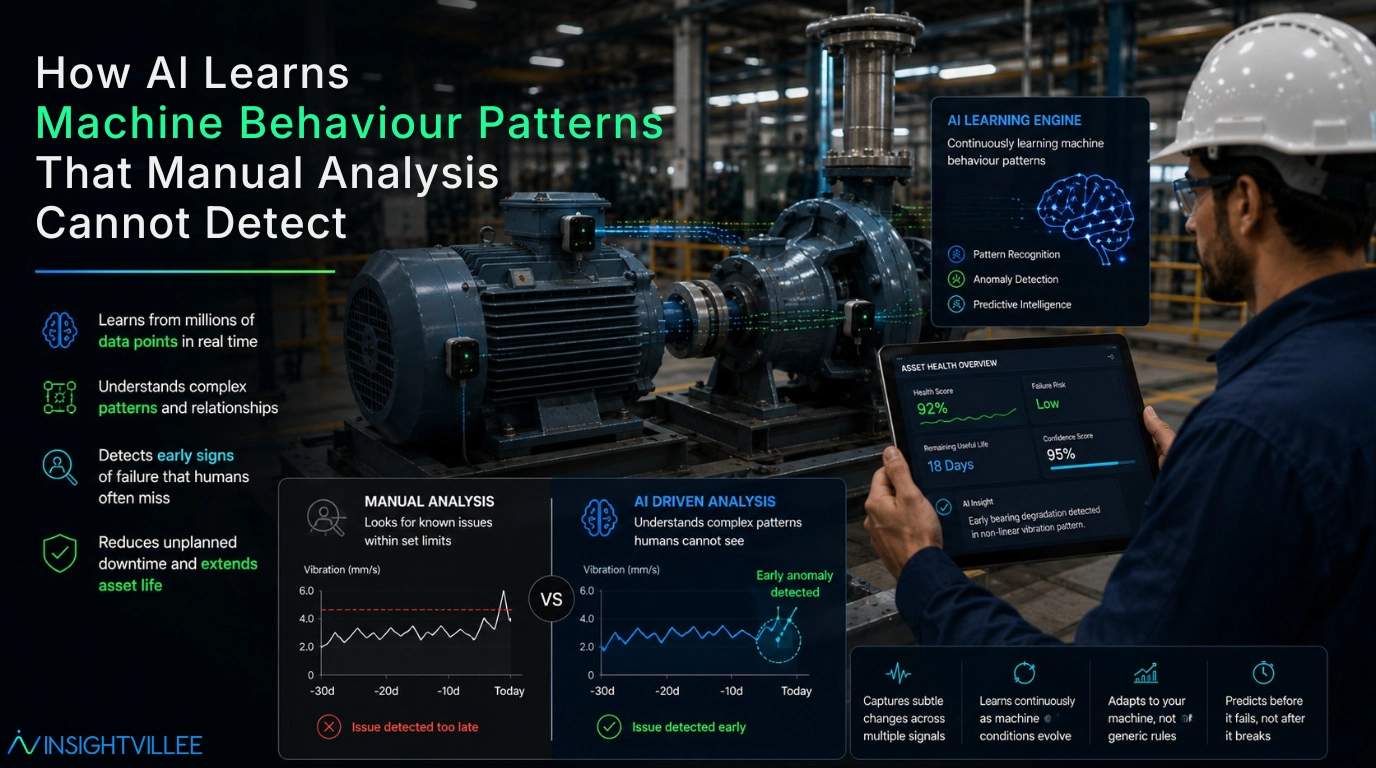
Every critical machine creates machine behaviour patterns long before it fails. The problem is that many of those patterns are too small, too slow, or too spread out for manual analysis to catch in time.
A motor does not always fail suddenly. A pump does not always move from healthy to failed in one shift. A compressor may slowly change pressure behaviour for weeks. A gearbox may show small vibration changes before the alarm limit is crossed.
Maintenance teams can see obvious changes. But in a large plant with hundreds of machines, many shifts, changing loads, and different products, no human team can manually study every small signal all the time.
NIST found that advanced maintenance can help manufacturers reduce downtime, defects, and maintenance cost, though results depend on execution quality [NIST, 2021]. Siemens reported that unplanned downtime costs the world’s 500 largest companies 11% of annual revenue [Siemens, 2024].
What Are Machine Behaviour Patterns?
Machine behaviour patterns are the normal ways a machine performs under different loads, speeds, shifts, products, process conditions, and maintenance states.
These patterns include vibration levels, temperature changes, pressure movement, motor current, energy use, speed variation, load response, runtime, and cycle behaviour.
A machine does not behave the same way all the time. A pump under full load behaves differently from the same pump at low load. A compressor during peak demand behaves differently from the same compressor during idle running.
This is why machine behaviour cannot be judged only by one fixed number.
ISO 13374 gives guidance for condition monitoring and diagnostics of machines, including how machine condition information can be processed and presented [ISO, 2003].
Why Do Maintenance Teams Analyse Machine Behaviour?
Maintenance teams analyse machine behaviour to understand whether equipment is healthy, unstable, overloaded, or slowly moving toward failure.
In practice, maintenance teams are not only asking, “Is this reading high?” They are asking, “Is this machine behaving differently from how it normally behaves?”
That question is important.
A small rise in vibration may be normal after a load change. The same rise may be risky if it appears with current drift and higher temperature. A pressure change may be harmless during one product run but serious during another.
Good maintenance judgement comes from reading this behaviour correctly.
Human angle: experienced technicians often say, “This machine does not sound right,” even when the report still looks normal. AI-driven maintenance tries to convert that kind of pattern sense into something visible, trackable, and repeatable.
Why Can Manual Analysis Not Detect Every Machine Behaviour Pattern?
Manual analysis cannot detect every machine behaviour pattern because people cannot continuously review thousands of small changes across machines, shifts, loads, and operating conditions.
Manual review works for obvious problems. It can catch high vibration, high temperature, abnormal noise, leakage, or visible damage.
But early failure signals are often not obvious. They may develop slowly. They may appear only during specific speed, load, or batch conditions. They may involve small changes across several signals at the same time.
A technician may notice one high reading. But it is much harder to detect a weak relationship between vibration, current, load, and operating speed over several weeks.
In many plants, failure signals are not missed because teams are careless. They are missed because the pattern is too small, too slow, or too spread across data points for manual review to catch in time.
[Link: AI driven maintenance vs rule-based alerts why thresholds alone miss real failures → /blog/ai-driven-maintenance-vs-rule-based-alerts]
What Machine Data Does AI Use to Learn Machine Behaviour?
AI uses machine data such as vibration, temperature, pressure, flow, current, power, speed, load, runtime, maintenance history, breakdown records, and production context.
Useful machine data includes vibration data, temperature data, pressure data, flow data, current and power data, speed and load data, runtime hours, start-stop cycles, work orders, breakdown records, production output, batch details, shift data, and process conditions.
The more connected the data is, the better the system can understand real machine behaviour.
For example, high temperature during peak load may be normal. The same temperature during low load may be abnormal. A vibration spike during startup may mean something different from a vibration spike during steady operation.
This is why maintenance data should not sit separately from production data.
[Link: what data quality does an AI driven maintenance system actually need to work → /blog/data-quality-ai-driven-maintenance-system]
How Does AI Learn Normal Machine Behaviour?
AI learns normal machine behaviour by studying historical machine data and comparing current performance with past behaviour under similar operating conditions.
It studies how a machine behaves during different loads, speeds, shifts, products, batches, and production conditions.
Instead of using one fixed threshold for every situation, it builds a behaviour baseline for each machine.
For example, a compressor may normally run warmer during peak demand. But if the same temperature rise appears during low demand, that may be abnormal. A motor may normally draw more current during heavy load. But current drift during stable load may need attention.
This is how AI learns machine behaviour patterns in a practical plant setting. It learns what is normal for that asset, not only what is written in a generic limit sheet.
How Does AI Detect Machine Behaviour Patterns Humans May Miss?
AI detects machine behaviour patterns humans may miss by analysing many signals together, finding small repeated changes, and comparing current behaviour with earlier failure patterns.
Manual analysis often looks at one chart at a time. AI analytics can study vibration, temperature, current, load, pressure, runtime, and production conditions together.
This helps pattern detection.
For example, vibration may rise slightly. Current may rise slightly. Output may fall slightly. Each signal may look safe alone. But together, they may show a developing fault.
This answers: Why can AI detect patterns humans miss? Because it can compare many small changes together, continuously, across long periods of machine history.
The value is not that it replaces people. The value is that it gives people a clearer early warning.
What Hidden Machine Behaviour Patterns Can AI Detect?
AI can detect hidden machine behaviour patterns such as gradual vibration drift, load-linked temperature rise, current imbalance, pressure drift, micro-stoppages, and energy use without output gain.
Some examples include:
- Gradual vibration drift before bearing failure.
- Temperature rise is linked to load changes.
- Current imbalance that appears only at specific speeds.
- Pressure drift before compressor or pump issues.
- Repeated micro-stoppages before larger downtime.
- Energy consumption increases without output improvement.
- Machine performance falling after maintenance.
- Failure patterns that repeat under one shift, batch, or process condition.
This is hidden machine behaviour analysis. It helps teams see what is building quietly before the failure becomes visible.
Why Does Context Matter in Machine Behaviour Learning?
Context matters in machine behaviour learning because the same reading can be normal in one operating condition and risky in another.
A vibration value may be normal at high speed but risky at low speed. A temperature rise may be acceptable during heavy load but abnormal during idle running. A pressure change may be harmless in one process stage but a sign of fouling in another.
This is why machine learning for equipment monitoring should not look at machine signals alone.
It should connect machine data with production load, process condition, runtime, maintenance history, batch, SKU, and shift behaviour.
A good maintenance head does not ask for a reading in isolation. He asks, “What was the machine doing when this reading changed?” That context often decides whether the issue is serious or not.
How Does AI Turn Machine Behaviour Data Into Maintenance Decisions?
AI turns machine behaviour data into maintenance decisions by showing whether a risk is new, repeating, worsening, or likely to affect production.
The goal is not only to say, “something looks unusual.”
The goal is to help teams decide what to do next.
Should the machine be inspected now? Can it wait until the next planned stop? Is the issue linked to load, lubrication, misalignment, bearing wear, pressure drift, or process condition? Is the risk growing?
This is where behaviour data becomes maintenance intelligence.
For Plant Heads, the value is simple. Better maintenance decisions protect production output, dispatch commitments, manpower planning, and downtime cost.
How Does AI Improve Machine Behaviour Learning With More Plant Data?
AI improves machine behaviour learning as it receives more operating history, maintenance actions, breakdown outcomes, false alarms, and production results.
Every month of machine data helps improve the understanding of normal and abnormal behaviour.
If a machine pattern leads to a real failure, that outcome becomes useful learning. If an alert turns out to be false, that also improves future judgement when reviewed properly.
This is why feedback matters. Maintenance teams should not only receive alerts. They should also close the loop by recording what action happened and whether the risk was real.
[Link: how an AI driven maintenance system improves with every month of plant data → /blog/ai-driven-maintenance-improves-with-plant-data]
What Is the Difference Between AI Learning and Manual Machine Behaviour Analysis?
The main difference is scale and consistency. Manual analysis depends on time and experience, while AI-driven behaviour learning can monitor many connected signals continuously.
| Area | Manual Analysis | AI-Driven Behaviour Learning |
| Data review | Limited by time and people | Continuous and large-scale |
| Pattern detection | Obvious changes | Subtle and connected changes |
| Signal view | Often one parameter at a time | Multiple connected signals |
| Context | Depends on human interpretation | Uses operating and historical context |
| Speed | Slow and periodic | Real-time or near real-time |
| Consistency | Varies by person | Consistent pattern monitoring |
| Outcome | Detection after visible symptoms | Earlier risk identification |
Manual analysis is still valuable. Plant experience is still important. The best result comes when system learning supports human judgement.
What Are the Best Practices for Using AI to Learn Machine Behaviour?
The best practice is to start with critical machines, connect sensor data with maintenance and production records, and review AI alerts with experienced plant teams.
Start with machines where failure affects output most.
Connect sensor data with production and maintenance records. Avoid relying only on fixed thresholds. Capture maintenance actions and breakdown outcomes. Review alerts with maintenance teams regularly.
Train floor teams on what recommendations mean. Do not make the system feel like a black box.
Use AI as decision support, not as a replacement for maintenance judgement.
The best maintenance systems are not judged by how many alerts they create. They are judged by how many early warnings turn into correct action before production is affected.
Conclusion
AI helps plants understand machine behaviour by learning normal patterns, detecting hidden deviations, and turning small signal changes into earlier maintenance decisions.
Manual analysis is valuable. But it cannot catch every pattern at plant scale.
Many early failure signals are small, slow, and connected across multiple data points. They may not cross a fixed threshold. They may not look serious in one report. But together, they can show a real risk.
The real value is not collecting more machine data. It is turning machine data into maintenance intelligence that supports faster and better decisions.
Insightvillee provides an AI driven maintenance system as part of its smart factory operations platform for large manufacturing plants that need earlier visibility into machine risks, downtime threats, and maintenance priorities.
Insightvillee supports this shift as a transformation partner for large-scale manufacturers through predictive maintenance, OEE monitoring, and one real-time intelligence layer across machines, lines, and systems. Its locked outcomes include up to 40% reduction in unplanned downtime in relevant deployments. This is deployment-specific, not a universal guarantee.
The AI driven maintenance system inside Insightvillee helps maintenance teams prioritise risks, reduce avoidable breakdowns, and plan action before production is affected.
Within the Insightvillee smart factory platform, the AI driven maintenance system connects equipment health with production impact, so leaders can make better maintenance decisions.
Key Takeaways
- Machine behaviour changes before many failures become visible.
- Manual analysis is valuable, but it cannot study every small signal across every machine at plant scale.
- AI can learn normal machine behaviour under different loads, shifts, batches, and process conditions.
- AI pattern detection in manufacturing helps identify slow, small, and connected failure signals.
- The strongest maintenance approach combines plant experience with data-backed behaviour learning.