
How Real-Time Zone Alerts Help Prevent Safety Incidents in Manufacturing Plants
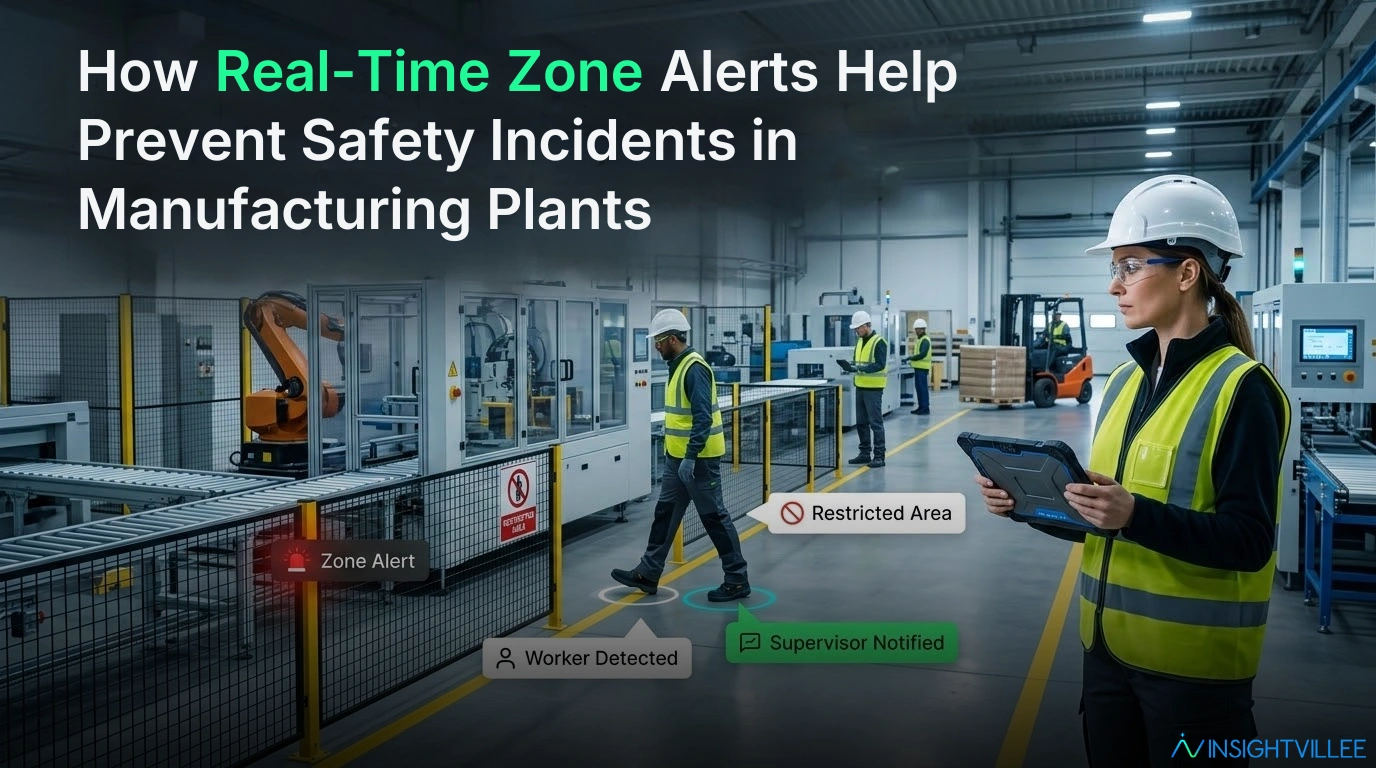
Real-time zone alerts help prevent safety incidents because they warn plant teams when unsafe movement is happening, not after the shift is over.
Manufacturing plants have many high-risk zones. A worker may enter a restricted machine area. A forklift may move close to a pedestrian path. A maintenance team may work near live equipment. A person may enter a chemical handling area without the right PPE.
Manual checks may record the issue later. But safety risk needs action while it is active.
The International Labour Organization reported that nearly 3 million workers die every year because of work-related accidents and diseases [ILO, 2023]. For large plants, safety control cannot depend only on memory, manual supervision, or delayed reporting.
What Are Real-Time Zone Alerts in Manufacturing?
Real-time zone alerts are instant notifications triggered when a person, vehicle, or asset enters, exits, or stays in a defined safety zone.
These zones can include restricted areas, machine danger zones, forklift movement paths, chemical handling areas, high-temperature zones, electrical areas, and maintenance-only spaces.
In simple words, zone alerts manufacturing helps teams know when someone has entered a place where they should not be, or stayed there longer than allowed.
The goal is not to create more reports. The goal is to identify unsafe movement before it becomes an incident.
[Link: how real-time zone alerts help prevent safety incidents in manufacturing plants > /blog/real-time-zone-alerts-prevent-safety-incidents]
Why Are Safety Zones Important on the Shop Floor?
Safety zones are important because they create clear boundaries between workers, machines, vehicles, hazardous materials, and live processes.
In large plants, every area does not carry the same risk. A packaging area has one type of risk. A chemical storage area has another. A welding line, boiler area, furnace zone, or forklift path may need stricter control.
ISO 45001 provides a framework for managing occupational health and safety risks and implementing control measures [ISO, 2018]. On the shop floor, zone control is one practical way to manage those risks.
Supervisors cannot manually watch every zone at all times. Without zone control, unsafe movement can go unnoticed until something goes wrong.
When Do Zone-Related Safety Incidents Usually Happen?
Zone-related safety incidents usually happen during live operations, especially during machine running, maintenance, material movement, loading, cleaning, inspection, and shift changes.
Safety risk often increases when the floor is busy.
During machine operation, workers may move too close to running equipment. During maintenance, teams may enter areas with stored energy or open guards. During forklift movement, pedestrians and vehicles may cross the same path. During shift change, attention may drop.
OSHA says finding and fixing hazards before injury or illness is more effective than reacting after harm happens [OSHA, 2016]. This is why real-time safety monitoring matters. The plant must see risk while there is still time to act.
5 reasons static production plans fail on the shop floor
Production pressure can also increase safety risk because teams move faster to meet targets.
Why Is Manual Zone Monitoring Not Enough?
Manual zone monitoring is not enough because it depends on people being present at the right place, at the right time, and noticing every unsafe movement.
Manual supervision is important. But it has limits.
A supervisor may be handling production issues, manpower gaps, quality concerns, material movement, and safety checks together. CCTV footage may be reviewed only after an incident. Paper logs and checklists may be filled at shift end.
This creates a gap between risk and response.
In practice, many unsafe entries are missed because the plant only sees the issue after something has already happened. This is why safety alerts factory systems are useful when they support supervisors with faster information.
End-of-shift records are useful for compliance. They cannot provide full-time protection.
How Do Real-Time Zone Alerts Help Prevent Safety Incidents?
Real-time zone alerts help prevent safety incidents by detecting unsafe entry immediately, notifying the right owner, reducing response time, and creating a record of action.
For example, if a worker enters a restricted machine zone during operation, the alert can reach the safety owner or shift supervisor immediately. If a forklift enters a pedestrian zone, the responsible team can respond while the risk is still active.
This supports how real-time safety alerts prevent incidents in factories. The plant does not wait for a checklist or CCTV review.
The alert also creates a record. It shows when the violation happened, where it happened, how long it lasted, and how it was handled.
Key insight: zone safety improves when unsafe movement becomes visible during the event, not after the incident.
What Types of Zone Risks Can Be Detected in Real Time?
Zone risks that can be detected in real time include restricted entry, forklift movement near people, PPE gaps, unsafe machine access, and entry into chemical, heat, pressure, or electrical risk zones.
A plant can use alerts for many practical situations.
A worker enters a restricted machine area. A forklift moves near a pedestrian path. A person enters a chemical zone without required PPE. A worker stands too close to moving equipment. A maintenance team enters a live area without clearance.
This is automated zone violation detection in manufacturing. It means the plant can identify unsafe movement in defined zones without waiting for a manual report.
PPE monitoring manufacturing can also help when certain zones require helmets, gloves, goggles, jackets, or masks.
How Does AI-Driven Intelligence Improve Zone Safety?
AI-driven intelligence improves zone safety by finding repeated violation patterns and linking them with shifts, areas, machines, teams, and production conditions.
The value is not only detecting who entered where. The value is understanding why the same risk keeps repeating.
For example, if zone violations keep happening near one loading area during night shift, the plant may need better route marking, lighting, manpower planning, or material flow control.
Automated hazard zone monitoring for Indian manufacturing becomes useful when it helps teams fix the root cause, not only record the violation.
Insightvillee supports safety and compliance automation through PPE monitoring, zone alerts, and incident tracking. It helps connect safety events with live plant operations so the right person can act faster.
how cross-plant benchmarking helps leaders find hidden performance gaps
What Key Metrics Should Plants Track for Zone Safety?
Plants should track zone violations, repeat violations, alert response time, unsafe condition duration, closure time, and high-risk zones with repeated incidents or near misses.
Good safety tracking should show more than the number of violations.
It should show where violations happen, which shift sees them often, how fast teams respond, and whether corrective action is closed.
Useful metrics include:
Number of zone violations.
Zone violations by area, line, or machine.
Repeat violations by shift.
Alert response time.
Unsafe condition duration.
Corrective action closure time.
High-risk zones with repeated incidents or near misses.
This is how to reduce safety incidents with real-time monitoring. Track the pattern, not only the incident.
What Are the Best Practices for Using Real-Time Zone Alerts?
The best way to use real-time zone alerts is to start with high-risk zones, define clear boundaries, set alert levels, assign owners, and review repeat patterns.
Do not start with every area at once. Start with the zones where one wrong movement can create the biggest risk.
These may include forklift routes, machine danger zones, chemical handling areas, loading bays, boiler areas, electrical rooms, and maintenance zones.
Set alert levels based on severity. Assign clear owners for each alert. Connect alerts with incident and corrective action tracking. Review repeat patterns weekly.
Train operators so alerts support safety, not punishment.
6 multi-plant reporting problems that slow down operations leaders
For large groups, zone safety should be visible across plants, not only inside one facility.
Conclusion
Real-time zone alerts help plants prevent safety incidents because they detect unsafe movement early, reduce response time, and build stronger accountability during live operations.
Zone-related safety incidents happen while production is running. Manual supervision, CCTV review, and end-of-shift records are useful, but they cannot give full-time protection.
The future of zone safety is continuous, connected, and action-focused.
Insightvillee supports this shift as a transformation partner for large-scale manufacturers. Its safety and compliance automation helps plants monitor PPE compliance, zone alerts, and incident tracking in real time.
smart factory operations what one intelligence layer changes for manufacturers
With one real-time intelligence layer, plant leaders can move from delayed safety reporting to live safety control.
Key Takeaways
- Real-time zone alerts help plants act while safety risk is active.
- Safety zones protect workers from machines, vehicles, hazardous materials, and live processes.
- Manual monitoring is useful, but it cannot watch every area every minute.
- Zone alerts create faster response, clearer ownership, and better safety records.
- Safety teams should start with high-risk zones and review repeat violation patterns.