
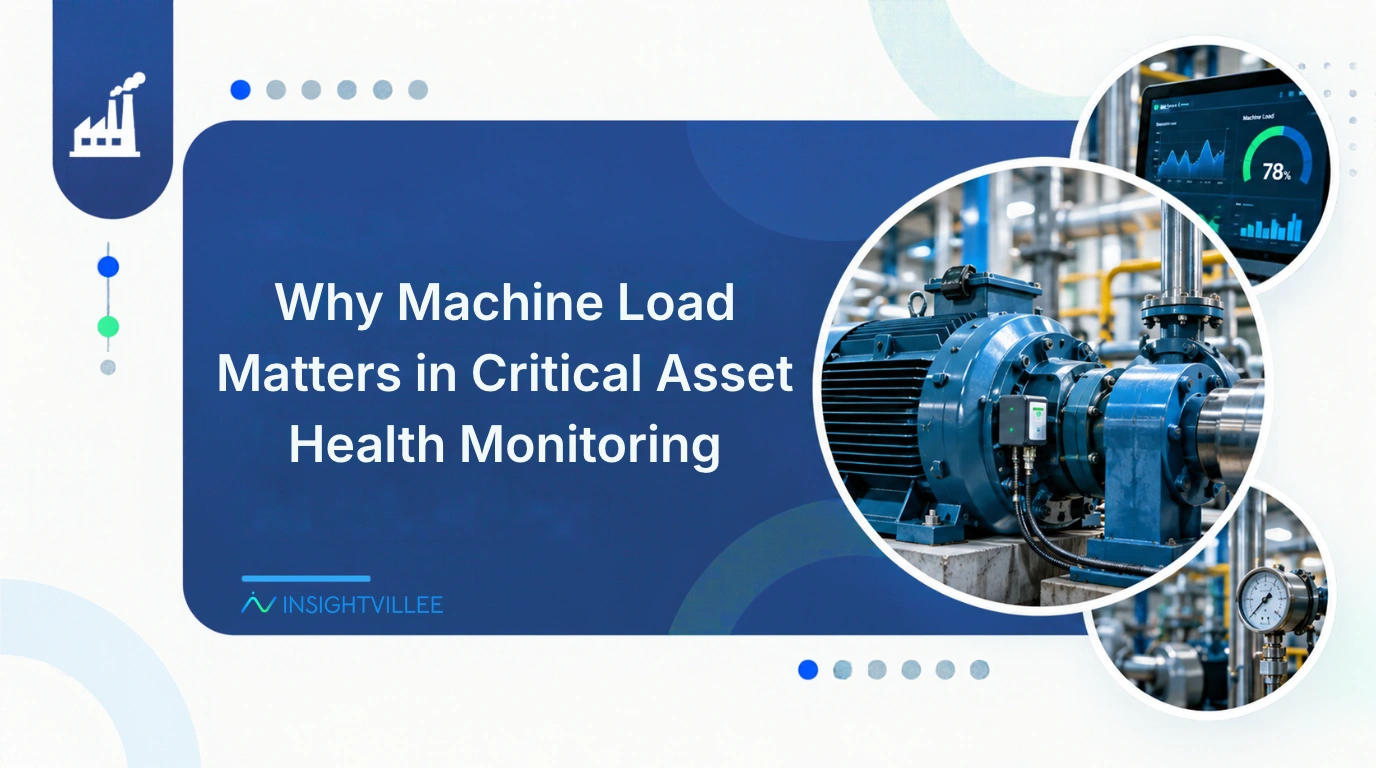
Why Machine Load Matters in Critical Asset Health Monitoring
Machine load matters in Critical Asset Health Monitoring because it directly affects vibration, temperature, pressure, and energy consumption. Changes in these readings may reflect normal operating demand rather than equipment deterioration.
By comparing machine health indicators under similar operating loads, manufacturers can distinguish expected variations from potential equipment problems.
This helps maintenance teams identify meaningful abnormalities, avoid unnecessary inspections, and make more accurate maintenance decisions.
Key Takeaways
- Machine load affects asset health assessments because equipment condition readings change with operating demand.
- Vibration, temperature, pressure, and energy consumption can increase or vary as machine load changes.
- Higher condition readings do not always indicate deterioration because increased production demand can cause normal variations.
- Load-specific operating baselines help distinguish expected machine behaviour from abnormal condition changes.
- Stable loads with rising vibration or temperature may indicate developing mechanical problems.
- Connected Industry 4.0 systems combine load, machine health, and production data for more accurate assessments.
- Load-aware monitoring supports maintenance decisions by helping teams investigate genuine abnormalities and prioritise critical assets.
Why Does Machine Load Matter?
Machine load affects how equipment operates, making it an important factor when evaluating machine condition and identifying potential problems.
Machine load refers to the mechanical or process demand placed on equipment during operation.
Depending on the machine, load may be represented by:
- Motor torque
- Electrical current
- Production throughput
- Pump flow and pressure
- Compressor demand
- Mechanical force
Equipment behaviour changes as operating demand changes.
For example, a motor working under a higher load may generate additional heat without experiencing mechanical deterioration.
Similarly, vibration readings may differ between low-load and high-load operation.
Manufacturers need to compare equipment readings under appropriate operating conditions.
A reliable machine health baseline establishes expected equipment behaviour across different load levels, helping teams recognise deviations that cannot be explained by normal operating demand.
How Does Machine Load Affect Equipment Health?
Changes in machine load can influence vibration, temperature, pressure, energy consumption, and mechanical stress.
These effects vary according to equipment design and operating conditions.
Vibration
Changes in mechanical load can affect vibration behaviour.
A machine may produce different vibration readings at different operating speeds or loads.
However, persistent abnormal vibration under comparable conditions may indicate:
- Bearing problems
- Mechanical imbalance
- Misalignment
- Component looseness
Temperature
Equipment temperature may increase with operating demand.
Motors, bearings, and other components generate heat during operation.
Higher temperature readings become concerning when they exceed expected values for a particular load.
Pressure
Pumps and compressors operate according to system demand.
Changes in pressure or flow may reflect normal process requirements rather than equipment deterioration.
Energy Consumption
Machines generally consume different amounts of energy at different operating loads.
An increase in electricity consumption should therefore be evaluated against the work being performed.
Component Wear
Operating beyond recommended load limits can place additional stress on equipment.
Repeated excessive loading may contribute to accelerated wear and reduced equipment reliability.
Interpreting machine health signals alongside operating load helps maintenance teams distinguish expected changes in vibration, temperature, and energy consumption from potential equipment problems.
Why Can Load Changes Resemble Equipment Problems?
Normal changes in operating load can produce condition readings that resemble early equipment deterioration.
Consider a production motor operating at two different loads.
| Operating condition | Possible observation |
| Low load | Lower current and operating temperature |
| Higher load | Increased current and temperature |
| Stable load with rising temperature | Possible abnormal condition |
| Stable load with increasing vibration | Potential mechanical problem |
Higher temperature during increased production demand may be expected.
However, the same temperature increase under unchanged operating conditions deserves closer investigation.
This distinction matters because incorrect comparisons can lead to:
- Unnecessary maintenance inspections
- Misleading equipment health alerts
- Incorrect assumptions about machine deterioration
- Avoidable maintenance disruption
- Genuine problems being overlooked
Machine health assessments should account for both operating conditions and historical behaviour.
How Does Load-Aware Monitoring Improve Accuracy?
Load-aware condition monitoring improves equipment assessments by comparing machine health readings under similar operating demands.
Traditional monitoring may rely on fixed thresholds.
However, one threshold may not accurately represent machines operating across different loads and speeds.
A more useful approach establishes expected behaviour for relevant operating conditions.
1. Record Operating Load
Capture the load or process demand alongside machine condition readings.
2. Establish Load-Specific Baselines
Define expected vibration, temperature, pressure, and energy consumption for different operating ranges.
3. Compare Similar Conditions
Review current readings against historical data from comparable loads.
4. Identify Abnormal Deviations
Investigate changes that cannot be explained by normal operating demand.
5. Verify Machine Condition
Use supporting condition indicators and maintenance history before confirming equipment problems.
For example, increasing vibration under a stable operating load may provide stronger evidence of deterioration than vibration changes caused by normal load variation.
ISO 17359:2018 provides guidance for establishing machine condition monitoring programmes, including baselines and operating conditions [ISO, 2018].
How Does Industry 4.0 Connect Load and Health Data?
Connected manufacturing intelligence allows plant teams to evaluate machine condition alongside operating load, production activity, and historical performance.
In many plants, machine condition and production information are recorded separately.
Vibration readings may come from sensors, while production loads are recorded through PLCs or manufacturing systems.
This separation can make equipment health assessments less reliable.
Manufacturing companies can use Insightvillee as an AI Industry 4.0 platform to connect existing ERP, MES, SCADA, PLC, sensor, and plant data into one intelligent system.
Connected operational information supports comparisons between:
- Machine load and vibration
- Operating demand and temperature
- Production activity and energy consumption
- Equipment performance and maintenance history
This broader context helps plant teams distinguish normal operating variations from potential equipment concerns.
Connecting these measurements is an important part of how manufacturers measure critical asset health, since accurate assessments depend on understanding machine condition alongside production performance and operating load.
What Does Abnormal Machine Load Reveal?
Abnormal machine load may indicate operating stress, changing production requirements, or equipment problems that require investigation.
Not every load increase indicates a fault.
A production line may require higher machine output during periods of increased demand.
However, unexplained loading changes can deserve closer attention.
| Observed condition | Possible explanation |
| Higher load with increased output | Normal production demand |
| Higher current at comparable output | Possible resistance or efficiency issue |
| Higher vibration at stable load | Potential mechanical deterioration |
| Rising temperature at unchanged load | Possible friction or cooling problem |
| Repeated operation above rated limits | Increased equipment stress |
A change becomes more meaningful when several indicators show unusual behaviour together.
For example, rising temperature and vibration under unchanged load may suggest a developing mechanical concern.
Identifying gradual equipment degradation requires manufacturers to distinguish persistent condition changes from variations caused by normal operating demand.
How Does Insightvillee Support Load-Aware Asset Monitoring?
Insightvillee connects equipment condition and operating information to support more informed maintenance decisions across manufacturing operations.
As an AI-driven Industry 4.0 platform, Insightvillee gives manufacturing leaders real-time visibility across machines, production lines, and multiple plants.
Its predictive maintenance capability supports connected assessment of equipment condition.
Relevant capabilities include:
- Predictive maintenance
- OEE monitoring and improvement
- Energy management
- Smart production planning
- Multi-plant intelligence
By bringing available machine condition data together with operational information, Insightvillee helps plant teams investigate potential equipment risks in context.
This supports better coordination between production and maintenance teams.
The objective is to identify meaningful equipment abnormalities without treating every load-related variation as a developing fault.
How Can Load-Aware Monitoring Improve Reliability?
Load-aware monitoring helps manufacturers investigate abnormal conditions more accurately and prioritise maintenance according to equipment risk.
A practical approach includes:
- Identify critical assets: Focus on machines whose failure could disrupt production.
- Monitor operating loads: Record actual operating demand.
- Compare condition readings: Review vibration, temperature, and other indicators at comparable loads.
- Investigate deviations: Examine unexplained condition changes.
- Assess operational risk: Consider machine importance and potential failure consequences.
- Plan maintenance: Schedule appropriate inspections and corrective actions.
- Verify improvements: Review machine behaviour after maintenance.
Using relevant critical asset health indicators helps maintenance teams evaluate machine condition under comparable loads before deciding which equipment requires inspection or corrective maintenance.
This approach supports maintenance decisions based on evidence rather than isolated readings.
Making Machine Load Part of Asset Health Decisions
Reliable critical asset health assessments require manufacturers to understand how equipment behaves under different operating loads.
A higher temperature, vibration reading, or power requirement does not automatically indicate deterioration.
The important question is whether the reading is normal for the machine’s current operating demand.
Plant leaders should focus on:
- Comparing equipment under similar operating conditions
- Establishing load-specific baselines
- Investigating persistent abnormalities
- Connecting machine health with production information
- Prioritising maintenance according to actual equipment risk
Load-aware monitoring provides the operational context needed to make more reliable condition assessments.