
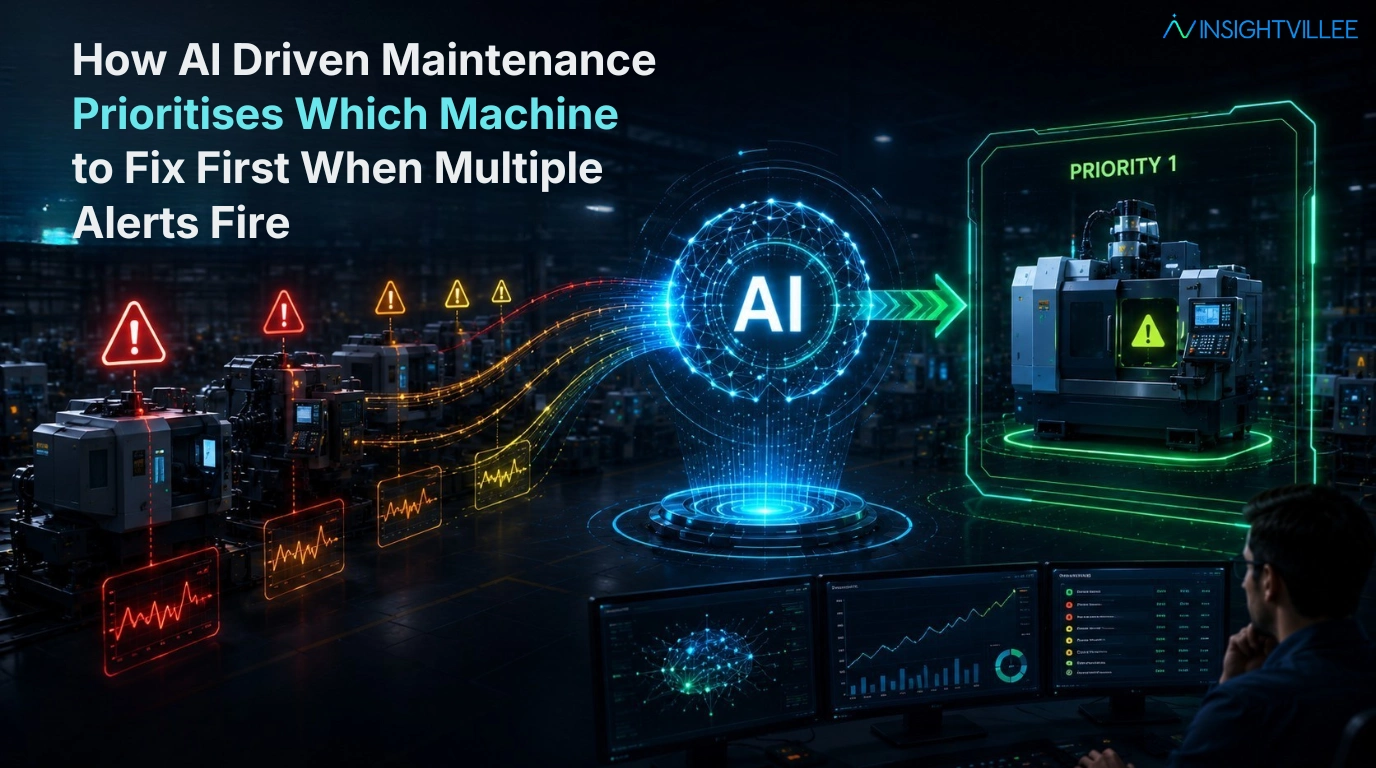
How AI Prioritises Machine Alerts When Multiple Alerts Fire
AI driven maintenance alert prioritization helps plant teams decide which machine to fix first when several alerts appear at the same time.
In a large plant, this can happen in one shift. A pump shows vibration drift. A compressor shows pressure instability. A motor shows rising temperature. A conveyor shows repeated stoppages. Each alert looks important, but the team has limited people, limited time, and production waiting.
The challenge is not only detecting alerts. The real challenge is deciding which machine creates the highest risk if ignored.
NIST notes that advanced maintenance approaches can help manufacturers reduce downtime, defects, and maintenance cost when implemented well [NIST, 2021]. Siemens reported that unscheduled downtime costs the world’s 500 biggest companies 11% of annual revenues [Siemens, 2024].
What Happens When Multiple Machine Alerts Fire at the Same Time?
When multiple machine alerts fire at the same time, maintenance teams must quickly decide what is critical, what can wait, and what only needs monitoring.
Multiple alerts can come from different machines, lines, utilities, or process areas. Some alerts may be urgent. Others may be routine variations caused by startup, load change, or process movement.
Without a clear priority system, teams may respond to the loudest alert instead of the most dangerous one.
This is where human pressure becomes real. The production team wants a quick answer. The maintenance team wants time to inspect. Leadership wants to avoid downtime. In that moment, alert prioritization becomes a business decision, not just a maintenance task.
[Link: 5 maintenance decisions an AI driven system can make faster than a human team → /blog/maintenance-decisions-ai-driven-system-makes-faster]
Why Is Maintenance Prioritisation Difficult in Large Plants?
Maintenance prioritisation is difficult because every alert must be judged against machine criticality, production dependency, spare availability, safety risk, downtime cost, and repair window.
Large plants have many connected assets running under different operating conditions. An alert cannot be judged only by its current reading.
A compressor alert may affect a full production area. A pump alert may affect a process batch. A small motor alert may have limited impact. A utility failure may stop several lines at once.
The data needed for maintenance priority is often spread across PLCs, SCADA, CMMS, ERP, operator logs, and manual inspection records.
The problem is not lack of alerts. The problem is lack of connected decision intelligence.
Why Do Threshold-Based Machine Alerts Not Tell Teams What to Fix First?
Threshold-based machine alerts show that a signal crossed a limit, but they do not always show how serious the risk is or which machine should be fixed first.
A high vibration alert on a non-critical machine may be less urgent than a small abnormal pattern on a critical compressor.
Thresholds also do not always account for load, speed, process condition, maintenance history, or production dependency.
ISO 13374 gives guidance for condition monitoring and diagnostics of machines, including how machine condition information can be processed and presented [ISO, 2003]. But useful maintenance action needs more than condition information. It needs risk context.
This is why plants need prioritisation based on consequence, not only alarm severity.
How Does AI-Driven Maintenance Prioritise Machine Alerts?
AI-driven maintenance prioritises machine alerts by comparing current behaviour, historical behaviour, deterioration speed, production impact, asset criticality, safety risk, and maintenance history.
It studies whether the condition is getting worse. It checks whether multiple signals are moving together. It compares the current alert with past machine behaviour.
Then it ranks which machine needs attention first based on likely consequence and urgency.
This answers: How does AI prioritize machine alerts? It does not treat every alert as equal. It connects the alert with what may happen if the machine fails.
The goal is to move maintenance teams from alert response to risk-based action.
Where Does Insightvillee Fit Into AI Driven Maintenance Alert Prioritization?
Insightvillee provides an AI driven maintenance system for large manufacturing plants that need earlier visibility into machine risks, downtime threats, and maintenance priorities.
This matters because alert prioritization is not only about machine health. It is about connecting machine signals with production impact, asset criticality, safety risk, and maintenance history.
Insightvillee supports this through its smart factory operations platform, where predictive maintenance works with OEE monitoring, smart production planning, and one real-time intelligence layer across machines, lines, and systems.
What Factors Does AI Consider Before Ranking a Maintenance Alert?
AI considers asset criticality, failure probability, deterioration rate, production impact, safety risk, maintenance history, past failures, spares, shutdown windows, operating load, and downtime cost.
A strong maintenance priority ranking system should consider:
Asset criticality.
Failure probability.
Rate of deterioration.
Production impact.
Safety and compliance risk.
Maintenance history.
Similar past failures.
Spare parts availability.
Planned shutdown windows.
Current operating load.
Process condition.
Downtime cost.
This is why AI maintenance can support faster decisions. It can connect many factors at once, while a human team may need time to gather the same information from different people and systems.
How Does AI Separate Urgent Alerts From Routine Variations?
AI separates urgent alerts from routine variations by comparing the current alert with similar past operating conditions and checking whether the pattern is temporary, repeating, or worsening.
Machines often show temporary variation during startup, changeover, high load, cleaning, or process transition.
A basic alert system may treat every deviation in the same way. But an experienced technician knows that not every deviation is a failure.
AI can compare the alert with similar historical conditions. It can check whether this same behaviour appeared earlier and whether it led to a real issue.
This helps reduce unnecessary intervention while keeping critical alerts visible.
Human angle: The best maintenance teams do not want every alert to become a panic call. They want to know which alert deserves attention now and which one should be watched.
[Link: AI driven maintenance for rotating equipment pumps motors compressors and turbines → /blog/ai-driven-maintenance-rotating-equipment]
How Does AI Connect Machine Risk With Production Impact?
AI connects machine risk with production impact by checking what the machine supports, which line depends on it, and what happens if that machine stops.
Maintenance priority is not only about machine health. It is also about consequence.
A machine supporting a bottleneck line, continuous process, or critical utility system may need faster action than a standalone auxiliary machine.
For example, a compressor feeding a critical production section may deserve urgent action even if its pressure drift looks small. A small auxiliary motor may cross a threshold, but its failure may not stop output immediately.
The Insightvillee AI driven maintenance system is part of a larger smart factory platform that connects machine data, maintenance history, and production context, so teams can rank alerts by business risk instead of sensor value alone.
This is which machine to fix first AI maintenance in practical terms. It ranks alerts by business risk, not just sensor value.
How Does AI Help Teams Decide the Right Maintenance Action?
AI helps teams decide the right maintenance action by showing whether a machine needs immediate inspection, planned maintenance, closer monitoring, or root cause analysis.
After ranking the alert, the next question is action.
Some machines may need immediate inspection. Some may need planned maintenance during the next stoppage. Some may only need closer monitoring. Some recurring alerts may need root cause analysis instead of repeated temporary fixes.
This supports faster coordination between maintenance, production, and planning teams.
Expert angle: The first decision is not always “repair or no repair.” Often it is “inspect now, monitor closely, plan for next stop, or start root cause analysis.” Good prioritisation protects both uptime and maintenance discipline.
What Should a Good AI Maintenance Priority Score Show?
A good AI maintenance priority score should show which machine is at risk, why it is prioritised, what changed, how fast it is worsening, and what action should happen next.
A useful priority score should not be a black box.
It should show:
Which machine is at risk.
Why it has been prioritised.
Which signals changed.
How fast the condition is worsening.
What production area may be affected.
What similar past events indicate.
Recommended urgency level.
Suggested next action.
Owner and closure status.
This helps maintenance teams trust the recommendation and explain the decision to production leaders.
What Example Shows AI Choosing Between Three Machine Alerts?
A practical example is when AI ranks a critical compressor above a non-critical motor and a temporary pump alert because the compressor creates the highest production risk.
Imagine three alerts fire in the same shift.
A non-critical motor crosses a vibration threshold.
A critical compressor shows small but consistent pressure drift.
A pump shows temperature rise during a temporary high-load condition.
A rule-based system may show all three as alerts. But AI may prioritise the compressor first because the pattern is worsening, similar failures occurred earlier, and the compressor supports a critical production area.
As part of its predictive maintenance capability, Insightvillee works as an AI driven maintenance system that helps plant teams act before failures affect production.
This is how AI helps teams act on risk, not noise.
Multiple machine alerts in manufacturing are common. The difference is whether the team sees three alarms or one clear priority.
What Are the Best Practices for AI-Based Maintenance Prioritisation?
The best practice is to define asset criticality, connect alerts with production and maintenance systems, review rankings with teams, and capture action outcomes.
Plant teams should start by defining asset criticality clearly. Not every machine has the same production or safety impact.
They should connect machine alerts with production and maintenance records. They should avoid treating every alert as equal.
Teams should review priority rankings with maintenance teams. They should capture what action was taken after each alert. They should feed repair outcomes back into the system.
Use prioritisation to support people, not replace engineering judgement.
This also helps leaders measure the real return from better maintenance action. [Link: AI driven maintenance ROI what to measure beyond downtime reduction → /blog/ai-driven-maintenance-roi-beyond-downtime]
Conclusion
AI-driven maintenance prioritises alerts by connecting machine health, failure probability, production impact, safety risk, and maintenance history so teams fix the right machine first.
When multiple alerts fire, the biggest challenge is deciding what to fix first.
Rule-based alerts show that something changed. But they do not always show which machine creates the highest risk.
The real value is not more alerts. It is helping teams take the right action on the right machine before failure affects production.
Insightvillee is a smart factory transformation partner that includes an AI driven maintenance system for reducing unplanned downtime and improving maintenance planning.
Insightvillee supports this shift as a transformation partner for large-scale manufacturers through predictive maintenance, OEE monitoring, smart production planning, and one real-time intelligence layer across machines, lines, and systems. Its locked outcomes include up to 40% reduction in unplanned downtime in relevant deployments. This is deployment-specific, not a universal guarantee.
The AI driven maintenance system inside Insightvillee helps maintenance teams prioritise risks, reduce avoidable breakdowns, and plan action before production is affected.
Within the Insightvillee smart factory platform, the AI driven maintenance system connects equipment health with production impact, so leaders can make better maintenance decisions.
[Link: 5 reasons predictive alerts alone do not stop production loss → https://insightvillee.com/5-reasons-predictive-alerts-alone-do-not-stop-production-loss/]
Key Takeaways
Multiple alerts do not always mean equal risk.
AI-driven maintenance alert prioritization helps teams decide which machine needs attention first.
Maintenance priority should consider asset criticality, production impact, safety risk, failure probability, and deterioration speed.
A good priority score should explain why a machine has been ranked high.
Human teams should keep final judgement, but AI can reduce time spent comparing disconnected data.