
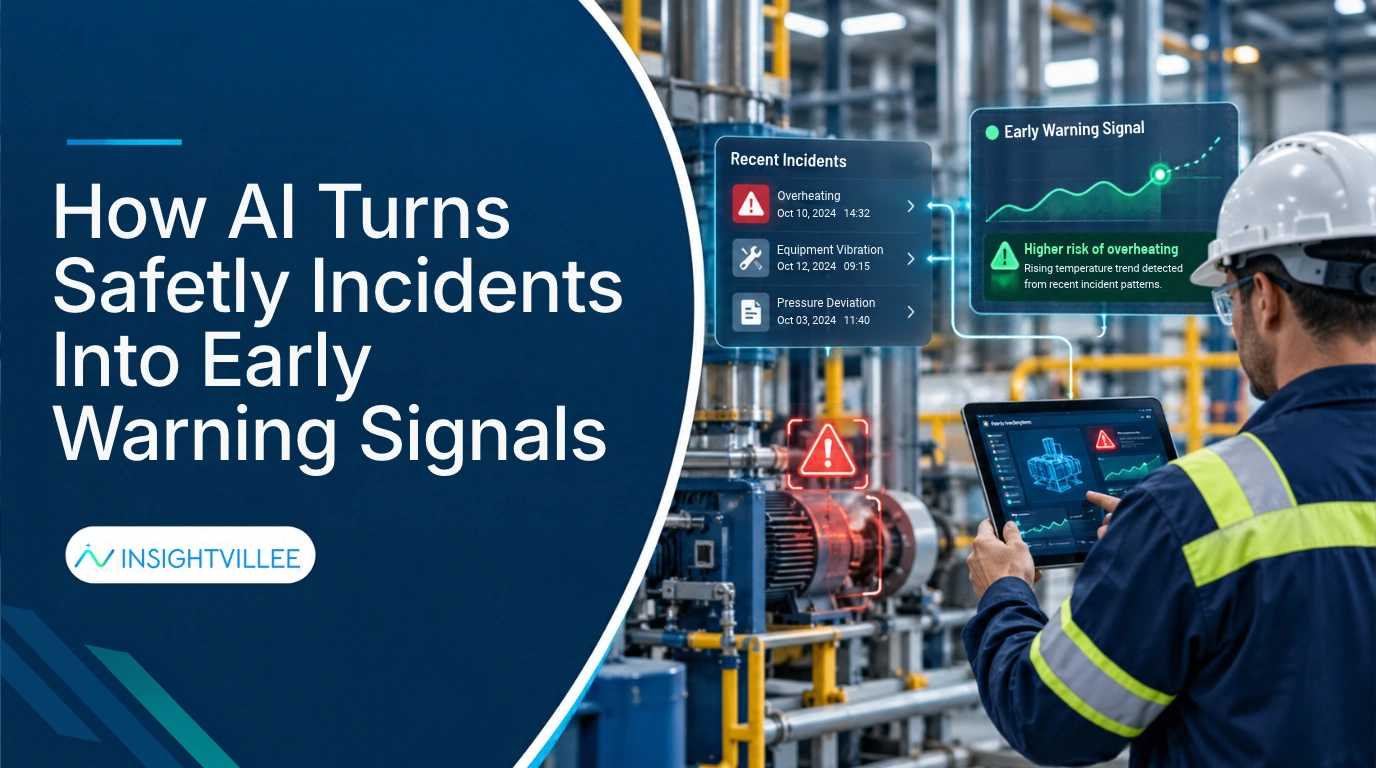
How AI Turns Safety Incidents Into Early Warning Signals
AI turns safety incidents into early warning signals by analysing historical incident reports, near-miss records, and current operating conditions to identify recurring hazards before similar accidents occur.
AI Safety Monitoring helps manufacturing plants recognise patterns involving unsafe equipment interactions, forklift incidents, restricted-area violations, and unresolved safety risks.
By connecting past incidents with current manufacturing activities, safety teams can investigate potential hazards earlier and take preventive action before they result in injuries.
Key Takeaways
- AI turns past safety incidents into early warnings by identifying recurring hazards and comparing them with current plant conditions.
- Traditional incident reviews may miss recurring risks when safety reports are investigated separately.
- Incident reports, near-miss records, equipment details, and corrective-action logs help reveal patterns associated with workplace hazards.
- AI-supported incident analysis groups similar events by location, equipment, activity, and operating conditions.
- Recurring unsafe conditions help safety teams identify areas requiring earlier inspection or stronger controls.
- Connected Industry 4.0 systems link safety information with production, equipment, and maintenance data for better risk investigation.
- Effective prevention requires corrective action, human verification, and continuous monitoring of recurring hazards.
Why Do Safety Incidents Reveal Problems Too Late?
Safety incidents often reveal operational weaknesses only after workers have already been exposed to a hazard.
Traditional safety reviews are essential, but they frequently focus on individual events.
A report may document:
- What happened
- Where it happened
- Who was involved
- Which procedure was followed
- What immediate corrective action was taken
However, an isolated report may not explain whether similar conditions exist elsewhere.
For example, an incident involving a pedestrian and a forklift may be recorded as a vehicle safety problem.
But earlier reports may reveal that the same crossing repeatedly creates visibility issues.
Without connecting these records, the underlying hazard may remain unresolved.
AI near-miss safety detection can provide additional observations of unsafe interactions before injuries occur, helping safety teams recognise hazards that individual incident reports may miss.
What Incident Data Reveals Early Warnings?
Historical safety information can reveal recurring hazards, operating conditions, and unresolved problems associated with previous incidents.
Useful information includes:
- Incident type and severity
- Near-miss reports
- Event location
- Date and shift
- Equipment involved
- Production activity
- Operating conditions
- Investigation findings
- Corrective actions
- Previous hazard observations
These details help safety teams understand whether incidents share underlying causes.
| Historical observation | Potential warning signal |
| Repeated incidents near forklifts | Inadequate vehicle-pedestrian separation |
| Similar injuries during maintenance | Weak equipment isolation procedures |
| Recurring access violations | Inadequate restricted-area controls |
| Multiple incidents during changeovers | Unsafe handover or changeover practices |
| Repeated unresolved hazard reports | Ineffective corrective-action follow-up |
These patterns do not guarantee another incident.
They show where existing safety controls may need attention.
OSHA recommends grouping similar incidents and identifying trends in injuries, illnesses, and reported hazards [OSHA, Hazard Identification and Assessment].
How Does AI Analyse Safety Incidents?
AI can support safety incident analysis by organising historical records, identifying similarities, and highlighting conditions associated with previous hazards.
Industrial safety monitoring becomes more useful when past events are analysed alongside current operating information.
A practical process includes five stages.
1. Collect historical records
Gather available information from:
- Incident investigations
- Near-miss reports
- Safety inspections
- Hazard observations
- Maintenance records
- Corrective-action logs
2. Organise incident information
AI-assisted analysis can help classify reports by incident type, location, equipment, and activity.
This is particularly useful when incident descriptions are written in different formats.
3. Identify recurring conditions
The analysis may reveal similarities that are difficult to recognise through individual reports.
Examples include repeated incidents involving the same equipment, task, or production area.
4. Compare with current conditions
Where current operating information is available, plants can assess whether conditions resemble those associated with earlier incidents.
5. Highlight risks for investigation
Safety teams can review potential warning patterns and determine whether preventive action is necessary.
AI identifies possible relationships. It does not independently establish causation or confirm that an accident will occur.
How Can Past Incidents Warn of Future Risks?
Past incidents become useful early warning signals when manufacturers identify the conditions that contributed to them and check whether those conditions still exist.
Consider a hypothetical manufacturing scenario.
A worker experiences a near miss during maintenance because equipment starts unexpectedly.
The investigation identifies incomplete isolation procedures as a contributing factor.
Later, a safety inspection finds a similar procedural gap on another production line.
The earlier incident becomes a warning because the underlying unsafe condition has appeared again.
The plant can act before another incident occurs.
Other examples include:
- Previous forklift incidents informing reviews of pedestrian crossings
- Repeated access violations prompting checks of restricted-area controls
- Earlier maintenance injuries informing equipment isolation inspections
- Recurring slips prompting investigation of drainage and housekeeping
This approach differs from simply comparing incident counts.
The focus is on recognising previously identified hazards within current operations.
Which Current Conditions Need Attention?
Manufacturers should prioritise current conditions that resemble known hazards, especially when potential consequences are serious or existing controls are ineffective.
Potential warning signs include:
- Repeated exposure to moving machinery
- Unresolved vehicle-pedestrian conflicts
- Incomplete equipment isolation
- Recurring failures to follow critical safety procedures
- Repeated hazards during maintenance activities
- Delayed corrective-action closure
Safety teams should evaluate:
- Potential severity of harm
- Frequency and duration of exposure
- Existing protective controls
- Previous incident findings
- Whether corrective actions remain effective
A risk involving serious potential injury should not be ignored simply because no recent incident has occurred.
Identifying repeating safety risks across shifts helps manufacturers recognise recurring hazardous conditions that may appear during different operating periods, even when individual incidents are recorded separately.
How Can AI Support Earlier Safety Action?
AI-assisted safety analysis can help plant teams prioritise inspections and corrective actions when current conditions resemble previously identified hazards.
Early warning is valuable only when it leads to action.
For example, a plant may identify repeated incidents associated with a particular material-handling operation.
The response may involve:
- Reviewing traffic routes
- Improving physical separation
- Changing equipment movement procedures
- Strengthening access controls
- Checking maintenance arrangements
- Reviewing worker training requirements
Where suitable camera or sensor systems are implemented, current safety observations may provide additional evidence.
However, these systems can only recognise conditions supported by their detection capabilities and available data.
An automated alert should prompt appropriate verification, not replace safety judgement.
OSHA emphasises correcting underlying causes rather than focusing on blame when investigating incidents [OSHA, Incident Investigation].
How Does Industry 4.0 Connect Safety Data?
Connected manufacturing intelligence helps plants review safety incidents alongside equipment, maintenance, and production information.
Historical safety reports may be stored separately from operational records.
This can make it difficult to understand which production conditions contributed to an incident.
Manufacturing companies can use Insightvillee as an AI Industry 4.0 platform to connect existing ERP, MES, SCADA, PLC, sensor, and plant data into one intelligent system.
This creates opportunities to review available safety information alongside:
- Equipment operating conditions
- Production activities
- Maintenance schedules
- Shift information
- Process changes
- Operational abnormalities
For example, incident findings may be more useful when teams understand which equipment was operating and what maintenance activity was taking place.
Connected information provides context for investigation.
It does not automatically establish native accident prediction, camera-based hazard recognition, or automated safety-alert capabilities.
How Does Insightvillee Support Safety Intelligence?
Insightvillee connects manufacturing operations and safety-related information within a broader platform, supporting informed safety and compliance decisions.
As an AI-driven Industry 4.0 platform, Insightvillee gives manufacturing leaders real-time visibility across machines, production lines, and multiple plants.
Its established capabilities include:
- Safety and compliance automation
- Predictive maintenance
- OEE monitoring and improvement
- Multi-plant intelligence
- Smart production planning
These capabilities support a more connected understanding of manufacturing activities and operational conditions.
Where compatible incident records or safety observations are integrated, teams can use that context to support investigations and preventive planning.
Specific AI incident-classification, automated risk-scoring, and visual hazard-detection functions should be verified before being described as native Insightvillee features.
Insightvillee’s automated safety and compliance monitoring capability supports the management of safety-related information within a broader connected manufacturing environment.
How Can Plants Turn Warnings Into Prevention?
Manufacturers can use safety warning signals to identify underlying hazards, strengthen preventive controls, and check whether corrective actions are effective.
A practical response framework includes:
| Step | Recommended action |
| Identify | Recognise patterns linked to previous incidents |
| Verify | Confirm that the current hazard exists |
| Investigate | Review underlying causes and operating conditions |
| Prioritise | Assess severity, exposure, and existing controls |
| Correct | Eliminate or reduce the hazard |
| Communicate | Share findings with affected teams |
| Review | Check whether the risk remains controlled |
Corrective measures should prioritise effective hazard controls.
Training and safety reminders are useful, but they should not replace physical safeguards or safer operating processes where those are needed.
OSHA recommends evaluating both leading and lagging indicators to assess safety programme effectiveness [OSHA, Leading Indicators].
Which Safety Indicators Should Plants Track?
Plant leaders should monitor whether hazards are identified, investigated, and controlled before they cause further incidents.
Useful indicators include:
- Repeat incidents involving the same hazard
- Time taken to investigate reported concerns
- Outstanding corrective actions
- Completion of preventive inspections
- Recurring near-miss observations
- Verified effectiveness of implemented controls
These measures help explain whether the plant is becoming better at preventing incidents.
Incident totals alone may be misleading.
An increase in near-miss reports can reflect improved reporting rather than worsening conditions.
Safety information should therefore be reviewed alongside worker participation, exposure, and corrective-action performance.
The range of safety risks AI can detect depends on available cameras, sensors, system configuration, and the hazards present within the manufacturing environment.
Safety requirements also differ between production environments, making safety applications across manufacturing industries dependent on plant processes, equipment, and operating conditions.
Moving From Incident Reporting to Prevention
Safety incident data becomes more valuable when manufacturers use it to recognise known hazards before similar events occur.
Historical incidents reveal what happened.
Current operating information helps teams understand whether contributing conditions remain present.
AI-assisted analysis can connect these sources, identify recurring warning patterns, and support more informed safety investigations.
However, preventing accidents still depends on effective controls, worker involvement, reliable reporting, and timely corrective action.
The objective is not to predict every accident. It is to recognise preventable risks earlier and respond before they cause harm.