
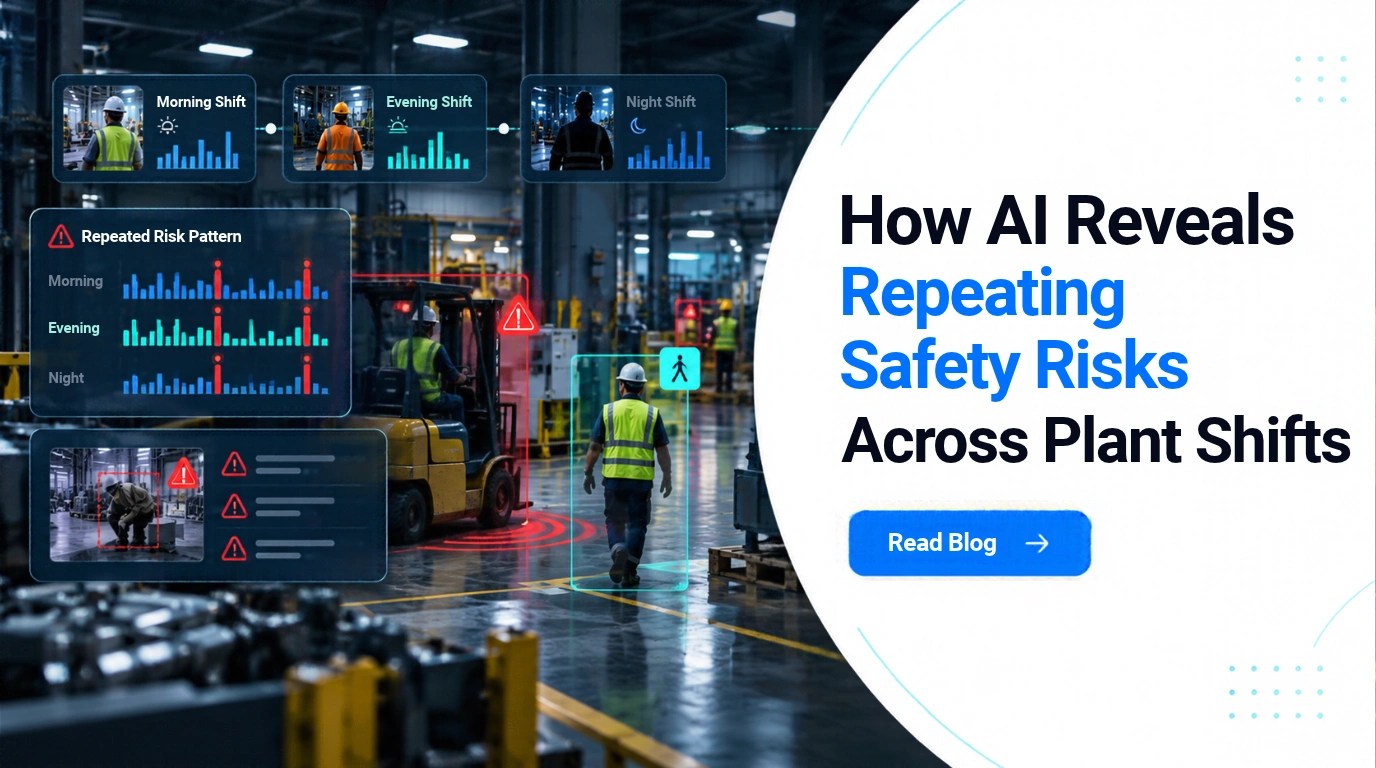
How AI Reveals Repeating Safety Risks Across Plant Shifts
AI reveals repeating safety risks across plant shifts by analysing safety incidents, near-miss reports, inspection findings, and shift-level data to identify recurring hazards across manufacturing operations.
AI Safety Monitoring helps manufacturers recognise patterns such as repeated restricted-area entry, unsafe forklift-pedestrian interactions, PPE violations, and incomplete equipment handovers.
By connecting these observations with production activities, locations, and operating conditions, safety teams can identify unresolved risks and take preventive action before similar incidents occur again.
Key Takeaways
- AI identifies repeating safety risks by analysing safety events across shifts, locations, and operating conditions.
- Unresolved hazards, incomplete handovers, and inconsistent procedures allow safety risks to recur across shifts.
- Restricted-area violations, PPE issues, unsafe machine proximity, and forklift interactions are common recurring safety concerns.
- Comparing shift-level safety data helps identify recurring hazards while accounting for differences in worker exposure and reporting.
- AI-supported safety analysis helps locate high-risk areas where similar unsafe events repeatedly occur.
- Connected Industry 4.0 systems link safety information with production activity and equipment conditions for better risk investigation.
- Corrective actions and follow-up monitoring help manufacturers address underlying hazards and assess whether risks continue.
Why Do Safety Risks Repeat Across Shifts?
Safety risks can repeat across production shifts when underlying hazards remain unresolved or important safety information is not communicated consistently.
A restricted area may be entered repeatedly. Forklift routes may create unsafe pedestrian interactions. Equipment handovers may leave workers unaware of changing conditions.
Common reasons include:
- Incomplete shift handovers
- Inconsistent safety procedures
- Unresolved workplace hazards
- Limited communication between teams
- Different operating conditions
- Repeated unsafe work practices
Manual safety reports may record individual events without revealing their connection.
The UK Health and Safety Executive highlights effective shift handover as essential for communicating information needed for safe operations [HSE, Shift Handover].
Patterns identified through AI near-miss detection become more useful when similar unsafe interactions are compared across shifts, revealing hazards that may remain unresolved despite individual incident investigations.
Which Safety Risks Commonly Repeat?
Recurring workplace safety risks may involve restricted-area access, PPE violations, unsafe equipment proximity, vehicle interactions, and shift handover gaps.
| Recurring safety risk | Potential concern |
| Restricted-area entry | Exposure to hazardous machinery |
| Missing protective equipment | Increased injury exposure |
| Unsafe machine proximity | Contact with moving equipment |
| Forklift-pedestrian interaction | Potential vehicle collision |
| Incomplete equipment handover | Workers unaware of operating hazards |
| Repeated unsafe crossings | Inadequate traffic separation |
Restricted-area violations
Workers may repeatedly enter hazardous areas because access controls or working procedures are inadequate.
PPE compliance issues
Repeated missing or incorrect PPE may indicate problems with availability, training, task requirements, or supervision.
Vehicle and pedestrian risks
Unsafe interactions can recur around loading areas, warehouse intersections, and material-handling routes.
Shift handover problems
Maintenance activities, equipment restrictions, and unfinished tasks may not be communicated effectively.
These observations help identify where safety controls require improvement.
How Does AI Identify Repeating Safety Risks?
AI-supported safety analysis can identify recurring risks by organising detected or reported events according to type, location, shift, and operating conditions.
Depending on the available technology, information may come from:
- AI-enabled cameras
- Connected safety sensors
- Incident reports
- Near-miss records
- Safety inspection findings
- Production and shift records
AI-supported analysis can help group comparable events and highlight recurring patterns.
A typical process includes:
- Collect events: Record available safety observations and incident information.
- Classify risks: Group events by hazard type.
- Connect shifts: Associate events with relevant working periods.
- Compare locations: Identify areas reporting repeated concerns.
- Review conditions: Examine related activities and operating circumstances.
- Highlight patterns: Present recurring issues for safety investigation.
For example, repeated forklift proximity events during material transfer may indicate an unsafe traffic arrangement.
However, a camera detection is not automatically proof of a safety violation or near miss.
Human verification remains important.
How Can Plants Compare Safety Across Shifts?
Shift-wise safety analysis helps manufacturers understand whether similar hazards occur under different working conditions and where preventive controls may be insufficient.
Comparing morning, evening, and night shifts can reveal patterns that individual reports may miss.
Useful comparisons include:
- Type of reported safety event
- Event location
- Production activity
- Equipment operating status
- Shift handover period
- Exposure hours
- Relevant task frequency
For example:
| Safety observation | Possible investigation |
| Repeated unsafe crossings during the evening shift | Traffic routes and material movement |
| More equipment access concerns during changeovers | Handover and isolation procedures |
| PPE issues during maintenance activities | Task-specific PPE requirements |
| Similar hazards across all shifts | Plant-wide control weaknesses |
Event counts should be interpreted alongside exposure.
A shift with more workers, greater vehicle movement, or longer operating hours may naturally record more events.
Differences in reporting practices can also affect the results.
Manufacturers should avoid treating higher event counts as automatic evidence that one shift is less safe.
How Does AI Locate High-Risk Areas?
Safety analytics can identify locations where similar incidents or unsafe conditions recur, helping plant teams focus investigations on persistent hazards.
Recurring events may appear around:
- Forklift intersections
- Conveyor access points
- Loading and unloading zones
- Maintenance areas
- Restricted machinery sections
- Shift changeover locations
AI-supported manufacturing safety pattern detection can help connect repeated observations with these locations.
For example, repeated pedestrian proximity concerns at a warehouse crossing may indicate that existing traffic controls are inadequate.
The corrective action could involve:
- Physical separation barriers
- Changes to vehicle routes
- Improved pedestrian crossings
- Better visibility
- Revised material-handling procedures
The objective is to correct the underlying hazard rather than simply record more violations.
Treating recurring safety incidents as early warning signals helps teams recognise familiar hazardous conditions and prioritise preventive action before similar incidents occur.
Why Does Industry 4.0 Matter for Safety Analysis?
Connected manufacturing intelligence helps plants examine recurring safety events alongside production activity, equipment information, and shift conditions.
Safety reports, machine records, inspection findings, and production information may be stored in separate systems.
This makes it harder to recognise relationships between operating conditions and reported hazards.
Manufacturing companies can use Insightvillee as an AI Industry 4.0 platform to connect existing ERP, MES, SCADA, PLC, sensor, and plant data into one intelligent system.
Connected operational information can provide useful context for reviewing:
- Shift activities
- Machine operating conditions
- Maintenance periods
- Production changes
- Available safety and compliance records
This broader context can help manufacturers investigate why recurring risks appear during particular activities.
Camera-based recognition and automatic safety-event detection require specific supported integrations and capabilities. They should not be assumed from plant-system connectivity alone.
How Does Insightvillee Support Safety Intelligence?
Insightvillee connects manufacturing operations and safety-related information to support better visibility into plant conditions and compliance activities.
As an AI-driven Industry 4.0 platform, Insightvillee gives manufacturing leaders real-time visibility across machines, production lines, and multiple plants.
Its established capabilities include:
- Safety and compliance automation
- Predictive maintenance
- OEE monitoring and improvement
- Multi-plant intelligence
- Smart production planning
These capabilities position safety information within a broader manufacturing operations environment.
Where compatible safety-event data is available, connecting it with operational context may support investigation of recurring risk patterns.
Insightvillee’s verified capabilities do not, by themselves, establish native AI camera surveillance, automatic PPE recognition, or real-time worker proximity alerts.
Insightvillee’s Safety and Compliance monitoring capability forms part of its broader connected manufacturing environment, supporting the use of available safety information alongside equipment conditions and plant operations.
How Can Plants Prevent Repeated Safety Risks?
Manufacturers can reduce recurring safety risks by identifying common causes, improving controls, and reviewing whether corrective actions prevent similar events.
A practical response process includes:
| Step | Recommended action |
| Identify | Find recurring safety patterns |
| Verify | Confirm reported or detected events |
| Investigate | Examine hazards and contributing conditions |
| Prioritise | Consider potential severity and exposure |
| Correct | Improve physical and operational controls |
| Communicate | Share findings across relevant shifts |
| Review | Check whether similar risks continue |
Corrective action should address the cause, not only the observed behaviour.
For example, repeated unsafe crossings may require improved pedestrian routes rather than repeated safety reminders.
OSHA recommends investigating incidents and near misses to identify underlying hazards and prevent recurrence [OSHA, Hazard Identification and Assessment].
Training remains useful, but it should complement effective physical and operational safeguards.
What Should Plants Measure After Corrective Action?
Plants should assess whether corrective measures reduce hazardous conditions and whether reporting remains consistent across shifts.
Useful measures include:
- Recurrence of the same hazard
- Event frequency relative to exposure
- Closure of corrective actions
- Repeated findings at the same location
- Worker-reported safety concerns
- Compliance with revised procedures
A reduction in reported incidents does not automatically prove improved safety.
Lower counts may also reflect reduced reporting or incomplete detection.
Worker participation and reporting should remain encouraged.
OSHA emphasises that employees should be able to report workplace concerns without fear of retaliation [OSHA, Worker Participation].
Safety expectations also vary between industries.
The range of manufacturing safety risks AI can detect depends on the available cameras, sensors, detection capabilities, and hazards present within each production environment.
These differences also influence manufacturing industry safety use cases, since chemical plants, automotive facilities, and other manufacturing environments may require different preventive controls.
Turning Repeated Risks Into Safer Operations
Recurring safety patterns become valuable when manufacturers use them to identify unresolved hazards and improve preventive controls across shifts.
AI-supported analysis can help organise safety information and highlight patterns that deserve investigation.
However, technology cannot replace worker reporting, supervisor judgement, physical safeguards, or formal safety procedures.
The goal is to recognise repeated hazards, understand why they occur, and take corrective action before another incident develops.
Connected operational intelligence can support this approach by giving plant leaders a clearer understanding of safety risks across manufacturing activities.