
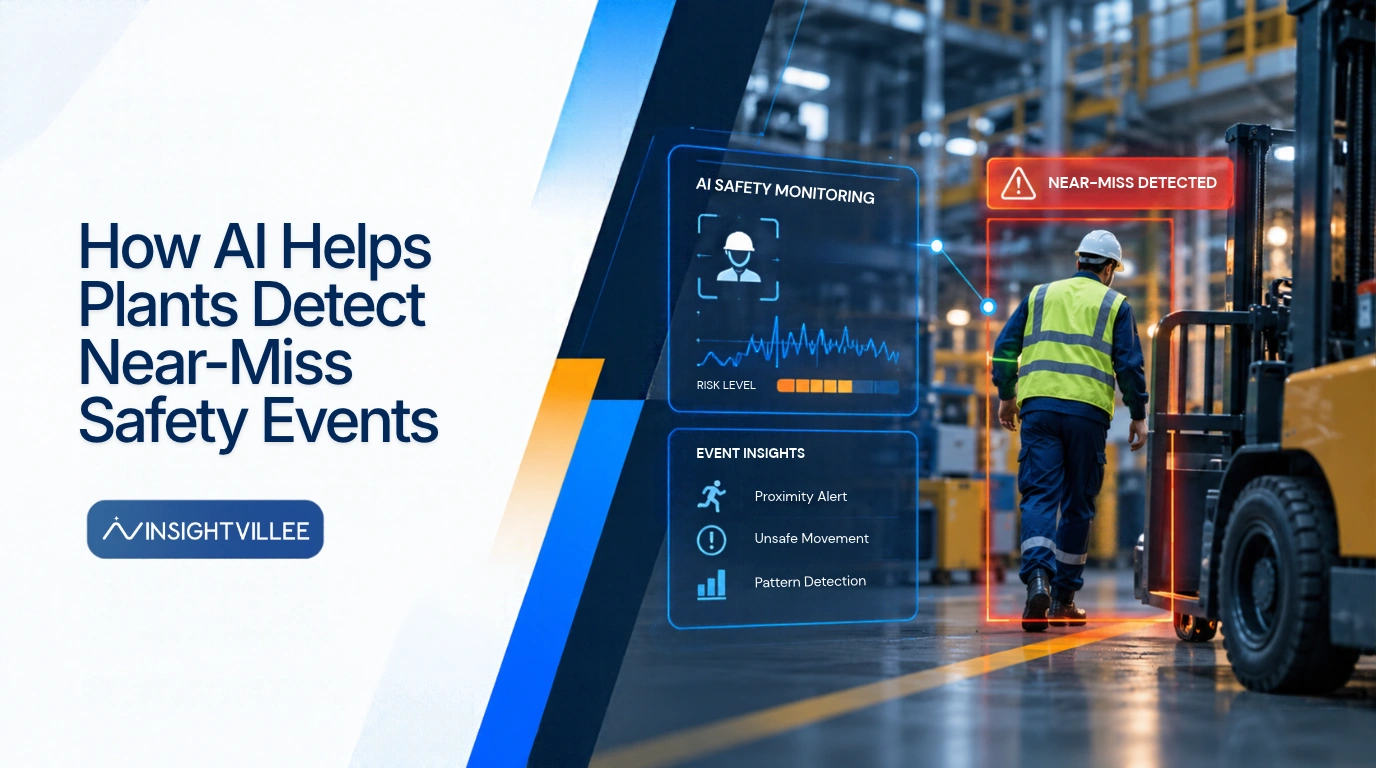
How AI Helps Plants Detect Near-Miss Safety Events
AI helps manufacturing plants detect potential near-miss safety events by analysing camera feeds, sensor data, and predefined safety rules to identify unsafe interactions between workers, vehicles, and machinery.
AI Safety Monitoring can highlight restricted-area entry, unsafe machine proximity, and dangerous forklift-pedestrian interactions that might otherwise go unnoticed.
These detections help safety teams investigate hazards earlier, identify recurring risks, and take preventive action. However, AI-generated alerts require human verification before an event can be confirmed as a near miss.
Key Takeaways
- AI detects potential near-miss events by analysing camera and sensor data for predefined unsafe conditions.
- Near misses often go unnoticed because they cause no immediate injuries, damage, or production interruptions.
- Restricted-area entry, unsafe machine proximity, and forklift-pedestrian interactions are potential AI detection applications.
- Computer vision systems identify visible safety risks and flag unusual interactions for human review.
- Recurring safety-event patterns can reveal hazardous locations, unsafe practices, and shift-level risks.
- AI safety monitoring supports early warnings by helping teams identify hazards before accidents occur.
- Human verification remains essential because AI cannot reliably detect every near miss or confirm every flagged event.
Why Do Near-Miss Events Go Unnoticed?
Near-miss safety events often go unnoticed because they do not cause immediate injuries, equipment damage, or production interruptions.
A near miss occurs when an event could have caused harm but did not.
Examples include:
- A forklift narrowly missing a pedestrian
- A worker almost contacting moving equipment
- An object falling close to an employee
- A person entering a hazardous area during operation
- A worker narrowly avoiding an unexpected machine movement
Not every unsafe condition is a near miss. Some are hazards that could lead to one.
Traditional safety monitoring depends heavily on:
- Supervisor observations
- Worker reporting
- Routine inspections
- Incident records
- Safety audits
These methods remain essential but may not capture every unsafe interaction.
When minor events go unreported, manufacturers can lose valuable information about developing workplace risks.
The European Agency for Safety and Health at Work identifies near-miss reporting and analysis as opportunities to improve preventive safety measures [EU-OSHA, 2025].
Which Near-Miss Risks Can AI Identify?
AI can help identify visible unsafe interactions involving workers, vehicles, machinery, and restricted areas when suitable cameras or sensors are available.
Potential applications include:
1. Workers Entering Restricted Areas
Camera-based systems can be configured to identify people entering predefined hazardous zones.
Examples include:
- Robot operating areas
- Restricted production sections
- Material-handling zones
- Machinery exclusion areas
These events may indicate unsafe access or a potential exposure to danger.
2. Unsafe Machine Proximity
AI can help identify when workers move close to operating equipment or enter defined machine safety boundaries.
Detection depends on camera placement, visibility, and the configured safety rules.
3. Forklift and Pedestrian Interactions
AI-supported monitoring can help identify unsafe distances between moving vehicles and pedestrians.
It may highlight potentially dangerous interactions at:
- Warehouse intersections
- Loading areas
- Material transfer routes
- Production-floor crossings
4. Missing Protective Equipment
Where suitable visual detection is implemented, AI can identify visible PPE compliance issues.
Examples include missing helmets or high-visibility clothing in designated areas.
Missing PPE is a safety violation or hazard indicator, not automatically a near-miss event.
5. Unsafe Movements Around Machinery
Certain visible activities may indicate unsafe operating conditions.
These include entering an equipment danger zone or approaching a moving vehicle too closely.
| Observable event | Potential safety concern |
| Worker inside restricted zone | Exposure to machinery hazards |
| Forklift close to pedestrian | Potential vehicle collision |
| Missing required PPE | Increased exposure to injury |
| Worker near moving equipment | Possible contact hazard |
| Repeated unsafe crossings | Inadequate traffic separation |
These are examples of what appropriately configured AI safety systems may detect, not a claim that every system supports every capability.
How Does AI Detect Near-Miss Events?
AI-based near-miss detection analyses available visual or sensor information to identify predefined unsafe situations and flag events for safety review.
Camera-based detection commonly involves several steps.
1. Capture Safety Information
Cameras observe selected production areas, vehicle routes, or restricted zones.
Additional sensors may provide equipment status or operating information.
2. Identify Relevant Objects
Computer vision can recognise visible objects such as:
- Workers
- Forklifts
- Moving vehicles
- Machinery
- Restricted-area boundaries
- Selected protective equipment
3. Evaluate Safety Conditions
The system compares observed activity against configured safety rules.
For example, it may evaluate whether a pedestrian has entered a restricted vehicle movement area.
4. Highlight Potential Risks
When a configured condition is violated, the system may generate an event record or alert.
5. Support Human Verification
Safety teams review the event to determine:
- Whether an actual near miss occurred
- Whether the detection was accurate
- Which operating conditions contributed
- Whether corrective action is necessary
A detected safety-rule violation is not automatically a confirmed near miss.
Camera position, lighting, obstructions, and visual ambiguity can affect detection accuracy.
How Does AI Identify Repeating Safety Risks?
AI-supported event analysis can help manufacturers recognise recurring unsafe conditions across production areas, operating periods, and shifts.
An individual event may appear minor.
Repeated events at the same location can reveal a broader operational problem.
For example:
- Workers repeatedly entering a restricted zone
- Frequent pedestrian movement near forklift routes
- PPE violations occurring during specific activities
- Unsafe interactions during material transfer
- Repeated hazardous movements during shift changes
Patterns become more useful when events are reviewed alongside operational information.
| Recurring pattern | What safety teams should investigate |
| Unsafe crossings near forklifts | Pedestrian route design |
| Repeated restricted-zone entry | Access controls and work procedures |
| Recurring PPE violations | PPE availability and task requirements |
| Unsafe activity during changeovers | Changeover planning and supervision |
| Similar events across shifts | Shared hazards or inconsistent controls |
Identifying repeating safety risks across plant shifts helps safety teams recognise unresolved hazards that may remain hidden when incidents are recorded and investigated separately.
OSHA recommends grouping similar incidents and analysing trends to identify recurring hazards [OSHA, Hazard Identification and Assessment].
How Can AI Support Early Safety Warnings?
AI can support earlier hazard recognition by identifying observable risk conditions before they result in injury.
Near-miss information becomes useful when safety teams connect detections with preventive action.
A practical process includes:
- Identify a potentially unsafe event.
- Verify what happened.
- Review the location and operating conditions.
- Determine the underlying hazard.
- Assess the possible consequences.
- Implement appropriate safety controls.
- Monitor whether similar events recur.
For example, repeated close interactions between workers and forklifts may indicate that pedestrian routes are poorly separated.
The corrective action may involve redesigning traffic routes, improving physical barriers, or changing material movement procedures.
The objective is not simply to record unsafe events.
It is to remove or control the hazards behind them.
Using safety incidents as early warning signals helps plant teams connect previous incidents with recurring hazardous conditions and take preventive action before similar events cause harm.
How Does Industry 4.0 Connect Safety Information?
Industry 4.0 platforms can connect safety information with manufacturing operations, giving plant leaders additional context for investigating recurring risks.
Safety information often exists across separate sources.
These may include incident reports, inspection records, production systems, equipment information, and available sensor data.
When these sources are disconnected, understanding where and why incidents occur can require manual investigation.
Manufacturing companies can use Insightvillee as an AI Industry 4.0 platform to connect existing ERP, MES, SCADA, PLC, sensor, and plant data into one intelligent system.
This connected approach supports analysis of:
- Safety observations and reported incidents
- Production activities
- Machine operating conditions
- Shift-level information
- Maintenance and operational records
Where compatible safety-detection information is available and integrated, it may also contribute to broader operational risk analysis.
Connecting plant information does not, by itself, establish camera-based near-miss detection capability.
How Does Insightvillee Support Near-Miss Safety Risk Management?
Insightvillee supports connected safety and compliance intelligence within a broader manufacturing operations platform.
As an AI-driven Industry 4.0 platform, Insightvillee gives manufacturing leaders real-time visibility across machines, production lines, and multiple plants.
Its established capabilities include:
- Safety and compliance automation
- OEE monitoring and improvement
- Predictive maintenance
- Multi-plant intelligence
- Smart production planning
These capabilities support a more connected understanding of operational conditions and safety-related information.
For near-miss detection specifically, camera-based recognition, worker proximity detection, and automatic visual alerts would need to be confirmed as supported capabilities before being presented as native Insightvillee features.
Insightvillee’s AI-powered safety and compliance monitoring capabilities help position safety-related information within a broader view of manufacturing operations, equipment conditions, and plant performance.
The main objective is to connect relevant safety information with manufacturing activity so plant teams can make more informed risk-management decisions.
How Can Plants Act on Near-Miss Findings?
Manufacturers can improve workplace safety by investigating potential near misses, correcting recurring hazards, and verifying whether preventive actions are effective.
A useful process includes:
| Step | Recommended action |
| Detect | Identify potential unsafe events |
| Verify | Confirm the event and circumstances |
| Investigate | Determine contributing hazards |
| Prioritise | Assess severity and likelihood |
| Correct | Improve safety controls and procedures |
| Review | Check whether the risk recurs |
Corrective actions may include:
- Improving physical separation between pedestrians and vehicles
- Strengthening machinery access controls
- Updating operating procedures
- Improving worker safety training
- Reviewing equipment movement routes
- Correcting unsafe working conditions
Manufacturers should also consider the safety requirements of their production processes.
A chemical plant, automotive facility, battery manufacturing unit, and food processing plant may face different operational hazards.
These differences make safety requirements across manufacturing industries important when selecting appropriate controls for specific production environments and operating conditions.
What Are the Limits of AI Near-Miss Detection?
AI cannot identify every near-miss event because detection depends on the available information, system design, and the type of hazard involved.
Important limitations include:
- Cameras cannot reliably identify events outside their field of view.
- Machinery or other objects may block visibility.
- Poor lighting can affect visual recognition.
- Some hazards have no visible warning signs.
- A detected unsafe condition may not be an actual near miss.
- False alerts and missed detections remain possible.
AI monitoring should therefore complement, not replace:
- Human supervision
- Worker reporting
- Physical safety controls
- Routine inspections
- Incident investigations
- Established emergency procedures
Safety systems should be evaluated under actual plant conditions before operational reliance.
Turning Near-Miss Detection Into Prevention
Near-miss information becomes valuable when manufacturers use it to identify recurring hazards and prevent similar situations from developing into accidents.
The priority should be understanding why potentially dangerous interactions occur.
AI-supported detection can provide additional observations, while safety teams remain responsible for verification, investigation, and corrective action.
Connected operational information can make these investigations more informed and help manufacturers strengthen long-term industrial safety practices.