
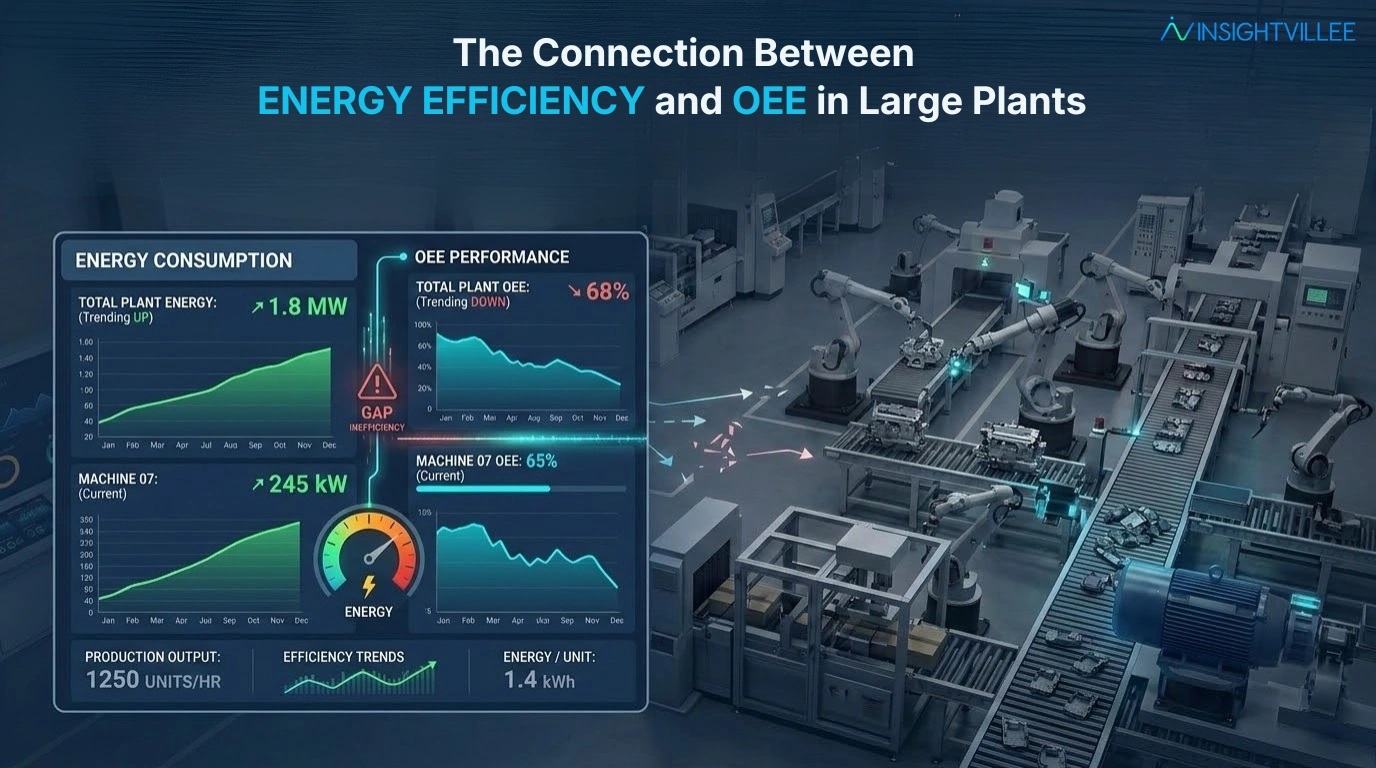
Why Energy Efficiency and OEE Should Be Looked at Together
Energy efficiency and OEE should be looked at together because a plant can appear productive while still wasting energy, or appear energy-efficient while losing output.
In many large plants, production teams review OEE and utility teams review energy consumption separately. This creates a blind spot. A line may show acceptable OEE, but energy per unit may rise because machines are running idle, cycles are slow, or rework is increasing.
The industrial sector accounted for 37% of global energy use in 2022 [IEA, 2023]. Industry electricity use also grew by nearly 4% in 2024 [IEA, 2025]. For large manufacturing plants, energy is not a side cost. It is directly linked to production efficiency.
The Connection Between Energy Efficiency and OEE in Large Plants
Key insight: OEE shows how effectively equipment produces output. Energy efficiency shows how much energy is consumed to produce that output. Both must be read together.
What Is OEE ?
OEE means how effectively a machine or line uses planned production time to make good output.
OEE has three parts: availability, performance, and quality. Availability shows whether the machine was running when planned. Performance shows whether it ran at the expected speed. Quality shows whether the output was good the first time [OEE.com, 2025].
For example, a line may be scheduled for eight hours. If it stops for breakdowns, availability drops. If it runs slower than standard cycle time, performance drops. If it produces rejected units, quality drops.
Plant leaders use OEE because it converts downtime, speed loss, and rejection into one operating view. But OEE alone does not always show whether the plant used energy efficiently during that time.
Key insight: OEE tells you how much productive time you achieved. It does not automatically tell you how much energy you wasted to achieve it.
3. What Is Energy Efficiency in Manufacturing?
Energy efficiency in manufacturing means producing the required output with less wasted energy.
This does not only mean reducing electricity bills. It means understanding whether machines, utilities, furnaces, compressors, boilers, HVAC systems, and production lines are consuming energy in proportion to actual output.
ISO 50001 provides a framework for improving energy performance through a structured energy management system [ISO, 2025]. The U.S. Department of Energy also recommends using energy performance indicators that reflect plant, line, or process-level energy performance [U.S. DOE, 2025].
A practical metric is energy per unit. For example, kWh per vehicle, kWh per tonne, kWh per batch, or steam per unit produced. This helps teams see whether energy use is rising because output is lower, equipment is inefficient, or scheduling is poor.
Key insight: energy efficiency is not only about consuming less energy. It is about consuming the right amount of energy for the output produced.
4. How Energy Efficiency Affects OEE
Why Poor Energy Usage Often Shows Hidden Production Losses
Poor energy usage often shows hidden production losses because machines may consume power even when useful output is low.
Consider a plant where a line runs below planned speed for three hours. The machines, conveyors, compressed air system, lighting, and utilities still consume energy. OEE may show performance loss. Energy data may show higher energy per unit. Together, they reveal that the plant paid more energy cost for less output.
A common pattern in manufacturing plants is that energy waste follows operational instability. Frequent stops, slow cycles, rework, and waiting time increase energy consumption per good unit.
ENERGY STAR states that plant energy performance indicators help manufacturers benchmark energy performance and optimize energy efficiency for their operations [ENERGY STAR, 2025].
[Link: 7 Hidden Links Between Energy Waste and OEE Loss in Large Plants
Key insight: when energy per unit rises, it often points to a production problem, not only an energy problem.
How Low OEE Increases Energy Cost
Machines Consume Power Even When Output Is Low
Low OEE increases energy cost because many machines and utilities continue consuming power even when output drops.
For example, a paint line may slow down due to quality checks. The oven may still run. The ventilation system may still operate. The conveyor may still move intermittently. The compressor may still support line pressure. But fewer good units are produced.
In this situation, total energy consumption may not fall in proportion to output. Energy per good unit increases. The plant spends more energy to produce each saleable unit.
This is common in energy-intensive plants such as chemicals, paints, automotive, FMCG, and battery manufacturing. In the U.S., energy-intensive manufacturing subsectors such as chemicals, petroleum and coal products, paper, primary metals, food, and nonmetallic minerals accounted for 97% of manufacturing energy use in 2022 [EIA, 2022].
Key insight: low OEE does not only reduce production output. It also increases the energy cost of every good unit produced.
Common Reasons Energy and OEE Do Not Match
Energy and OEE do not match when machines consume energy without producing good output at the planned rate.
Common reasons include idle running, slow cycles, minor stoppages, rework, breakdown losses, poor batch sequencing, unnecessary peak demand, and poor start-stop discipline.
For example, a compressor may run at high load because air leaks are ignored. A furnace may remain heated during production gaps. A packaging line may run slower due to repeated adjustments. Each issue affects either OEE, energy efficiency, or both.
Production teams often focus on output recovery. Energy teams focus on consumption. The missed opportunity is the connection between the two.
Key insight: the same root cause can reduce OEE and increase energy waste at the same time.
What Large Plants Should Track Together
Large plants should track energy and production metrics together to understand the real cost of performance loss.
Important metrics include energy per unit, machine runtime, planned production time, downtime, cycle time, rejection, rework, line output, specific energy consumption, peak demand, and asset utilisation.
Energy per unit is especially useful because it connects energy consumption with actual production volume. The U.S. DOE recommends selecting energy performance indicators that effectively show energy performance for a plant, line, or process [U.S. DOE, 2025].
For example, if energy per unit rises during a shift, teams should not only ask whether energy use increased. They should also ask whether output dropped, rejection increased, or machines ran idle.
Key insight: energy performance becomes useful when it is connected to production conditions.
Why Manual Reports Miss the Real Connection
Manual reports miss the real connection because they usually show energy and production performance after the shift, day, or month is over.
In many plants, energy teams prepare utility reports. Production teams prepare OEE reports. Quality teams prepare rejection reports. These reports are reviewed separately. By then, the chance to correct the issue during production is gone.
A common scenario involves high energy consumption during a night shift. The utility report shows higher kWh. The production report shows lower output. The quality report shows more rework. But unless these are connected, teams may not identify the real cause.
Key insight: separate reports create separate discussions. Connected visibility creates faster decisions.
How Real-Time Manufacturing Intelligence Helps
Connecting Energy Data With Machine and Production Performance
Real-time manufacturing intelligence helps by connecting energy data with machine status, production output, downtime, and quality performance.
Instead of only showing total energy consumption, it helps teams understand when energy was consumed, which line was running, what output was produced, and whether the machine was operating efficiently.
Insightvillee fits into this category as a manufacturing intelligence platform. It helps plant teams connect machine, production, and energy data into one operational view. In relevant deployments, Insightvillee has recorded 15 to 20% energy savings and 15% OEE improvement. These are deployment-specific outcomes, not universal guarantees.
The value is not only monitoring. The value is turning energy and production data into better shift-level decisions.
10. Practical Steps to Improve Both OEE and Energy Efficiency
Simple Actions Plant Teams Can Start With
Plant teams can improve both OEE and energy efficiency by finding where energy is consumed without good output.
Start with these practical steps:
- Track energy per unit by line, shift, and product.
- Compare OEE loss with energy per unit changes.
- Review idle running time on critical machines.
- Check energy use during breakdowns and changeovers.
- Track rework energy separately where possible.
- Identify peak demand events linked to poor scheduling.
- Review top five machines with high energy use and low output.
Plant Heads should ask one simple question: where are we consuming energy without producing saleable output?
That question usually reveals the biggest improvement opportunities.
Conclusion
Better Energy Visibility Helps Improve Plant Performance
Better energy visibility helps improve plant performance because it shows where output loss and energy waste are connected.
Large plants cannot treat OEE and energy efficiency as separate topics. A line that runs slowly, stops often, or produces rework will usually consume more energy per good unit. A plant that only tracks total energy cost may miss the production reason behind the increase.
Beyond Prediction: Closing the Execution Gap in Manufacturing Operations
The next stage of manufacturing performance is not only improving OEE or reducing energy bills separately. It is connecting both so teams can make faster and better operational decisions.
Insightvillee supports this direction by helping manufacturers turn production and energy visibility into practical plant-level intelligence.