
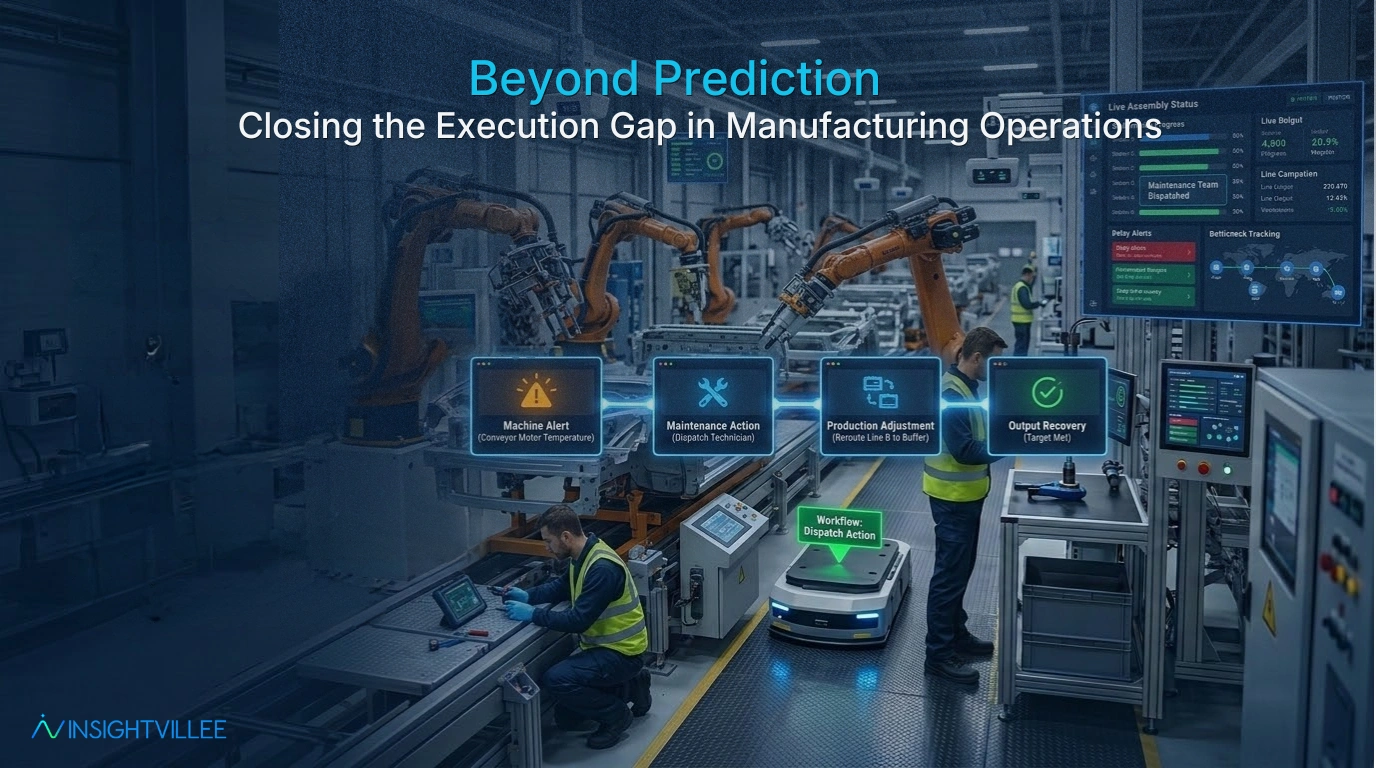
Why Prediction Alone Does Not Improve Factory Performance
Prediction alone does not improve factory performance because knowing a problem early is not the same as fixing it on time.
Many large plants already receive machine alerts, downtime reports, energy dashboards, and quality warnings. Yet the same losses continue. A compressor shows abnormal vibration. A line runs below planned speed. A furnace consumes more energy than usual. The signal is visible, but action is delayed.
This is the uncomfortable reality. Many factories do not lose production because nobody knew there was a problem. They lose production because the right action did not happen fast enough.
Siemens reported that one unproductive hour can cost automotive manufacturers around $2.3 million [Siemens, 2024]. The number will differ by industry and plant size, but the operating pressure is clear. Delayed action turns early warning into lost output.
What Is the Execution Gap in Manufacturing?
Understanding the Gap Between Knowing the Problem and Fixing It
The execution gap in manufacturing is the distance between identifying a problem and completing the corrective action on the shop floor.
A plant may know that a machine is slowing down. It may know that quality rejection is rising. It may know that energy consumption is above the normal range. But unless someone owns the action, prioritises it, follows up, and verifies closure, the insight does not improve performance.
One of the most common patterns observed in manufacturing plants is that teams have enough reports, but not enough clarity on what to do next.
For example, a predictive alert may show that a motor is likely to fail. Maintenance receives the alert. Production wants to continue because customer dispatch is urgent. Planning does not know whether to stop the line now or wait for the next window. The alert is correct, but the decision is delayed.
This is the execution gap.
Why Predictions Often Fail on the Shop Floor
Alerts, Reports, and Dashboards Do Not Always Lead to Action
Predictions often fail on the shop floor because alerts, reports, and dashboards do not automatically create ownership or action.
A dashboard can show downtime trends. An alert can show an abnormal condition. A report can show that OEE dropped last week. But these signals are only useful if teams know who must act, what must be done, and how urgent the issue is.
Many manufacturers discover that prediction without action design creates alert fatigue. Teams receive too many signals. Some are urgent. Some are informational. Some repeat every day. Over time, people stop treating alerts as decision triggers.
Why Machine Alerts Alone Still Cost Large Plants Production Hours
Research from NIST found that manufacturers relying more on preventive and predictive maintenance had 52.7% less unplanned downtime and 78.5% fewer defects compared with heavier reactive maintenance users [NIST, 2021]. The lesson is clear. Prediction helps only when it changes maintenance behaviour.
Key insight: a prediction is not an outcome. It becomes valuable only when it leads to timely action.
Where the Execution Gap Usually Happens
Maintenance, Production, Quality, Energy, and Safety Teams
The execution gap usually happens between departments because each team sees only part of the problem.
Maintenance may see equipment risk. Production may see output pressure. Quality may see rising defects. Energy teams may see higher consumption. Safety teams may see unsafe workarounds. Each view is valid, but no single team has the full operational picture.
A common scenario involves a packaging line running below target speed. Production sees missed output. Maintenance sees no major breakdown. Quality sees more rework. Energy teams see higher consumption per unit. The root cause may be minor stoppages and frequent adjustments at one station.
If these signals remain separate, teams debate symptoms instead of solving the cause.
Deloitte noted that manufacturers continue to face supply chain risks, delays, and elevated costs [Deloitte, 2025]. In this environment, slow internal execution becomes even more costly because plants have less room for lost capacity.
Key insight: the execution gap is often not a knowledge problem. It is a coordination problem.
What Happens When Execution Is Delayed
Downtime, Missed Targets, Rework, Energy Loss, and Customer Delays
When execution is delayed, small problems turn into measurable business losses.
A machine that could have been serviced during a planned window fails during production. A quality issue that started at one station spreads across multiple batches or units. An energy anomaly that could have been corrected during the shift becomes a monthly cost variance. A safety risk that was visible remains open because follow-up was unclear.
In practice, the biggest challenge is often not the first loss. It is the repeated loss. The same stoppage happens every shift. The same rework reason appears every week. The same equipment consumes extra energy every month.
McKinsey has reported that advanced manufacturing use cases can improve efficiency when data is connected to operational changes, not just collected for visibility [McKinsey, 2022].
Key insight: delayed execution makes problems look normal because teams get used to seeing the same losses again and again.
Why Teams Struggle to Act on Predictions
Unclear Ownership, Slow Communication, Manual Follow-Ups, and Siloed Data
Teams struggle to act on predictions because responsibilities, priorities, and follow-ups are often unclear.
An alert may be visible, but who owns it? Maintenance, production, quality, utilities, or planning? If the issue affects all teams, it can remain stuck between them.
Manual follow-up makes the problem worse. Supervisors call maintenance. Maintenance checks availability. Production waits for approval. The issue moves through phone calls, WhatsApp messages, Excel trackers, and shift handover notes. By the time action starts, the loss has already grown.
5 Reasons Predictive Alerts Alone Do Not Stop Production Loss
High-performing manufacturers typically do three things differently. They assign ownership quickly. They rank issues by production impact. They track closure until the action is completed.
Key insight: prediction without ownership creates awareness, not improvement.
What Manufacturing Operations Need Beyond Prediction
Clear Actions, Priority, Responsibility, and Real-Time Tracking
Manufacturing operations need clear actions, priority, responsibility, and real-time tracking beyond prediction.
Plant teams do not need more alerts. They need fewer open questions. What is the risk? What is the impact on output, quality, energy, or safety? Who must act? What is the recommended action? When must it be completed? Has it been closed?
This is where data must become intelligence. A machine may generate thousands of data points. The value emerges only when those points show that a specific asset is creating recurring performance loss under specific operating conditions, and the team can act on it.
For example, if a pump creates repeated flow variation during high-load production, the useful output is not just an alert. The useful output is a priority action for maintenance before the next high-load run.
Key insight: factories improve when predictions are converted into clear operational decisions.
8. How Real-Time Manufacturing Intelligence Helps
Turning Alerts Into Timely Decisions and Shop Floor Action
Real-time manufacturing intelligence helps by connecting alerts to decisions, responsibilities, and follow-up.
It brings production, equipment, quality, and energy signals into one operational view. This helps teams understand not only that something is wrong, but what it affects and what action should come first.
Insightvillee fits into this category as a manufacturing intelligence platform. It connects with existing plant systems and helps teams identify performance losses, downtime patterns, and equipment risks earlier. In relevant deployments, Insightvillee has recorded up to 40% downtime reduction and 15% OEE improvement. These are locked platform metrics and should be treated as deployment-specific outcomes, not universal guarantees.
The value is not the dashboard. The value is faster action on the plant floor.
9. Practical Steps to Close the Execution Gap
Simple Ways Plants Can Move From Prediction to Action
Plants can close the execution gap by treating every important prediction as an action workflow, not just a warning.
Plant leaders can start with five questions:
- Who owns this alert?
- What production, quality, energy, or safety impact does it create?
- How urgent is the action?
- What is the next step?
- How will closure be verified?
The first practical step is to review the top five recurring alerts that did not lead to action last month. Then identify why action was delayed. Was ownership unclear? Was the alert too generic? Was production approval delayed? Was the follow-up manual?
This simple review often reveals where execution breaks.
Conclusion
Better Execution Turns Factory Data Into Real Operational Improvement
Better execution turns factory data into real operational improvement because results come from action, not prediction alone.
Manufacturers already have data. Many also have alerts and dashboards. The next stage of operational maturity is closing the gap between knowing and doing.
The plants that improve fastest will be the ones that connect intelligence to ownership, priority, and action. They will not only predict downtime, quality loss, energy waste, or production delay. They will reduce it before it becomes a larger business problem.
Insightvillee supports this direction by helping manufacturers move from visibility to operational intelligence and from operational intelligence to timely execution.