
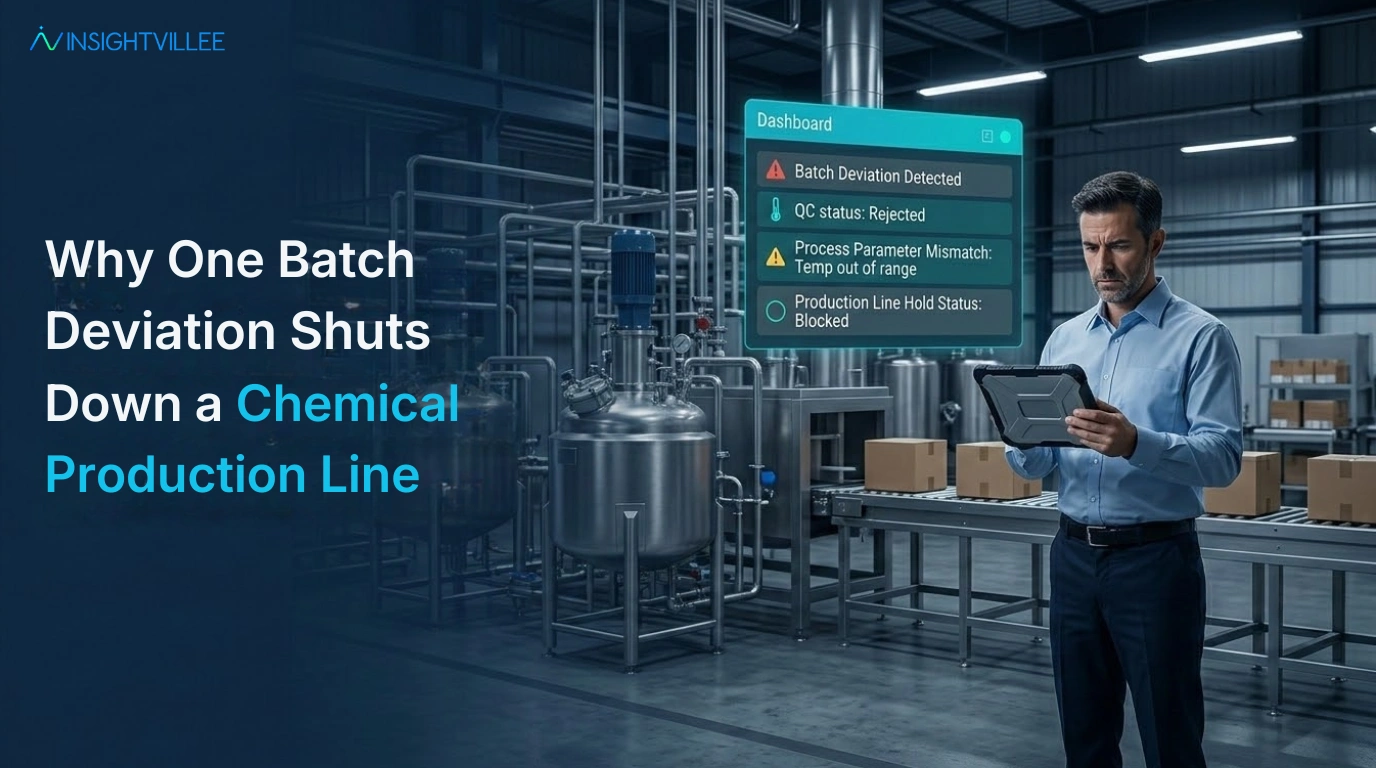
Why One Batch Deviation Can Stop an Entire Chemical Production Line
One batch deviation can stop an entire chemical production line because chemical production is tightly connected from raw material to final dispatch. If one batch fails quality, the plant cannot simply continue as if nothing happened.
A chemical plant completes a batch of intermediates. Four hours later, lab results show that pH is 0.3 units below specification. The batch is quarantined. The reactor is stopped, drained, and cleaned. Quality teams begin investigation. Downstream production schedules are disturbed.
The issue is not only the deviation. The bigger issue is late detection.
By the time final lab results arrive, raw materials are already used, production time is already lost, and the next batch is already affected. What could have been corrected during the process becomes a production stoppage.
For large chemical plants, one failed batch can mean wasted material, overtime, delayed delivery, customer pressure, and hours of chemical plant downtime.
What Is a Batch Deviation?
A batch deviation means a batch has moved away from the approved process, quality, or operating standard. In simple terms, something did not happen as planned.
Every chemical batch has defined limits. These may include temperature, pressure, pH, flow rate, mixing time, reaction time, raw material quantity, or final quality values.
A deviation may happen when:
- Reactor temperature moves outside the accepted range
- Feed rate drops during charging
- pH falls below specification
- Raw material quality changes
- An operator misses or delays a process step
Not every batch deviation becomes a batch failure. Some deviations can be corrected if teams detect them early. But if they are found only at final QC, the batch may already be off-spec.
This is why batch quality control is critical in chemical production.
How a Small Deviation Becomes a Big Problem
The Chain Reaction That Leads to Production Stoppages
A small deviation becomes a big problem when it continues unnoticed until the batch reaches final quality testing.
In chemical production, small process changes build up slowly. A sensor may start drifting. A valve may not open fully. A pump may underfeed. A heat exchanger may lose efficiency. Individually, these issues may not look serious. Together, they can affect final batch quality.
For example, a temperature sensor may show only a small variation. The system may not trigger a major alarm. But if the actual temperature is different, the reaction may not complete properly. The batch reaches the final stage, but the result fails specification.
At this point, the issue is no longer small. The batch may need to be held, reworked, downgraded, or rejected.
This is how one quality deviation manufacturing issue becomes a production line shutdown.
Why Machine Alerts Alone Still Cost Large Plants Production Hours
What Happens When Production Stops?
The Cost of Downtime, Rework, and Delayed Deliveries
When production stops, the plant loses output, material, manpower, schedule reliability, and customer confidence.
Once a batch is suspected to be off-spec, it is usually placed on hold. Quality teams check records. Production teams review process logs. Maintenance teams inspect equipment. Planning teams revise delivery schedules.
The reactor may also need cleaning before the next batch can start. If the same line is used for multiple products, one stoppage can affect several batches.
The cost may include:
- Lost production output
- Wasted or downgraded material
- Cleaning and changeover time
- Lab retesting
- Overtime for production and quality teams
- Delayed dispatch
- Customer penalties or urgent rescheduling
Unplanned downtime costs manufacturing an estimated $50 billion annually [Aberdeen Group, 2024]. A single hour of downtime can cost $25,000 to $260,000 depending on plant size and product value [Siemens, 2024; TeepTrak, 2025].
For Indian chemical plants, one production stoppage can easily run into lakhs or crores.
Common Reasons for Batch Deviations
Batch deviations usually happen because of equipment issues, process variation, human errors, raw material inconsistency, or delayed maintenance.
In many plants, the final QC result shows the problem, but the real cause started much earlier.
Common reasons include:
Equipment issues: A valve drifts, a pump underperforms, a sensor gives wrong readings, or a heat exchanger gets fouled.
Process variations: Temperature, pressure, flow rate, mixing speed, or reaction time moves outside the ideal range.
Human errors: Manual entries, missed checks, incorrect adjustments, or delayed reporting create quality risk.
Raw material problems: Supplier change, purity variation, moisture, or particle size affects batch behaviour.
Delayed maintenance: Equipment may run, but still perform below the level needed for stable quality.
In chemical production, these reasons are connected. One equipment issue can create process variation. That variation can affect manufacturing quality. If teams do not detect the link early, the deviation reaches final QC.
Why Many Deviations Are Detected Too Late
The Limitations of Traditional Monitoring Methods
Many deviations are detected too late because traditional monitoring depends on final lab results, manual checks, and disconnected plant systems.
In many chemical plants, production data sits in one system, lab data in another, and maintenance records somewhere else. Operators may also use paper logs or Excel sheets.
Because this information is not connected in real time, teams may not see quality risk while the batch is running.
A batch may look normal because no major alarm is triggered. But the actual deviation may be building slowly. By the time the sample reaches the lab and results are approved, the batch is already complete.
This creates a detection gap.
The plant may discover a batch failure after four, six, or twelve hours. But the root cause may have started in the first two hours.
Delayed detection also makes investigation harder. Teams must check logs, shift notes, process trends, and maintenance records to understand what went wrong.
In regulated environments, weak deviation investigation can also create compliance risk. The FDA issued 105 drug quality warning letters in FY2024, with inadequate deviation investigations being a frequent observation [FDA, 2024].
How Real-Time Monitoring Helps
Finding Problems Before They Shut Down Production
Real-time monitoring helps teams detect abnormal process and equipment behaviour while the batch is still running, not after it has failed.
Instead of waiting for final QC, real-time monitoring connects equipment data, process parameters, and quality indicators. This helps teams catch early warning signs before they become batch failures.
For example, if a heat exchanger starts losing efficiency, the system can show unstable temperature control. If a pump underfeeds, flow variation can be detected early. If a sensor drifts, the system can highlight unusual readings.
This gives teams time to act before the batch reaches failure.
Insightvillee connects PLC, SCADA, machine, and quality-related data into one real-time intelligence layer. For chemical plants, this helps teams identify process risks earlier and reduce avoidable downtime. In chemical manufacturing deployments, Insightvillee has recorded 15% OEE improvement, partly by reducing unplanned downtime through earlier anomaly detection.
Real-time monitoring does not replace quality teams. It gives them better visibility before the damage is complete.
Ways to Reduce Batch Deviations
Practical Steps Chemical Manufacturers Can Take
Chemical manufacturers can reduce batch deviations by improving process visibility, connecting plant data, strengthening maintenance, and reducing manual dependency.
The first step is to measure the detection gap. Plant Heads should ask: how much time passes between the first process drift and the moment the team detects it?
If the answer is more than one hour, the plant is carrying avoidable risk.
Practical steps include:
- Connect process and equipment data
- Monitor critical parameters in real time
- Use predictive maintenance
- Reduce manual log dependency
- Review deviations faster
- Track repeat deviations
- Improve batch traceability
Batch Traceability in Chemical Plants: From Raw Material to Dispatch
For large-scale chemical manufacturers, reducing batch deviation is not only a quality task. It is an operations, maintenance, planning, and business continuity priority.
Conclusion
Preventing One Deviation Can Save Hours of Production Time
Preventing one batch deviation can save hours of production time because it avoids shutdowns, rework, cleaning delays, customer disruption, and investigation pressure.
A batch deviation may look like a quality issue on paper. But on the shop floor, it quickly becomes a production issue, maintenance issue, planning issue, and delivery issue.
The biggest opportunity for chemical plants is not only to investigate deviations after they happen. The bigger opportunity is to detect them earlier.
When teams can see process drift, equipment degradation, and batch quality risk in real time, they can act before the batch fails.
For Plant Heads, Operational Directors, and CEOs, the question is simple: is your plant finding deviations when they start, or only after the batch fails?
If deviations are found late, one batch deviation can still shut down the line. If they are found early, the same issue can become a controlled correction instead of a costly production stoppage.