
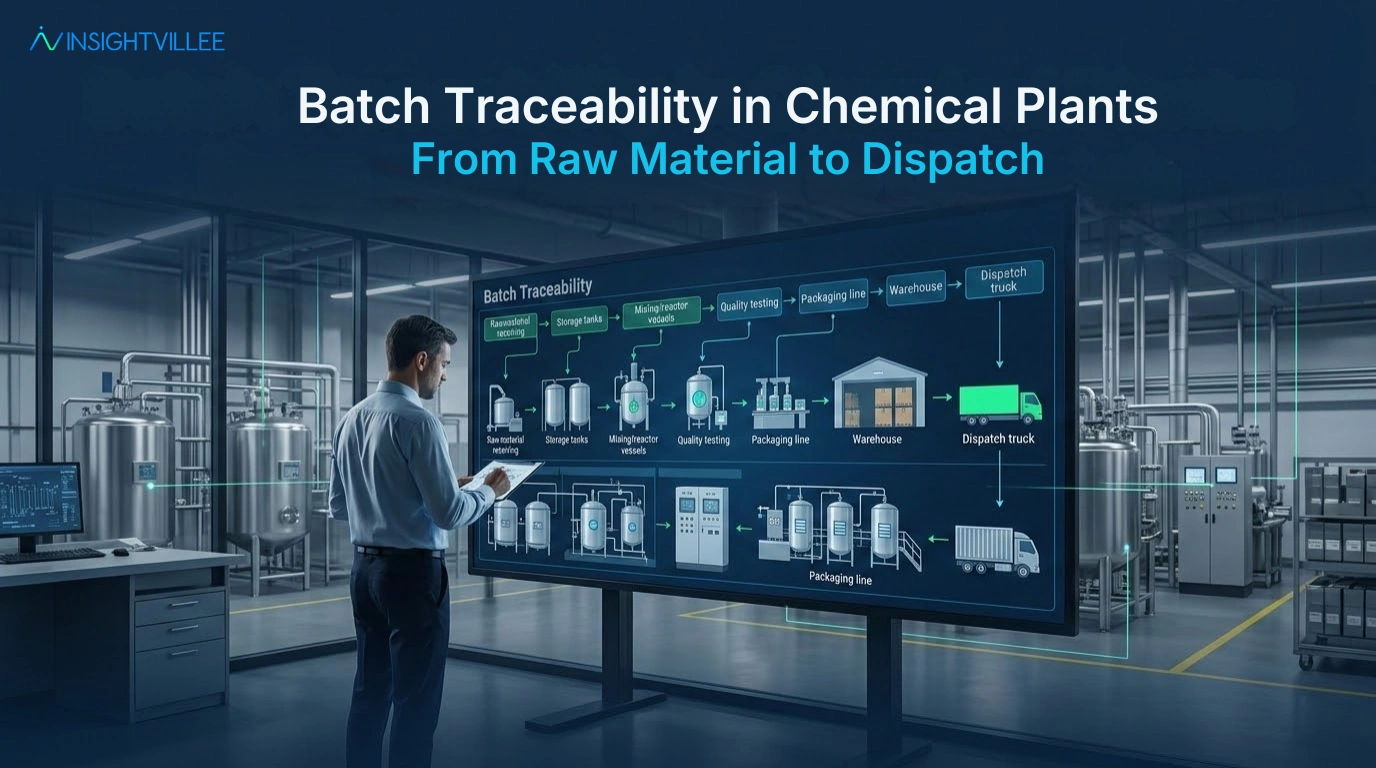
Why Batch Traceability Matters in Chemical Plants
Batch traceability matters because one quality issue should not force the plant to search through disconnected records for hours.
In chemical plants, every batch carries risk from raw material receipt to dispatch. A wrong lot, delayed test report, missed process value, or incomplete batch record can create serious problems during quality review or customer complaints.
The real issue is not only whether records exist. Most plants have records. The issue is whether teams can connect raw material, process, quality, packaging, storage, and dispatch details quickly.
FDA’s FY2024 report recorded 421 recalled drug products, with contamination as the most common defect group [FDA, 2024]. For chemical manufacturers, the lesson is clear. When product quality is questioned, traceability decides how fast the plant can isolate the affected batch.
What Is Batch Traceability?
Understanding Batch Traceability in Simple Terms
Batch traceability means knowing the full journey of a batch from raw material to finished goods dispatch.
It answers practical questions. Which supplier lot was used? Which reactor processed it? What were the key process parameters? Which lab results approved it? Which packaging material was used? Which customer received it?
A common misconception is that batch tracking and batch traceability are the same. Batch tracking shows where a batch is. Batch traceability explains what happened to that batch at every important step.
ICH Q7 says batch production records should be prepared for each intermediate and API and should include complete production and control information [ICH Q7, 2000].
Why Traceability Starts Before Production
Traceability starts before production because raw material quality directly affects final batch quality.
A common scenario involves a solvent, additive, pigment, or intermediate arriving from an approved supplier. The material is received, labelled, sampled, tested, and released. If supplier lot numbers or test reports are not linked properly, the plant may not know which production batches used that material later.
In practice, many quality investigations become slow because teams first search purchase records, goods receipt entries, QC reports, and warehouse logs separately.
ICH Q7 requires written procedures for receipt, identification, quarantine, storage, sampling, testing, approval, or rejection of materials [ICH Q7, 2000].
Key insight: batch traceability begins at the gate, not at the reactor.
How Batch Traceability Works During Production
Batch traceability during production works by linking each major process step to the batch record.
This includes charging time, operator details, reactor used, equipment status, process parameters, in-process checks, deviations, cleaning status, and yield at key stages.
For example, if a batch shows lower yield, the team should be able to check whether charging was delayed, temperature control was unstable, or the batch used a different raw material lot.
Many plants collect this data, but it sits across paper logs, PLC records, operator notes, and quality forms. The value comes only when the data explains the operating condition behind the result.
21 CFR 211.186 requires master production and control records to include components, quantities, production controls, and processing instructions to assure batch-to-batch uniformity [eCFR, 2026].
Why Quality Checks Must Be Linked to Each Batch
Quality checks must be linked to each batch because lab results alone do not explain why a batch passed or failed.
A lab report may show viscosity, pH, purity, moisture, colour, or assay results. But plant leaders also need to know what happened during processing. Was there a temperature drift? Was mixing time extended? Was there any hold time delay? Was any in-process correction made?
This is where many chemical plant operations face a visibility gap. Quality sees the test result. Production sees the process log. Maintenance sees the equipment history. But the batch story is incomplete unless these records are connected.
ICH Q7 states that laboratory control records should include complete data from tests and that out-of-specification results should be investigated and documented [ICH Q7, 2000].
How Traceability Continues After Production
Traceability continues after production because a batch is still a business risk until it reaches the customer safely.
Finished goods must be linked to packaging material, labels, storage condition, warehouse location, dispatch date, transport details, and customer shipment. If a complaint comes later, the plant should know exactly which batches, packs, and customers are affected.
This matters in chemical manufacturing production traceability because one finished batch may be split across multiple drums, tanks, containers, warehouses, or customer shipments.
ICH Q7 says a system should be in place so distribution of each batch can be readily determined to permit recall [ICH Q7, 2000]. GS1 India also notes that traceability supports targeted product recalls through better supply chain visibility [GS1 India, 2026].
What Happens When Batch Traceability Is Weak?
When batch traceability is weak, teams lose time finding facts during the exact moment when fast decisions matter most.
A customer may complain about colour variation. The plant must check raw material lots, production records, lab approvals, packaging, storage, and dispatch details. If this takes two days, the business risk grows. More customers may receive the same batch. More finished goods may stay blocked. More production may be delayed.
Why One Batch Deviation Shuts Down a Chemical Production Line
Weak traceability also increases rework and recall impact. Instead of isolating one affected batch, teams may quarantine multiple batches because they cannot prove which ones are safe.
Key insight: poor traceability turns a quality issue into a plant-wide investigation.
Why Manual Batch Records Are Not Enough
The Problem With Paper Logs, Excel Sheets, and Delayed Updates
Manual batch records are not enough because they are slow to search, easy to separate, and often updated after the event.
Paper logs and Excel sheets may support documentation, but they do not give live visibility. In many plants, production updates one file, quality updates another, and warehouse teams maintain dispatch records separately.
During normal production, this may seem manageable. During a quality hold, recall, or customer complaint, it becomes a serious delay.
A common pattern observed in plants is that manual records capture what happened, but not fast enough to support action. Experienced teams do not only ask whether the record exists. They ask how quickly the record can support a decision.
How Digital Batch Traceability Helps Chemical Plants
Real-Time Visibility From Raw Material to Dispatch
Digital batch traceability helps chemical plants by connecting the full batch journey into one visible chain.
It helps plant teams see raw material details, process steps, quality approvals, packaging, storage, and dispatch status in one place. This reduces the time spent searching for records and improves confidence during investigations.
Insightvillee fits here as a manufacturing intelligence platform that connects plant data across machines, processes, and quality workflows. The purpose is not to replace quality systems. The purpose is to give plant leaders better visibility so they can act faster when batch risk appears.
For large chemical plants, the business outcome is clear. Faster investigation. Better batch control. Reduced production stoppage. Stronger manufacturing compliance.
Practical Steps to Improve Batch Traceability
Simple Actions Chemical Plants Can Start With
Chemical plants can improve batch traceability by first identifying where batch information breaks.
Plant Heads can start with five questions:
- Which raw material lots went into each batch?
- Can we link process parameters to final quality results?
- How quickly can we identify affected batches during a complaint?
- Are packaging and dispatch records connected to batch numbers?
- How much time does a full batch investigation take today?
High-performing manufacturers usually start with critical materials, high-value products, recurring complaint categories, and batches with high compliance exposure. They avoid trying to digitise everything at once.
The practical goal is simple. Convert batch records into batch intelligence. Data should not only be stored. It should help teams decide what to hold, what to release, what to investigate, and what to improve.
Conclusion
Better Traceability Gives Better Control Over Every Batch
Better traceability gives better control because it connects every important batch decision from raw material receipt to customer dispatch.
Chemical plants do not struggle because they have no records. They struggle because records are often scattered, delayed, and difficult to connect during pressure situations.
Batch traceability improves quality control manufacturing by giving teams a clear batch story. It supports faster investigations, more targeted recalls, stronger compliance, and better production confidence.
For Plant Heads and Operational Directors, the real question is simple. If one customer complains tomorrow, how quickly can your team prove which raw material, process condition, lab result, package, and shipment were involved?
Plants that can answer this quickly will manage quality issues with more control. Plants that cannot continue to lose time, output, and confidence during every batch investigation.