
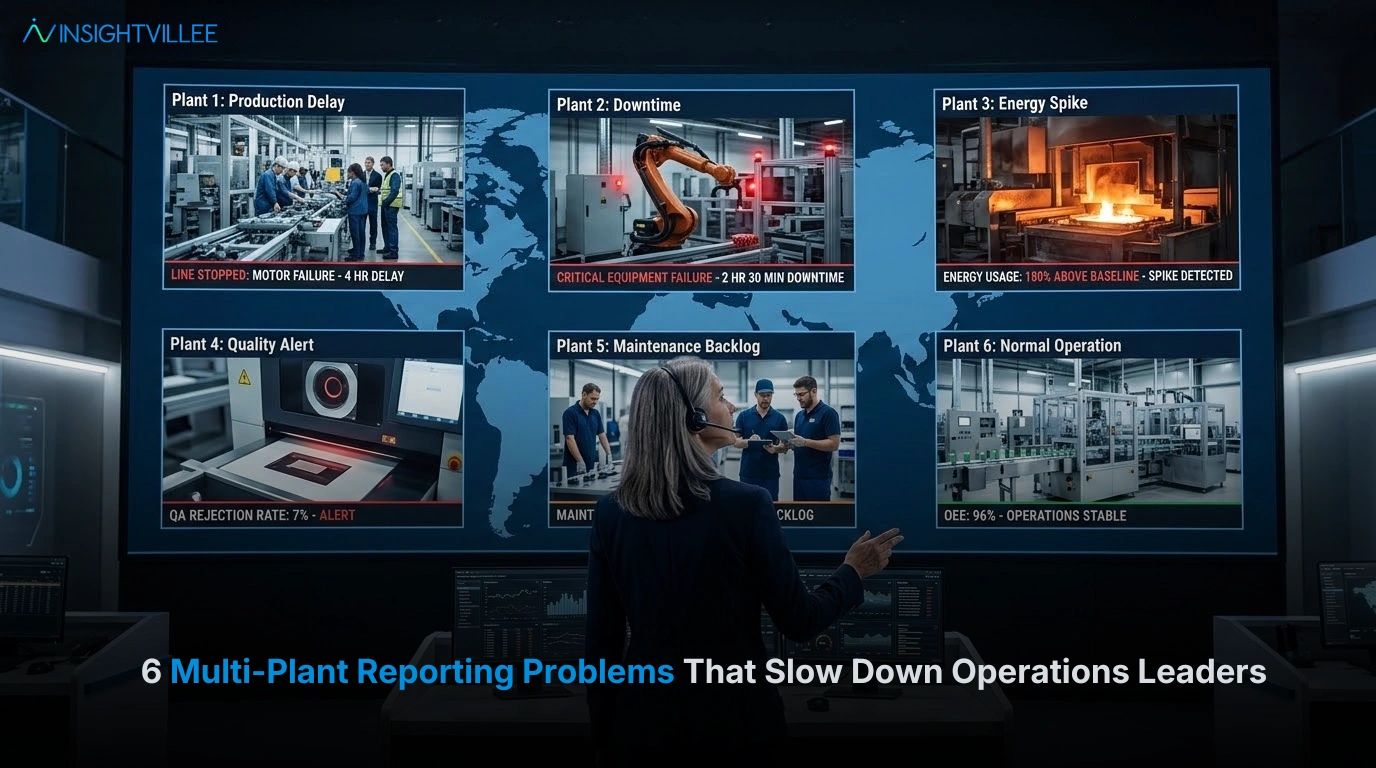
6 Multi-Plant Reporting Problems That Slow Down Operations Leaders
Multi-plant reporting slows down operations leaders when every plant sends different data, in different formats, at different times.
A leader managing five plants cannot wait for Excel sheets, emails, PDFs, and WhatsApp updates to understand what happened yesterday. By the time reports are cleaned and compared, the downtime is over, the energy spike has already hit cost, and the quality issue may have moved into dispatch.
The real problem is not that plants do not have data. The problem is that leaders do not get the same data, at the same time, in the same format.
What Is Multi-Plant Reporting?
Multi-plant reporting means collecting, comparing, and reviewing operational data from more than one manufacturing facility so leaders can see performance across locations clearly.
It usually includes OEE, downtime, production output, energy use, maintenance performance, quality, safety, compliance, and cost-related KPIs.
For operations leaders, the goal is simple. Know which plant is performing well, which plant needs attention, and where action is needed first.
In large manufacturing groups, this becomes difficult when each plant follows its own reporting method. One plant may send a detailed OEE report. Another may send only daily output. Another may delay maintenance data until weekly review.
ISO 22400 defines KPIs used in manufacturing operations management, which shows why standard KPI definitions matter when leaders compare performance across plants [ISO, 2014].
Why Does Multi-Plant Reporting Matter for Operations Leaders?
Multi-plant reporting matters because operations leaders cannot manage several plants through isolated reports that are delayed, inconsistent, or difficult to compare.
When reporting is weak, leaders spend more time checking numbers than making decisions. They need one standard view of plant performance reporting across locations.
Deloitte noted that manufacturers continue to face supply chain risks, possible delays, and elevated costs [Deloitte, 2025]. In this environment, slow reporting makes recovery harder because plants already work under delivery and cost pressure.
Better visibility also supports faster comparison. Leaders can see whether Plant A has a downtime problem, Plant B has an energy issue, or Plant C is losing output due to quality loss.
This is where how cross-plant benchmarking helps leaders find hidden performance gaps becomes important for leadership teams managing multi-site operations.
When Does Multi-Plant Reporting Start Slowing Down Decisions?
Multi-plant reporting starts slowing down decisions when reports arrive late, follow different formats, need manual consolidation, or cannot be compared directly.
By the time leadership sees the final report, the production loss, energy spike, downtime event, or quality issue may already be over.
This is one of the most common multi-plant reporting challenges in manufacturing. The report is correct, but it arrives too late to support action.
Siemens reported that unscheduled downtime takes 11% of annual revenues from the world’s 500 largest companies, equal to about $1.4 trillion [Siemens, 2024]. The exact impact differs by industry and plant size, but delayed visibility makes downtime harder to control.
At that point, reporting becomes a record of what happened, not a tool for what should happen next.
What are the Problems in Multi-Plant Reporting
1. Every Plant Uses a Different Reporting Format
The first problem in multi-plant reporting is that every plant may report the same topic differently, making leadership comparison slow and unreliable.
One plant may report OEE by line. Another may report OEE by shift. Another may send only total production output. One plant may include planned downtime. Another may not.
This creates inconsistent reporting across multiple factory locations.
The operations leader spends more time understanding the format than understanding the issue. If five plants send five reporting styles, comparison becomes a manual exercise.
Key insight: one of the most common issues in multi-plant operations is not lack of data. It is a lack of standardisation.
2. Reports Arrive Too Late to Support Action
The second problem in multi-plant reporting is reporting delay. Late reports show the loss after the plant has already missed the chance to correct it.
Many reports are shared at the end of the day, next morning, or during weekly reviews. This creates reporting delays across manufacturing facilities.
For example, if Plant A loses four hours due to repeated micro-stoppages during the afternoon shift, but the report reaches the operations head the next morning, the opportunity for same-day intervention is gone.
The same problem appears in energy and carbon tracking. Month-end reporting may show the number, but it does not help teams correct the spike while it is happening. This is why why carbon data should be tracked at machine level not month-end matters for large plants.
Key insight: late reporting does not prevent loss. It only explains it after the cost is already locked in.
3. Manual Consolidation Creates Errors and Delays
The third problem in multi-plant reporting is manual consolidation. When teams combine Excel sheets, PDFs, screenshots, and email summaries by hand, errors and delays increase.
Plant teams often send reports in different formats. Someone then has to copy, paste, verify, clean, and combine the data.
This creates risk of wrong entries, missed data, duplicate numbers, and version confusion. It also keeps senior leaders dependent on reporting teams instead of live operational visibility.
This is one reason why operations leaders struggle with multi-site reporting. The work is not only reviewing performance. The work becomes preparing the report itself.
Key insight: when reporting depends on manual consolidation, leadership visibility is only as fast as the slowest report.
4. KPIs Are Not Measured the Same Way Across Plants?
The fourth problem in multi-plant reporting is inconsistent KPI definition. If plants calculate the same KPI differently, cross-plant benchmarking becomes unreliable.
One plant may calculate downtime from line stoppage time. Another may calculate only machine breakdown time. One plant may report energy consumption at plant level. Another may report energy at line level.
This makes standardising KPIs across multiple manufacturing plants a leadership priority.
ISO 22400 shows the importance of defining manufacturing KPIs with clear formulas, time behaviour, units, and use groups [ISO, 2014]. Without this discipline, leaders may compare numbers that do not mean the same thing.
Key insight: a dashboard is not useful if every plant defines the same KPI differently.
5. Leaders Cannot Quickly See Which Plant Needs Attention First
The fifth problem in multi-plant reporting is lack of priority. When all reports look equal, leaders struggle to know which plant needs action first.
Multi-plant leaders do not need more reports. They need priority signals.
Should they focus on a downtime spike, energy overuse, quality deviation, delayed maintenance, or safety issue? Without ranking by business impact, every issue appears important.
This is also relevant to safety. If one plant repeatedly reports zone violations or delayed safety actions, leadership needs to know quickly. [Link: how real-time zone alerts help prevent safety incidents in manufacturing plants > /blog/real-time-zone-alerts-prevent-safety-incidents]
Multi-plant performance visibility for operations directors should show the largest loss, the most urgent risk, and the fastest action path.
Key insight: leadership reporting should not only show what happened. It should show what needs attention first.
6. Reports Show What Happened, Not What Is About to Happen
The sixth problem in multi-plant reporting is that traditional reports are backward-looking. They tell leaders what happened yesterday, not what risk is building now.
A report may show that downtime increased last week. It may show that energy consumption rose last month. It may show that quality rejection increased in one plant.
But operations leaders need earlier signals.
They need to see repeated downtime causes, rising energy use, worsening machine health, safety risk patterns, and recurring production losses before they become larger problems.
This is the practical answer to why multi-plant reporting is so difficult in manufacturing. Reporting often looks backward, while operations need forward action.
Key insight: reports should not only help leaders review the past. They should help them act before losses grow.
What Should Better Multi-Plant Reporting Look Like?
Better multi-plant reporting should give leaders one standard, real-time view of all plants, with common KPIs, automated data capture, cross-plant comparison, and clear priority signals.
A better system should include:
Standardised KPIs across all plants.
Real-time visibility into every facility.
Common reporting structure for production, downtime, energy, safety, quality, and maintenance.
Automated data capture instead of manual consolidation.
Cross-plant benchmarking.
Alerts that show where leadership should act first.
Reports that support decisions, not just documentation.
This answers how to standardise reporting across multiple plants. Start with common KPI definitions, common formats, and common timing. Then connect those reports to live operational visibility.
How Does AI-Driven Multi-Plant Intelligence Help Operations Leaders?
AI-driven multi-plant intelligence helps operations leaders by comparing plants faster, spotting patterns earlier, and showing where action is needed most.
It can show which plant, line, machine, or shift is creating the biggest loss. It can highlight repeated downtime causes, rising energy consumption, quality gaps, or delayed safety actions.
The value is not more reports. The value is exception-based management. Leaders stop asking every plant for updates and start focusing on the few areas that need action.
Insightvillee supports this through multi-plant intelligence, OEE monitoring, predictive maintenance, energy management, safety and compliance automation, and smart production planning. It connects machines, lines, ERP, MES, SCADA, PLCs, sensors, and CMMS into one real-time intelligence layer.
smart factory operations what one intelligence layer changes for manufacturers
Conclusion
Multi-plant reporting becomes a bottleneck when data is delayed, inconsistent, manual, and difficult to compare. Operations leaders need one standard view across all plants.
The goal is not more reports. The goal is faster decisions.
Large manufacturing groups need to answer simple questions quickly. Which plant is losing output? Which line is creating downtime? Which location has rising energy cost? Which site has repeated safety risks? Which plant needs leadership attention first?
That is how to get one view across all manufacturing plants. Connect the data, standardise the KPIs, remove manual delay, and make the right problem visible at the right time.
Insightvillee supports this shift as a transformation partner for large-scale manufacturers. With go-live in 6 weeks and ROI within 6 to 9 months, it helps leaders move from delayed reporting to live operational control.
Key Takeaways
- Multi-plant reporting slows down when every plant sends different data in different formats.
- The six major problems are format differences, late reports, manual consolidation, inconsistent KPIs, weak priority, and backward-looking reports.
- Operations leaders need standardised KPIs and one live view across all facilities.
- Multi-site operations improve when reports move from manual summaries to real-time visibility.
- Better reporting should help leaders act faster, not only review what already happened.