
Why Machine Alerts Do Not Always Prevent Production Loss
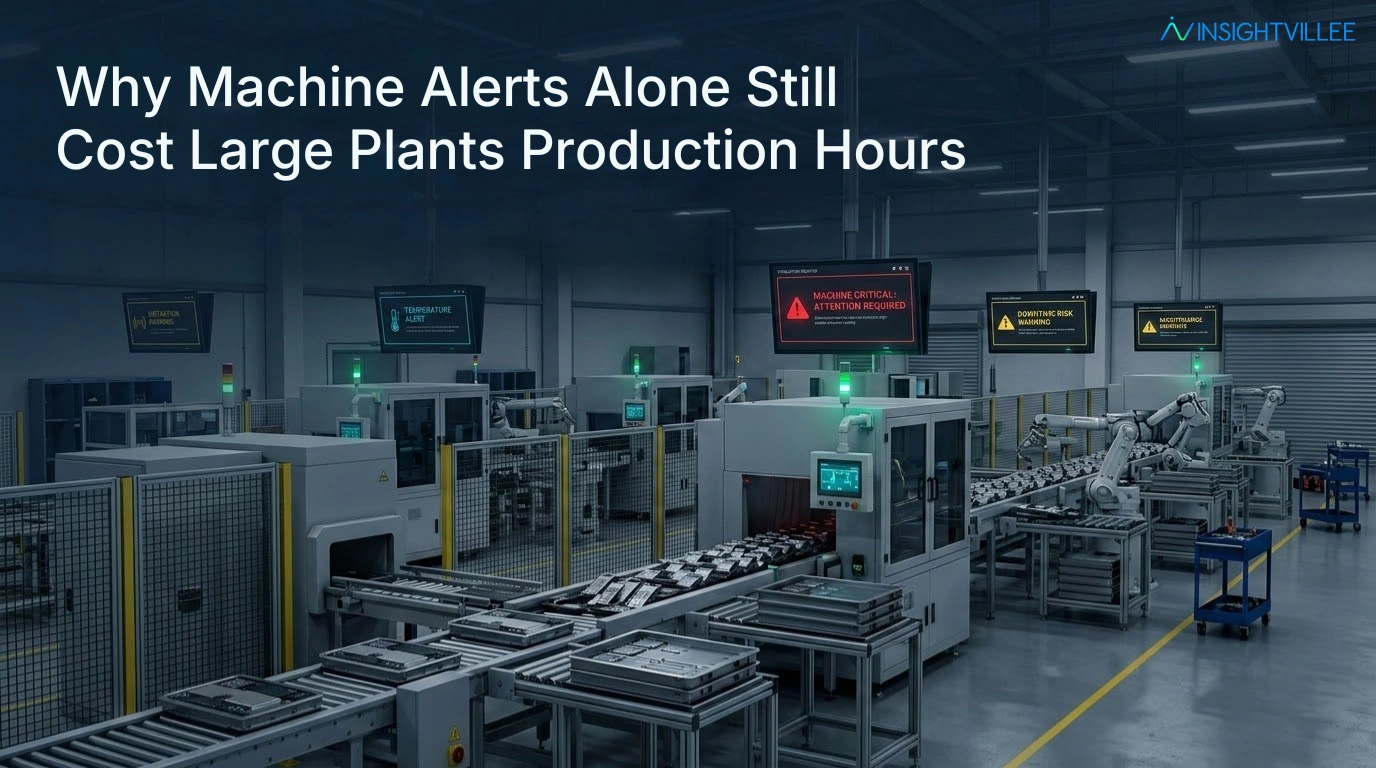
Machine alerts do not always prevent production loss because an alert only tells the plant that something is wrong. It does not ensure that the right action happens on time.
In many large plants, machines already send alerts for vibration, temperature, pressure, speed loss, overload, or abnormal running conditions. Still, production hours get lost. The machine warned the team, but the response was delayed, assigned to the wrong person, or not prioritised correctly.
This is one of the most common patterns observed in manufacturing plants. The alert exists. The loss still happens.
Siemens reported that one unproductive hour can cost automotive manufacturers around $2.3 million [Siemens, 2024]. The exact number will differ by industry and plant size, but the operating pressure is clear. Every delayed response can affect output, OEE, dispatch, and customer commitments.
What Are Machine Alerts?
Understanding Machine Alerts in Simple Terms
Machine alerts are warning signals that show when equipment is operating outside normal limits.
For example, a machine may generate an alert when temperature rises, vibration increases, oil pressure drops, cycle time slows, or motor load crosses a set range. These alerts help teams identify possible machine failure, downtime risk, or quality impact.
In simple terms, machine alerts are like early warning signals from the shop floor.
But an alert is only the first step. It does not explain the full business impact. It does not always show whether the issue will stop production in 10 minutes, reduce speed slowly, or affect quality after several hours.
A common misconception is that machine monitoring automatically protects production. In practice, monitoring protects production only when alerts lead to timely decisions.
Why Alerts Alone Are Not Enough
Knowing About a Problem Is Not the Same as Solving It
Alerts alone are not enough because knowing about a problem is different from solving it.
A machine may alert the team about abnormal vibration. Maintenance may receive the alert. Production may decide to continue because the shift target is tight. The issue may be discussed during handover. By the time action is approved, the machine may already slow down or stop.
This is where production loss begins.
NIST found that manufacturers using more preventive and predictive maintenance practices had 52.7% less unplanned downtime and 78.5% fewer defects than those relying more heavily on reactive maintenance [NIST, 2021]. The lesson is practical. Alerts help only when they change maintenance behaviour and shop floor action.
5 Reasons Predictive Alerts Alone Do Not Stop Production Loss
Key insight: alerts create awareness, but action protects production hours.
Where Production Hours Still Get Lost
Delayed Response, Wrong Priority, Unclear Ownership, and Poor Follow-Up
Production hours get lost when alerts are delayed, wrongly prioritised, poorly owned, or not followed through properly.
In many plants, an alert reaches the control room or maintenance team, but the next step is not clear. Who owns the issue? Is it urgent? Can it wait until planned maintenance? Will it affect output, quality, safety, or energy consumption?
If these questions are not answered quickly, the alert becomes noise.
For example, a packaging machine may send repeated stoppage alerts. Maintenance sees no major breakdown. Production treats it as a minor disturbance. Quality sees rising rework. At shift end, the plant discovers that output is below plan.
The machine gave signals. The plant lost time because the signals were not converted into coordinated action.
Key insight: the real gap is not between machine and alert. It is between alert and execution.
What Happens When Alerts Are Ignored or Delayed
Downtime, Slow Output, Quality Issues, and Missed Dispatch Targets
When alerts are ignored or delayed, small equipment problems become downtime, slow output, quality issues, and missed dispatch targets.
A temperature alert may become a quality deviation. A vibration alert may become equipment failure. A speed loss alert may become missed shift output. A pressure alert may become a safety concern.
Many facilities encounter situations where the first alert looks minor. The machine continues running. The team decides to check it later. But the issue repeats. The line slows down. Operators adjust manually. Rework increases. By the time the problem is taken seriously, the plant has already lost production hours.
Deloitte noted that manufacturers continue to face supply chain risks, delays, and elevated costs [Deloitte, 2025]. This makes internal production loss more damaging because plants have less room for avoidable delays.
Key insight: delayed alerts do not only create machine downtime. They create planning, quality, and customer delivery problems.
Why Large Plants Face This Problem More Often
Too Many Machines, Too Many Alerts, and Too Many Teams
Large plants face this problem more often because they manage many machines, many lines, many shifts, and many teams at the same time.
A small plant may handle alerts through direct supervision. A large plant cannot depend only on memory, phone calls, or shift handovers. There are too many signals and too many decision points.
One machine may send a temperature alert. Another may send a cycle time alert. A utility system may show abnormal energy consumption. A quality station may report repeated defects. Each alert may belong to a different team.
This creates alert fatigue. Teams see too many alerts and start treating them as routine. Some alerts are urgent. Some are not. Some need immediate shutdown. Some need a planned correction. Without priority, everything looks important and nothing gets acted on fast enough.
Key insight: large plants do not need more alerts. They need better alert prioritisation and faster ownership.
What Plants Need Beyond Alerts
Clear Action, Priority, Responsibility, and Real-Time Escalation
Plants need clear action, priority, responsibility, and real-time escalation beyond alerts.
A useful alert should answer four practical questions:
- What is the issue?
- What is the production impact?
- Who owns the action?
- How quickly must it be closed?
If these answers are missing, the alert may be technically correct but operationally weak.
High-performing manufacturers typically connect alerts to impact. They do not treat every warning equally. They ask whether the issue affects output, safety, quality, energy, or customer dispatch. Then they decide the response priority.
For example, a minor temperature deviation on a non-critical asset may wait. But a repeated speed loss on a bottleneck line may need immediate escalation because it directly affects throughput.
Key insight: the best alert systems do not just warn teams. They help teams decide what to do next.
How Real-Time Manufacturing Intelligence Helps
Turning Machine Alerts Into Faster Shop Floor Action
Real-time manufacturing intelligence helps by turning machine alerts into faster decisions and shop floor action.
It connects machine status, production output, downtime reasons, quality checks, and maintenance signals into one operational view. This helps leaders see which alerts matter most and which ones can wait.
Insightvillee fits into this category as a manufacturing intelligence platform. It helps plant teams connect existing machine and production data so they can identify downtime patterns, equipment risks, and performance losses earlier.
For example, instead of only showing that a machine generated an alert, the platform can help teams understand whether the alert is affecting OEE, throughput, quality, or shift output. This moves the plant from data to intelligence to action.
In relevant deployments, Insightvillee has recorded up to 40% downtime reduction and 15% OEE improvement. These are deployment-specific outcomes, not universal guarantees.
Practical Steps to Reduce Production Hour Loss
Simple Ways Plant Teams Can Improve Alert Response
Plant teams can reduce production hour loss by reviewing how alerts are received, prioritised, assigned, and closed.
Start with these practical steps:
- List the top recurring machine alerts from the last 30 days.
- Identify which alerts caused production loss.
- Check how long it took teams to respond.
- Assign clear ownership for each critical alert type.
- Separate urgent alerts from low-priority alerts.
- Track whether corrective action was completed.
- Review repeated alerts in daily production meetings.
Plant Heads should also ask one direct question: which alerts were known before production loss happened?
That question usually reveals the real problem. The plant did not lack warning. It lacked fast execution.
Conclusion
Alerts Are Useful, But Action Protects Production Hours
Alerts are useful, but action protects production hours.
Machine alerts help plants detect early signs of trouble. But alerts alone cannot prevent production loss, plant downtime, quality issues, or missed dispatch targets. The value comes when alerts are connected to priority, ownership, escalation, and closure.
Large plants already have machine data. The next step is to make that data useful for faster operational decisions.
Beyond Prediction: Closing the Execution Gap in Manufacturing Operations
The future of manufacturing operations will not be defined by who has the most alerts. It will be defined by who acts on the right alert at the right time. Insightvillee supports this direction by helping manufacturers move from machine monitoring to real-time manufacturing intelligence.