
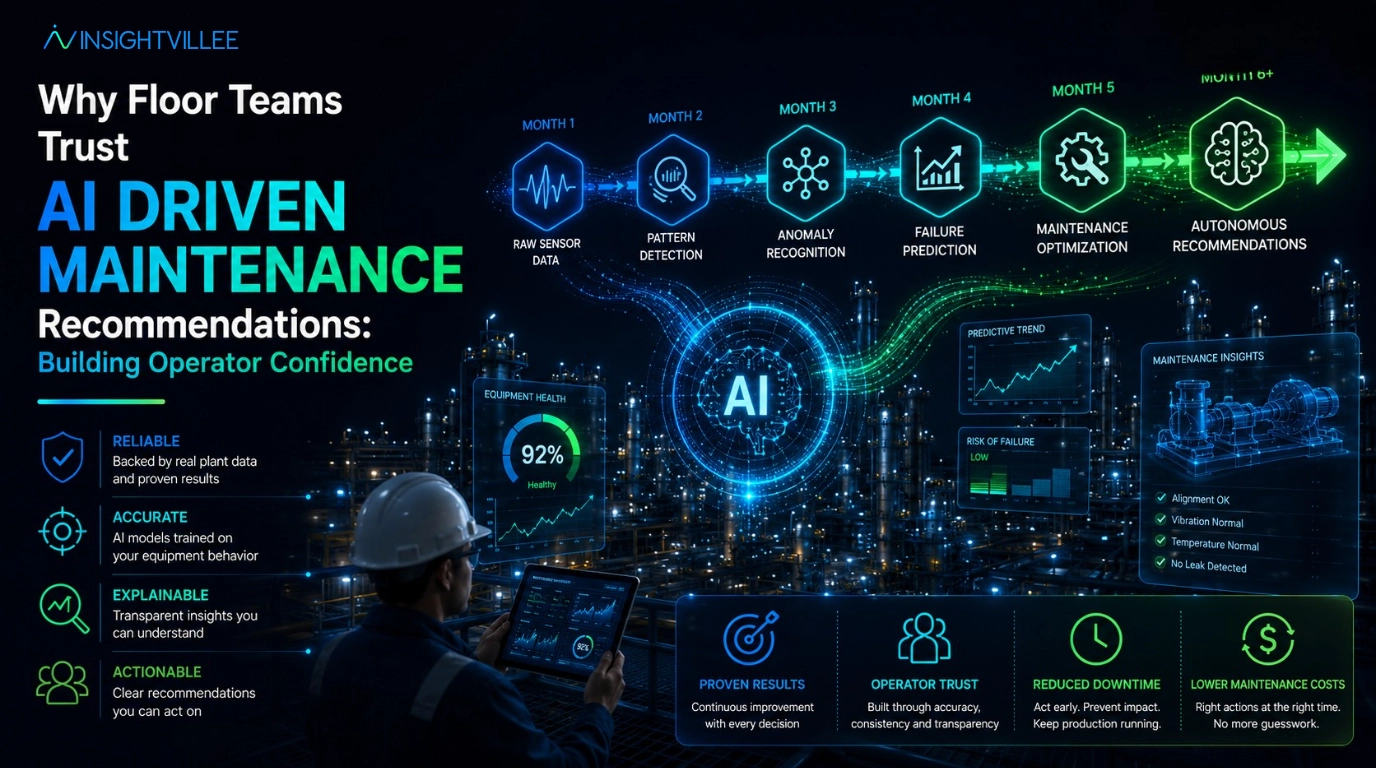
Why Floor Teams Trust AI-Driven Maintenance Recommendations
Operator trust decides whether AI-driven maintenance recommendations become real action or stay ignored inside a dashboard.
A plant may have early machine alerts, risk scores, and predictive recommendations. But if the operator does not believe the alert, the technician does not inspect, or the supervisor does not approve action, the recommendation has no value.
This is the uncomfortable truth. Maintenance improvement does not happen when the system detects risk. It happens when people trust the recommendation enough to act.
What Are AI-Driven Maintenance Recommendations for Operator Trust?
AI-driven maintenance recommendations are suggested actions based on machine data, operating context, maintenance history, and failure patterns that help teams decide what to inspect, repair, monitor, or schedule.
These recommendations may tell teams which machine needs attention, how urgent the risk is, what failure mode may be developing, and what action should happen next.
The goal is not to replace operators or technicians. The goal is to help them make better maintenance decisions with stronger machine information.
A recommendation becomes useful only when it fits the way floor teams actually work.
[Link: 5 maintenance decisions an AI driven system can make faster than a human team → /blog/maintenance-decisions-ai-driven-system-makes-faster]
Why Does Operator Trust Matter in AI-Driven Maintenance?
Operators trust matters because maintenance recommendations only create value when floor teams believe them, understand them, and act on them during real production pressure.
If floor teams do not trust the system, alerts may sit in dashboards without action.
Trust affects adoption, response time, maintenance planning, and long-term ROI. It also affects whether technicians treat alerts as useful guidance or extra work.
In practice, AI maintenance success depends as much on people and workflow as it does on data.
Expert angle: In many plants, AI does not fail because the model is weak. It fails because the recommendation never becomes a trusted action on the floor.
Why Do Floor Teams Initially Doubt AI Maintenance Recommendations?
Floor teams may doubt AI maintenance recommendations when alerts feel disconnected from real conditions, practical repair limits, or past experience with false alarms.
Operators may feel the system does not understand real floor conditions.
Technicians may worry that recommendations ignore practical maintenance experience. Supervisors may hesitate if alerts do not clearly explain urgency. Past false alarms can also reduce confidence.
Some teams may resist AI maintenance if it feels like monitoring people instead of supporting them.
Human angle: A technician who has checked the same machine three times and found nothing wrong will not trust the fourth alert easily. Trust has to be earned through proof.
What Makes AI Maintenance Recommendations Trustworthy?
AI maintenance recommendations become trustworthy when they explain what changed, why it matters, which machine signals moved, how urgent the risk is, and what action should happen next.
A useful recommendation should not only say, “Machine risk detected.”
It should show which signal changed, whether the condition is worsening, how it compares with past behaviour, and what the likely consequence may be.
ISO 13374 provides guidance for condition monitoring and diagnostics of machines, including processing and presentation of machine condition information [ISO, 2003]. For floor teams, presentation matters because unclear alerts slow action.
Good maintenance recommendations should give a practical action, not just a warning.
Why Does Explainability Build Operator Confidence in AI Maintenance?
Explainability builds operator confidence because floor teams trust recommendations more when they can see the reason behind the alert.
A simple alert saying “risk detected” is not enough.
A better recommendation explains that vibration increased during stable load, current drifted over three shifts, and similar patterns earlier led to bearing wear.
When teams understand the logic, AI becomes decision support instead of a black box.
This is why building trust in AI maintenance recommendations starts with clarity. People do not need a complex explanation. They need a clear reason they can verify on the machine.
The Insightvillee AI driven maintenance system is part of a larger smart factory platform that connects machine data, maintenance history, and production context, so recommendations can explain what changed and why the floor team should care.
How Should AI Maintenance Recommendations Match Floor Reality?
AI maintenance recommendations should match floor reality by giving practical options such as inspect now, monitor closely, plan during next stoppage, or schedule during shutdown.
A system that asks for immediate shutdown every time will lose trust quickly.
Floor teams work under production pressure. They need recommendations that consider asset criticality, spare availability, production schedule, safe repair windows, and maintenance manpower.
The recommendation should help supervisors choose the right action without creating unnecessary panic.
This is where [Link: how AI driven maintenance reduces false alarm rates without missing real failures → /blog/ai-driven-maintenance-reduces-false-alarm-rates] becomes important. Trust improves when alerts become fewer, clearer, and closer to real risk.
How Does Technician Feedback Improve Operator Trust in AI Maintenance?
Technician feedback improves operator trust by showing whether each recommendation was useful, false, confirmed, repaired, monitored, or closed without action.
After every alert, technicians should record what they found.
Was the alert useful? Was it a false alarm? Was the issue confirmed during inspection? Was maintenance completed? Did machine condition improve after action?
This feedback helps improve future recommendations. It also shows teams that their experience is part of the learning loop.
Floor teams trust systems more when they feel heard. If technicians give feedback and nothing changes, confidence drops. If feedback improves future alerts, confidence grows.
Why Do Early Wins Build Operator Confidence in AI Maintenance?
Early wins build operator confidence because floor teams trust AI maintenance faster when they see it prevent a real issue on a machine they care about.
A recommendation that helps avoid breakdown on a critical pump, motor, compressor, or gearbox creates strong confidence.
Early wins should be shared with operators and technicians, not only leadership.
When teams see that recommendations reduce emergency work, last-minute repairs, and production pressure, adoption improves naturally.
This is why operator confidence in predictive maintenance is built through proof, not presentation.
How Do False Alarms Affect Operator Trust in AI Maintenance?
False alarms reduce operator trust because repeated low-value alerts train teams to ignore the system even when a real risk appears.
Frequent false alarms make teams less responsive.
If operators inspect machines repeatedly and find nothing wrong, they begin to ignore alerts. Production teams may also resist maintenance action if previous alerts did not lead to real findings.
AI maintenance must reduce noise by learning normal machine behaviour under different operating conditions.
Trust improves when alerts are fewer, clearer, and more connected to real maintenance risk.
How Can Plant Leaders Build Operator Trust in AI Maintenance?
Plant leaders can build operator trust by involving floor teams early, explaining what AI does, starting with critical machines, and keeping human approval in the decision process.
Involve floor teams before rollout.
Explain what the system does and does not do. Start with critical machines where results are visible. Show why each alert was triggered. Let technicians validate recommendations.
Track alert-to-action outcomes. Avoid positioning AI as a replacement for human expertise.
Use it as a second layer of intelligence that supports engineering judgement.
As part of its predictive maintenance capability, Insightvillee works as an AI driven maintenance system that helps plant teams act before failures affect production, while keeping human approval and floor validation central to the decision process.
This is how AI maintenance adoption in manufacturing plants becomes practical instead of forced.
What Metrics Show Operator Trust in AI Maintenance Recommendations?
Operator trust can be measured through alert response rate, inspection conversion, work order conversion, false alarm rate, confirmed issue rate, technician feedback, and closure time.
Useful metrics include:
Alert response rate.
Percentage of alerts converted into inspections.
Percentage of recommendations converted into work orders.
False alarm rate.
Confirmed issue rate.
Technician feedback score.
Time from alert to action.
Repeat issue reduction.
Operator adoption rate.
Maintenance action closure time.
These metrics show whether recommendations are being acted on, not only whether alerts are being generated.
This also connects to ROI because maintenance value depends on completed action. [Link: AI driven maintenance ROI what to measure beyond downtime reduction → /blog/ai-driven-maintenance-roi-beyond-downtime]
What Example Shows Operator Trust Through a Confirmed AI Maintenance Alert?
A confirmed alert builds operator trust when the system flags a real pattern, the technician verifies it, and the machine improves after action.
Consider a plant where AI flags a motor for abnormal behaviour.
The temperature has not crossed the threshold. But vibration and current patterns are drifting together under normal load. The system recommends inspection during the next planned stoppage.
The technician finds early bearing wear and replaces the bearing before breakdown.
After the machine returns to normal behaviour, the team sees that the recommendation was useful.
The AI driven maintenance system inside Insightvillee helps maintenance teams prioritise risks, reduce avoidable breakdowns, and plan action before production is affected.
This kind of closed-loop result builds trust faster than any training presentation.
What Are the Best Practices for Building Operator Confidence in AI Maintenance?
The best practices are clear recommendations, visible signal explanation, practical actions, reduced false alarms, technician feedback, shared early wins, and regular review with floor teams.
Make recommendations easy to understand.
Explain the machine signals behind each alert. Connect alerts with practical maintenance actions. Reduce false alarms before scaling. Include operator and technician feedback.
Share early success stories with floor teams. Keep human approval in the decision process. Train teams on how to interpret recommendations.
Review performance regularly with maintenance and production teams.
This matters because [Link: 5 reasons predictive alerts alone do not stop production loss → https://insightvillee.com/5-reasons-predictive-alerts-alone-do-not-stop-production-loss/] explains the bigger issue. Alerts must turn into action to protect output.
Conclusion
Operator trust grows when AI-driven maintenance recommendations are clear, explainable, practical, and proven through real outcomes on the plant floor.
Floor teams trust recommendations when they match floor reality, reduce false alarms, and help technicians prevent actual failures.
The goal is not to replace operator experience. The goal is to strengthen it with better machine intelligence.
AI-driven maintenance succeeds when data, recommendations, and human judgement work together on the shop floor.
Insightvillee is a smart factory transformation partner that includes an AI driven maintenance system for reducing unplanned downtime and improving maintenance planning.
Insightvillee supports this shift as a transformation partner for large-scale manufacturers through predictive maintenance, OEE monitoring, smart production planning, and one real-time intelligence layer across machines, lines, and systems. Its locked outcomes include up to 40% reduction in unplanned downtime in relevant deployments. This is deployment-specific, not a universal guarantee.
Within the Insightvillee smart factory platform, the AI driven maintenance system connects equipment health with production impact, so leaders can make better maintenance decisions while floor teams keep final judgement.
Key Takeaways
Operator trust decides whether AI maintenance alerts become real action.
Floor teams trust recommendations when they are clear, explainable, and practical.
False alarms reduce confidence and make teams less responsive.
Technician feedback helps improve future recommendations.
AI should support operator judgement, not replace floor experience.