
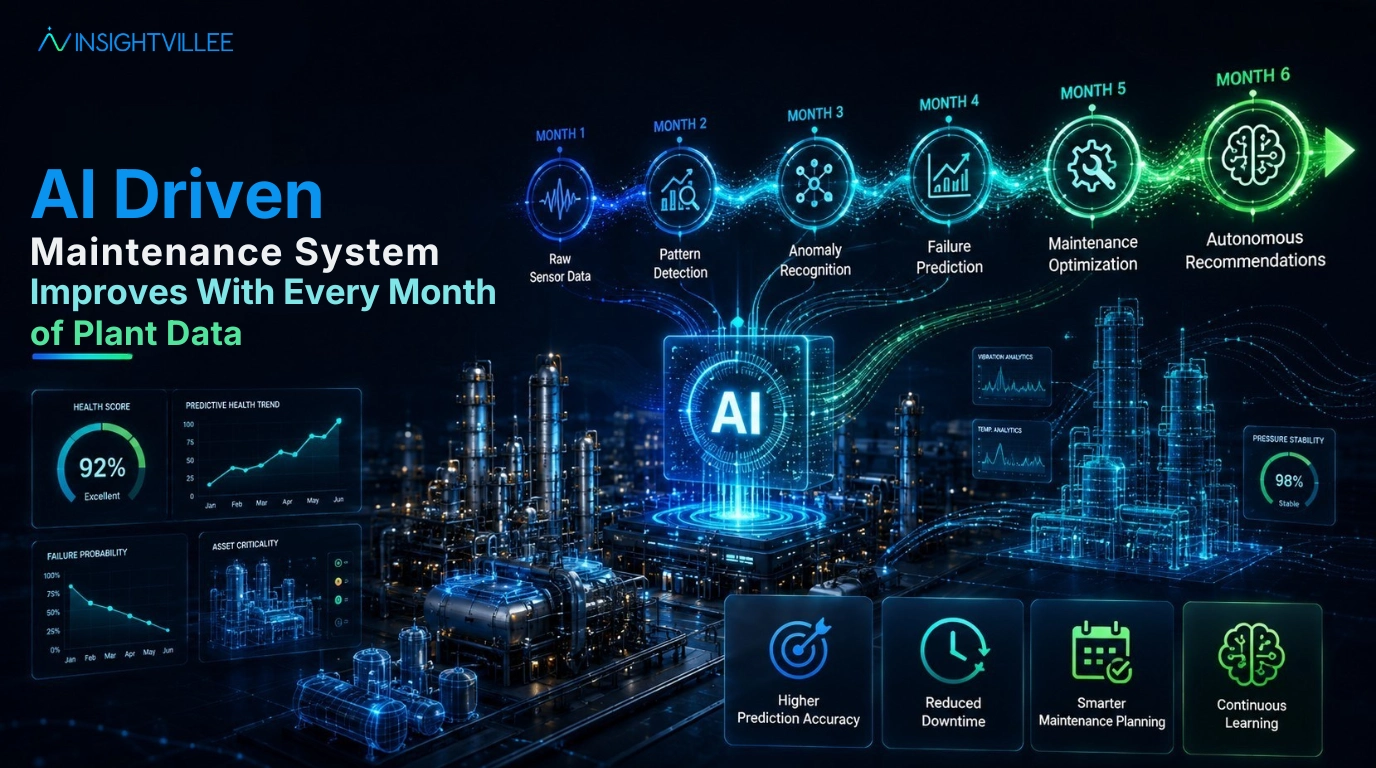
How an AI-Driven Maintenance System Improves With Every Month of Plant Data
AI maintenance improves with plant data because every month adds more machine behaviour, maintenance actions, failure records, alert outcomes, and production context.
An AI-driven maintenance system does not become fully intelligent on day one. In the first month, it may only understand basic normal behaviour. After more months, it starts learning which patterns matter, which alerts are noise, and which early signals lead to real maintenance action.
This is where many plants misunderstand the journey. The first value is visibility. The deeper value comes when data turns into learning, and learning turns into better maintenance decisions.
NIST notes that advanced maintenance approaches can help manufacturers reduce downtime, defects, and maintenance cost when implemented well [NIST, 2018]. ISO 13374 gives guidance for condition monitoring and diagnostics of machines, including processing and presentation of machine condition information [ISO, 2003].
What Is an AI-Driven Maintenance System?
An AI-driven maintenance system uses machine signals, sensor data, maintenance history, operating conditions, and production context to detect equipment risks before they become failures.
It learns machine behaviour patterns instead of depending only on fixed thresholds.
It helps maintenance teams identify abnormal behaviour, reduce false alarms, prioritise machine risks, and plan maintenance before production is affected.
The goal is not only monitoring. The goal is better maintenance intelligence.
For a Plant Head, this means one simple thing. The system should help the team act before machine trouble becomes output loss.
Why Does Plant Data Matter for AI Maintenance?
Plant data matters because every machine behaves differently under real plant conditions, and generic rules cannot fully understand those differences.
Machine behaviour changes by load, speed, shift, product, batch, temperature, process condition, and maintenance state.
A pump in one plant may behave differently from the same pump in another plant. A motor may run normally at one speed but abnormally at another. A compressor may run warmer under peak load but show risk if the same pattern appears during low load.
Plant data helps the system learn how each machine behaves in its actual environment.
This is why [Link: how AI learns machine behaviour patterns that manual analysis cannot detect → /blog/ai-learns-machine-behaviour-patterns] matters for long-term maintenance improvement.
What Data Helps an AI Maintenance System Improve?
An AI maintenance system improves when machine data is connected with maintenance outcomes, production context, inspection findings, false alarm feedback, and asset criticality.
Useful data includes vibration, temperature, pressure, flow, current, power, speed, load, runtime hours, start-stop cycles, maintenance history, breakdown records, work orders, inspection findings, false alarm feedback, production conditions, shift data, process data, and asset criticality.
The most useful learning happens when machine data is connected with what happened after the alert.
Did the team inspect the machine? Was there a real issue? Was the alert low priority? Did the machine fail later? Was the repair completed?
Without this feedback, the system sees patterns but cannot fully learn which ones created value.
What Happens in the First Month of AI Maintenance?
In the first month, AI maintenance starts building a baseline of normal machine behaviour and helps teams check whether the data foundation is strong enough.
It studies how machines behave during normal operation, peak load, idle time, startup, shutdown, changeovers, and different shifts.
At this stage, the system may focus more on abnormal behaviour detection than deep failure prediction.
The maintenance team also begins validating whether alerts are useful, noisy, or missing context.
In many plants, the first month is less about perfect prediction and more about learning the truth of the data. Are tags correct? Are sensors reliable? Are timestamps aligned? Are work orders complete enough to explain what happened?
How Does AI Learn Normal Machine Behaviour Over Time?
AI learns normal machine behaviour over time by comparing current machine signals with historical behaviour under similar operating conditions.
It studies what normal vibration, temperature, pressure, current, flow, and load patterns look like under different conditions.
A machine may behave normally at one speed but abnormally at another. A compressor may run warmer under peak load, but the same temperature during low load may indicate a problem.
Over time, the system builds a more accurate behaviour profile for each asset.
This is AI learning in practical plant language. It means the system becomes better at knowing what is normal for that machine, in that plant, under that condition.
How Does AI Improve Failure Pattern Detection?
AI improves failure pattern detection by comparing early warning signals with later maintenance actions, breakdowns, confirmed issues, and inspection results.
Failure patterns become clearer as more data is collected.
For example, if a small vibration drift later leads to bearing replacement, that pattern becomes more useful in future alerts. If pressure instability repeatedly appears before fouling is found, that relationship becomes clearer.
Every confirmed issue helps the system identify similar risks earlier next time.
This is how AI learns from maintenance data. It connects the early signal with the later outcome.
The Insightvillee AI driven maintenance system is part of a larger smart factory platform that connects machine data, maintenance history, and production context, so failure patterns become clearer as real plant outcomes are recorded month after month.
How Does AI Reduce False Alarms Month by Month?
AI reduces false alarms month by month by learning which variations are harmless and which behaviour changes are linked to real maintenance risk.
Some alerts come from startup conditions, temporary load changes, sensor noise, or normal process variation.
When maintenance teams mark an alert as false, low priority, or useful, that feedback helps improve future alert quality.
Over time, the system becomes better at separating normal operating behaviour from real maintenance risk.
This improves trust among technicians and floor teams. [Link: why floor teams trust AI driven maintenance recommendations building operator confidence → /blog/floor-teams-trust-ai-driven-maintenance]
Human angle: Trust grows when technicians see fewer useless calls and more alerts that match what they find on the machine.
How Does AI Get Better at Prioritising Machines?
AI gets better at prioritising machines when it learns asset criticality, failure history, downtime impact, repair outcomes, and production risk.
Not every alert has the same impact.
A small abnormal pattern on a critical compressor may deserve higher priority than a stronger alert on a non-critical auxiliary motor.
As the system sees more plant data, it can rank machine risks more accurately.
This helps teams focus first on assets that create the highest production, safety, or cost risk.
Predictive maintenance improves over time when the system learns not only failure signals, but also business consequences.
How Does Maintenance Feedback Make AI Smarter?
Maintenance feedback makes AI smarter by closing the loop between alert, inspection, repair, false alarm, confirmed failure, and final outcome.
The system needs to know what happened after every alert.
Did it lead to inspection? Did it lead to repair? Was no action taken? Was it a false alarm? Was it a confirmed failure? Was maintenance planned for the next shutdown?
Without feedback, the system can detect patterns but may not know whether those patterns were useful.
If technicians do not record what they found, the system keeps learning from half the story. The machine speaks through data, but the maintenance team completes the meaning.
As part of its predictive maintenance capability, Insightvillee works as an AI driven maintenance system that helps plant teams act before failures affect production, but that learning becomes stronger when teams record inspection findings, false alarms, repair actions, and final outcomes.
Why Does AI Need Plant-Specific Learning, Not Generic Models Alone?
AI needs plant-specific learning because the same machine can behave differently depending on installation, load, environment, maintenance quality, and operator practice.
Every plant operates differently.
The same motor, pump, compressor, or gearbox may behave differently based on installation, load, process, temperature, environment, and maintenance history.
Generic models can provide a starting point. But plant-specific data makes recommendations more accurate.
AI maintenance model training with plant data becomes stronger when it learns from the exact machines, conditions, and failure history inside that plant.
What Improvements Should Plants Expect Over Time?
Plants should expect gradual improvement in baselines, abnormal behaviour detection, false alarm reduction, risk prioritisation, failure mode clarity, and maintenance planning.
The improvement is gradual.
Plants can expect more accurate normal behaviour baselines, better abnormal behaviour detection, fewer false alarms, earlier detection of real failure risks, better alert prioritisation, clearer failure mode identification, stronger maintenance planning, more reliable root cause analysis, and higher trust from maintenance and production teams.
Machine learning maintenance system improvement depends on three things working together: data quality, feedback quality, and plant adoption.
The AI driven maintenance system inside Insightvillee helps maintenance teams prioritise risks, reduce avoidable breakdowns, and plan action before production is affected, but those improvements depend on consistent plant data and closed-loop maintenance feedback.
What Can Stop an AI Maintenance System From Improving?
An AI maintenance system can stop improving when data is missing, poorly mapped, disconnected, or not linked with real maintenance outcomes.
Common blockers include missing sensor data, poor timestamp alignment, wrong asset mapping, incomplete work orders, no feedback after alerts, failure records without root cause, maintenance actions not updated, production context not connected, and teams ignoring recommendations.
The biggest blocker is an open loop.
If the plant does not connect alert, action, and outcome, learning slows down.
This is why [Link: what data quality does an AI driven maintenance system actually need to work → /blog/data-quality-ai-driven-maintenance-system] should be treated as a maintenance priority, not only a data topic.
What Are the Best Practices to Help AI Improve Every Month?
The best practice is to start with critical machines, connect maintenance and production data, record outcomes clearly, review alerts regularly, and improve data quality over time.
Start with critical machines first.
Connect machine data with maintenance and production systems. Standardise asset names, tags, and failure categories. Record inspection findings clearly.
Mark alerts as true, false, useful, or low priority. Capture what action was taken after each recommendation. Review alerts with maintenance teams regularly.
Improve sensor quality and data gaps over time.
Use AI as decision support, not as a replacement for engineering judgement.
Conclusion
An AI-driven maintenance system improves with every month of plant data because it learns from real machine behaviour, operating context, maintenance actions, and failure outcomes.
In the beginning, it builds baselines and detects abnormal behaviour.
Over time, it becomes better at reducing false alarms, identifying early failure patterns, prioritising machine risks, and supporting maintenance planning.
The real value is not only the model. It is the continuous learning loop between plant data, maintenance decisions, and real outcomes.
Insightvillee is a smart factory transformation partner that includes an AI driven maintenance system for reducing unplanned downtime and improving maintenance planning.
Insightvillee supports this shift as a transformation partner for large-scale manufacturers through predictive maintenance, OEE monitoring, smart production planning, and one real-time intelligence layer across machines, lines, and systems. Its locked outcomes include up to 40% reduction in unplanned downtime in relevant deployments. This is deployment-specific, not a universal guarantee.
Within the Insightvillee smart factory platform, the AI driven maintenance system connects equipment health with production impact, so leaders can make better maintenance decisions as plant data, feedback, and maintenance outcomes improve over time.
Key Takeaways
AI-driven maintenance improves over time as it learns from real plant data and maintenance outcomes.
The first month is mainly about baselines, data checks, and early abnormal behaviour detection.
Maintenance feedback is critical because it tells the system which alerts were useful.
Plant-specific learning is stronger than depending only on generic rules.
Better data quality, feedback quality, and floor adoption improve long-term results.