
Factory Intelligence Platform: What Large Manufacturers Gain in the First Six Months
When large plants buy new digital software, managers often expect immediate magic. They want costs to drop on day one. But the reality is that real change takes a little time. Before you can make a machine run better, you must first be able to see what it is doing. The first half-year is all about building this clear view.
Many owners think they need more data. But data is not the real issue. Factories already have plenty of numbers. The problem is that these numbers are trapped inside different computers where nobody can read them together. A factory intelligence platform fixes this by gathering all factory data into one clear screen, helping teams make better choices every single day.
What Is a Factory Intelligence Platform?
This system is a smart layer of software for your whole plant. Traditional dashboards only show old reports about what broke yesterday. This new system connects directly to your machines, workflows, and tools to show you what is happening right now.
To get a clear picture of this setup, it helps to understand Smart Factory Operations: What Changes When Every System Feeds One Intelligence Layer . This software connects everything so that the maintenance team, production team, and plant heads all look at the exact same numbers at the same time.
Why Large Manufacturers Struggle Without a Unified Intelligence Layer
What we frequently see across production facilities is that different teams work with different versions of the truth. The maintenance crew blames a machine breakdown on poor raw materials. Meanwhile, the production team blames it on bad machine settings.
Because data is trapped in separate silos, decisions take days instead of minutes. This forces teams into reactive management, where they are always running around putting out fires instead of stopping problems before they happen.
The First Six Months: A Step-by-Step Operational Journey
High-performing manufacturers do not try to fix everything at once. They follow a simple path over their first six months to achieve true plant intelligence.
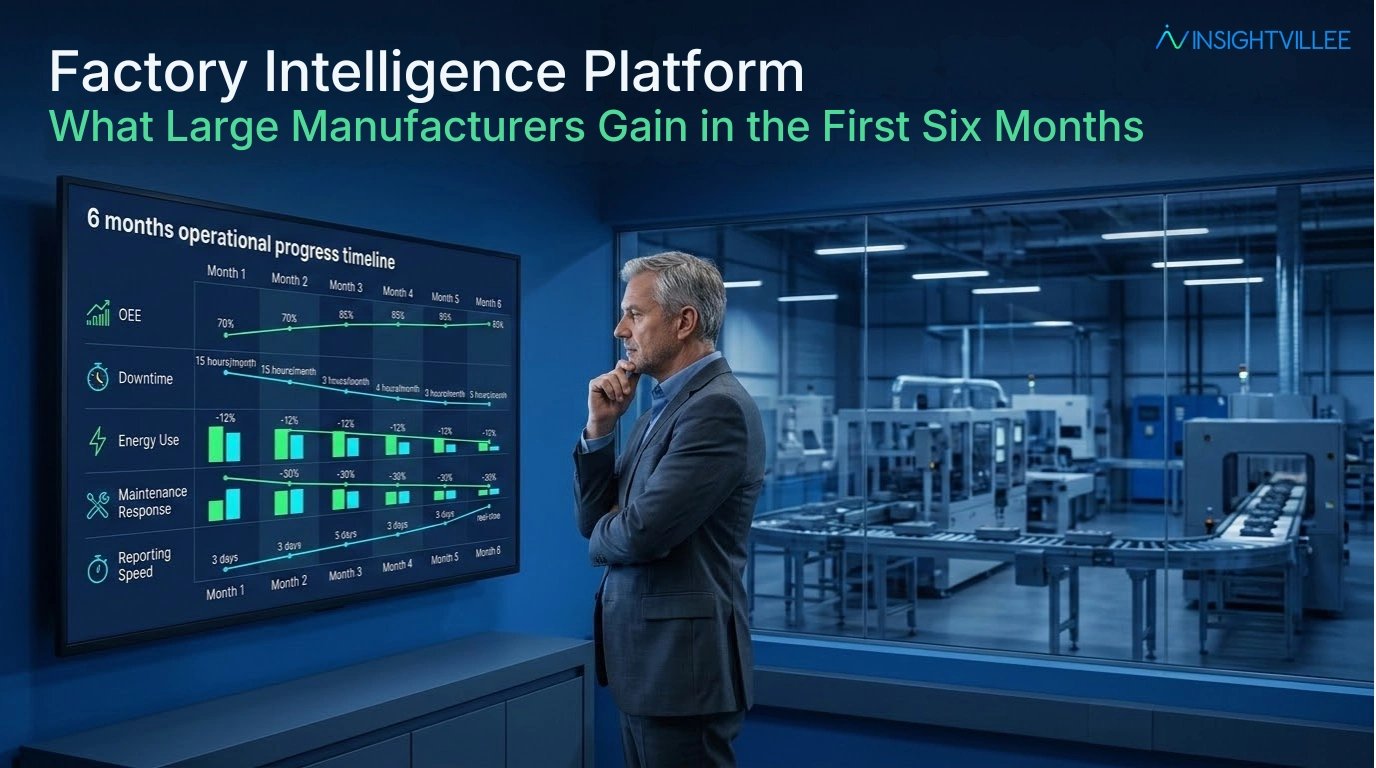
Month 1-2: Connect & See → Month 2-3: Find Patterns → Month 3-4: Better Teamwork → Month 4-6: Improve ROI
Months 1–2: Gaining Visibility Into Operations
The first two months are all about making the invisible visible. Engineers attach sensors to older machines and link newer systems together. Instead of relying on manual paper logs, the plant gets a single source of truth. Production teams quickly find hidden speed losses that were never written down before.
Months 2–3: Discovering What the Data Is Really Saying
Once the data flows, the system uncovers production bottlenecks. For example, a supervisor might find that Line 2 stops for three minutes every hour because an upstream conveyor is slightly too slow.
Months 3–4: Improving Operational Decision-Making
Teams stop relying on gut feelings and start using real-time facts. Daily morning meetings take ten minutes instead of an hour because the data tells everyone exactly where to focus. Production and maintenance teams work together easily because they can see the exact same issues.
Months 4–5: Driving Measurable Performance Improvements
With clear facts, factories see a major downtime reduction across critical assets. Teams fix small errors before they stop the line. This directly improves overall equipment effectiveness (OEE) and lets more goods roll out the factory door each day.
Months 5–6: Building Predictive and Proactive Operations
By the sixth month, the plant stops reacting to problems. The software spots small vibrations or heat changes in a motor. This lets the maintenance team service the asset during a planned break, completely avoiding a surprise breakdown.
Key Metrics Manufacturers Commonly Improve
A modern manufacturing platform helps teams track and improve these vital numbers within the first 180 days:
- OEE (Overall Equipment Effectiveness): Shows how healthy, fast, and accurate your machines are.
- Throughput: The total number of good units made per shift.
- MTBF and MTTR: How long a machine runs before failing, and how fast you fix it.
- Specific Energy Consumption (SEC): Tracking the power used to make a single item.
Real-World Scenario: What Changed in Six Months
Consider a large automotive component factory in Chennai that suffered from frequent line stops. They could never pinpoint the true root cause. To understand the gravity of these issues, teams must evaluate The Full Cost of Unplanned Downtime
When they deployed a modern system, the data revealed that a major stamping machine was overheating because an internal filter was clogged. This issue had gone unnoticed for months. By cleaning the filter and tracking real-time heat levels, the plant boosted its OEE by 8% within ninety days, achieving a fast manufacturing ROI.
How AI Expands the Value of the Platform
In many plants, major breakdowns receive immediate attention. However, minor speed losses and frequent small adjustments often account for a significant share of lost production time while receiving far less attention. This is where AI helps.
AI is not a marketing gimmick; it is an extra set of eyes. Traditional systems only tell you when a machine breaks down. AI analyzes hundreds of past batches to find the hidden reasons behind quality drops. It tracks how temperature changes affect power use, leading to a strong smart factory ROI. This is especially helpful for [Link: because it shows exactly how minor maintenance issues can quietly drive up your electricity bills.
Conclusion: Visibility Always Comes Before Optimization
The biggest lesson of the first six months is that you cannot fix what you cannot see. Manufacturers do not struggle because they lack data; they struggle because they lack actionable insights. By connecting your floor to a single system, you lay a strong foundation for long-term growth and smarter daily decisions.