
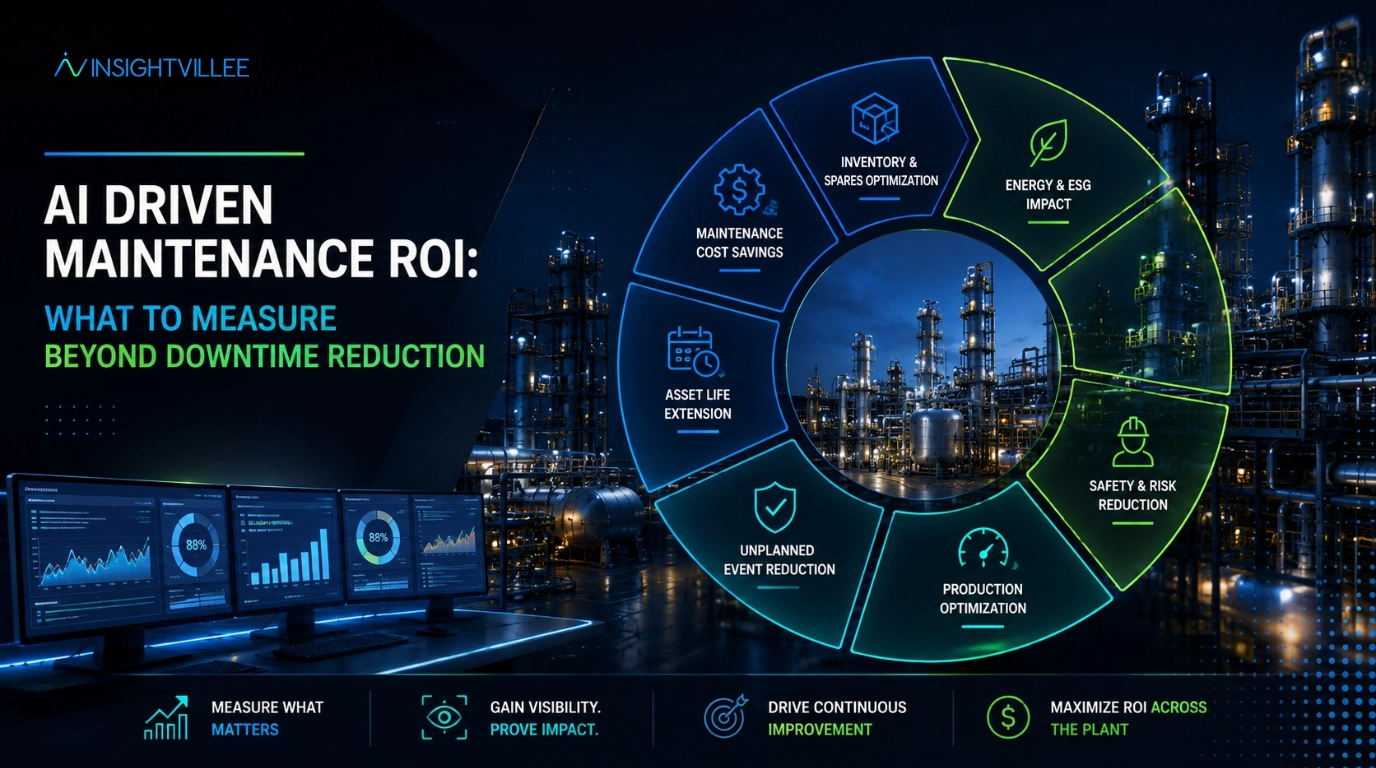
AI-Driven Maintenance ROI: What to Measure Beyond Downtime Reduction
Maintenance ROI is often judged by one question: how many breakdown hours did we avoid?
That question matters. But it is incomplete.
A plant may avoid a breakdown and still lose value through emergency spares, technician overtime, repeated troubleshooting, slow repairs, poor asset health, energy waste, and low trust in alerts. These costs do not always appear as full downtime. But they still reduce plant performance.
NIST reported that predictive maintenance was associated with 15% less downtime, 87% lower defect rate, and 66% less inventory increase due to maintenance issues among surveyed manufacturers [NIST, 2020]. Siemens also reported that unscheduled downtime costs the world’s 500 biggest companies 11% of annual revenues [Siemens, 2024].
What Is AI-Driven Maintenance ROI?
AI-driven maintenance ROI measures the business value created when better maintenance decisions reduce failures, repair cost, asset stress, energy waste, production loss, and safety risk.
It compares the cost of implementing and running the system against measurable operational gains.
These gains may include lower downtime, fewer emergency repairs, reduced spare consumption, better manpower use, lower energy waste, and improved production reliability.
The real question is not only, “Did downtime reduce?” It is, “Did maintenance decisions become better and cheaper for the plant?”
Why Does Downtime Reduction Alone Not Show Full Maintenance ROI?
Downtime reduction alone does not show full maintenance ROI because many maintenance gains happen before a machine fully breaks down.
Downtime is the most visible maintenance loss. That is why leaders measure it first.
But many improvements happen quietly. A team may reduce minor stoppages. It may avoid emergency repair. It may reduce repeated inspections. It may increase planned maintenance. It may extend asset life.
If the plant measures only downtime, it may undervalue AI maintenance.
Expert angle: In many plants, the biggest ROI is not only in avoiding one major breakdown. It is in reducing the daily maintenance noise that slowly drains time, spares, trust, and production confidence.
[Link: how AI driven maintenance prioritises which machine to fix first when multiple alerts fire → /blog/ai-driven-maintenance-prioritises-machine-alerts]
What Should Plants Measure Beyond Downtime Reduction?
Plants should measure emergency maintenance cost, planned maintenance ratio, MTBF, MTTR, labour productivity, spares, false alarms, production loss, energy efficiency, asset life, and safety risk.
This gives a fuller view of AI driven maintenance ROI metrics.
Useful measures include emergency maintenance cost, planned versus unplanned maintenance ratio, maintenance labour productivity, spare parts consumption, asset life extension, MTBF improvement, MTTR reduction, false alarm reduction, work order closure time, energy waste linked to machine condition, production loss avoided, and safety risk reduction.
These metrics show whether the plant is only avoiding breakdowns or actually improving reliability.
How Does Emergency Maintenance Cost Show Maintenance ROI?
Emergency maintenance cost shows ROI because urgent repairs usually cost more than planned repairs and often include overtime, expedited spares, vendor support, and production disruption.
Emergency repairs are expensive because they happen under pressure.
The plant may need urgent labour. It may pay for faster spare delivery. It may call external support. Production may wait while the team diagnoses the issue.
AI maintenance can reduce this dependency by identifying risk earlier.
Plants should track how many urgent repairs were avoided and how much emergency maintenance spend reduced over time.
This is one direct way to show how AI maintenance reduces costs.
How Does Planned vs Unplanned Maintenance Ratio Show Maintenance ROI?
Planned versus unplanned maintenance ratio shows whether the plant is moving from reactive repair to controlled intervention.
A strong maintenance program shifts work from breakdown-driven repair to planned maintenance.
If AI recommendations are working, more maintenance should happen during planned stops, scheduled windows, or controlled shutdowns.
This improves coordination between production and maintenance teams.
Plants should measure the percentage of maintenance work completed as planned work versus breakdown-driven work.
The Insightvillee AI driven maintenance system is part of a larger smart factory platform that connects machine data, maintenance history, and production context, so leaders can measure whether maintenance is shifting from emergency response to planned action.
This is important for maintenance ROI in manufacturing plants because planned work is easier to control, schedule, and close.
How Does MTBF Improvement Show Maintenance ROI?
MTBF improvement shows maintenance ROI because it proves machines are failing less often and becoming more reliable over time.
MTBF means Mean Time Between Failures.
If AI-driven maintenance helps identify early failure patterns and correct root causes, MTBF should improve.
Higher MTBF means machines run longer between failures. It is a strong reliability metric because it shows whether assets are becoming more stable.
ISO 22400 provides a KPI framework for manufacturing operations management, supporting standardised use of operational indicators across manufacturing environments [ISO, 2014].
How Does MTTR Reduction Show Maintenance ROI?
MTTR reduction shows maintenance ROI because it proves teams are diagnosing and restoring equipment faster after a failure or maintenance issue.
MTTR means Mean Time To Repair.
AI can reduce MTTR by giving teams better context before they inspect the machine.
When technicians know which signal changed, what failure mode may be developing, and what similar past events showed, diagnosis becomes faster.
Plants should track whether AI-supported repairs are being closed faster than manually diagnosed repairs.
Human angle: A technician with the right context does not waste time checking ten possible causes. He starts with the most likely one.
How Does Maintenance Labour Productivity Show Maintenance ROI?
Maintenance labour productivity shows ROI by measuring whether skilled teams spend less time on low-value alerts, unclear symptoms, and repeated troubleshooting.
Maintenance teams often spend time searching for information.
They check low-value alerts. They compare old reports. They inspect machines where no real issue is found. They troubleshoot the same fault again and again.
AI maintenance can reduce this effort by prioritising real risks and giving clearer recommendations.
Plants should measure technician time per issue, inspections converted into confirmed findings, and repeated troubleshooting hours.
Better labour productivity does not mean replacing people. It means helping skilled teams spend more time on the right work.
How Do Spare Parts and Inventory Efficiency Show Maintenance ROI?
Spare parts and inventory efficiency show ROI because better failure visibility helps plants reduce emergency purchases, stockouts, excess inventory, and repeat spare consumption.
Poor maintenance visibility creates panic buying.
A plant may keep too much inventory because it does not trust failure visibility. Or it may face stockouts during breakdowns because likely failures were not seen early.
AI maintenance can support better spare planning by identifying likely failures earlier.
Plants should measure emergency spare purchases, stockout incidents, inventory carrying cost, and spare consumption linked to repeated failures.
How Does False Alarm Reduction Show Maintenance ROI?
False alarm reduction shows maintenance ROI because fewer low-value alerts save technician time and improve trust in maintenance recommendations.
False alarms consume time and reduce confidence.
If AI improves alert quality, plants should see fewer unnecessary inspections and a higher confirmed issue rate.
Track false alarm rate, alert-to-inspection conversion, confirmed fault percentage, and repeat nuisance alerts.
This shows whether the system is creating useful maintenance intelligence or just more noise.
Trust also matters because recommendations only create value when floor teams act on them. [Link: why floor teams trust AI driven maintenance recommendations building operator confidence → /blog/floor-teams-trust-ai-driven-maintenance]
How Does Production Loss Avoided Show Maintenance ROI?
Production loss avoided shows maintenance ROI because machine issues can reduce output even when they do not cause full downtime.
A machine issue may not stop the line completely.
It may slow cycles, create micro-stoppages, reduce throughput, cause unstable operation, or increase quality deviation risk.
AI maintenance can help detect these hidden performance losses earlier.
Plants should measure output loss avoided, line speed recovery, reduced micro-stoppages, and production adherence improvement.
As part of its predictive maintenance capability, Insightvillee works as an AI driven maintenance system that helps plant teams act before failures affect production, making production loss avoided a practical ROI metric.
This is part of the business impact of AI driven maintenance because the value appears in production flow, not only maintenance records.
How Does Energy Efficiency Linked to Machine Health Show Maintenance ROI?
Energy efficiency linked to machine health shows ROI because poor equipment condition can consume more power for the same output.
A fouled compressor, misaligned motor, worn pump, or inefficient gearbox may use more energy.
That extra energy cost may continue for weeks before a breakdown occurs.
AI maintenance can connect machine health with energy use.
Plants should track energy consumption per machine, energy per unit produced, specific energy consumption, and energy waste reduced after maintenance action.
This is especially relevant in process-heavy environments. [Link: AI driven maintenance in chemical plants handling corrosion fouling and pressure drift → /blog/ai-driven-maintenance-chemical-plants]
How Does Asset Life Extension Show Maintenance ROI?
Asset life extension shows maintenance ROI because better maintenance decisions reduce repeated stress, overheating, vibration damage, lubrication failure, and overload.
Asset life extension may not show immediately in a monthly downtime report.
But it can reduce replacement cost and capital pressure over time.
Plants should track repeated failure reduction, major overhaul frequency, replacement deferral, and asset health improvement trends.
This is one reason predictive maintenance ROI beyond downtime should include longer-term asset health.
How Does Safety and Compliance Risk Reduction Show Maintenance ROI?
Safety and compliance risk reduction shows maintenance ROI because some equipment failures can create leaks, overheating, pressure incidents, unsafe conditions, or audit gaps.
This is especially important in chemical, pharma, utilities, energy, and heavy manufacturing environments.
AI maintenance can help identify risky equipment behaviour before it creates safety exposure.
Plants should measure safety-related alerts, corrective action closure time, repeat safety-critical equipment issues, and audit readiness.
This ROI is not only financial. It protects workers, compliance, and operational continuity.
How Should Plants Build a Practical AI-Driven Maintenance ROI Framework?
Plants should build ROI by setting a baseline, tracking hard savings and avoided losses, linking alerts to work orders, and reviewing value across maintenance, production, energy, and safety.
Start with a baseline before implementation.
Separate downtime savings from maintenance cost savings. Connect AI alerts with work orders and completed actions. Measure alert quality, not just alert volume.
Review ROI by asset type, line, plant, and failure mode.
Include production, maintenance, energy, and safety teams in ROI review.
The AI driven maintenance system inside Insightvillee helps maintenance teams prioritise risks, reduce avoidable breakdowns, and plan action before production is affected, but ROI should still be measured through completed work orders and verified plant outcomes.
This answers what to measure in AI maintenance ROI in a practical way.
What Mistakes Do Plants Make When Measuring AI Maintenance ROI?
Plants make mistakes when they measure only downtime, count every alert as value, ignore false alarms, and fail to connect alerts with completed maintenance action.
Common mistakes include measuring only downtime hours, counting every alert as value, ignoring false alarms, not linking alerts to work orders, not measuring avoided production loss, forgetting spares and labour savings, measuring too early, and not separating AI-driven improvements from normal maintenance work.
The biggest mistake is counting alerts as ROI.
An alert has value only when it leads to the right action.
[Link: smart factory operations what one intelligence layer changes for manufacturers → https://insightvillee.com/smart-factory-operations-what-one-intelligence-layer-changes-for-manufacturers/]
How Does AI-Driven Maintenance ROI Improve Over Time?
AI-driven maintenance ROI improves over time as plant data, maintenance feedback, alert quality, team trust, and completed action all improve together.
AI maintenance ROI usually improves as the system learns from more plant data.
Better data improves alert accuracy. Maintenance feedback improves recommendations. Confirmed outcomes improve failure pattern detection.
As trust grows, teams act faster on recommendations.
Over time, value shifts from single breakdown prevention to continuous reliability improvement.
Conclusion
AI-driven maintenance ROI is strongest when plants measure better reliability decisions, not only fewer breakdown hours.
Downtime reduction is important. But it is only one part of the value.
Plants should also measure emergency repair cost, planned maintenance ratio, MTBF, MTTR, labour productivity, spare efficiency, false alarm reduction, production loss avoided, energy efficiency, asset life, and safety risk reduction.
The real value of AI-driven maintenance is better reliability decisions across the plant.
Insightvillee is a smart factory transformation partner that includes an AI driven maintenance system for reducing unplanned downtime and improving maintenance planning.
Insightvillee supports this shift as a transformation partner for large-scale manufacturers through predictive maintenance, OEE monitoring, energy management, safety and compliance automation, and one real-time intelligence layer across machines, lines, and systems. Its locked outcomes include up to 40% reduction in unplanned downtime and ROI within 6 to 9 months in relevant deployments. These are deployment-specific outcomes, not universal guarantees.
Within the Insightvillee smart factory platform, the AI driven maintenance system connects equipment health with production impact, so leaders can make better maintenance decisions across maintenance, production, energy, and safety teams.
Key Takeaways
Downtime reduction is important, but it is not the full ROI story.
AI-driven maintenance ROI should include maintenance cost, labour, spares, energy, safety, and production loss avoided.
Alerts do not create ROI unless they turn into completed maintenance action.
Better ROI measurement needs a baseline before implementation.
The strongest ROI comes from better reliability decisions across maintenance, production, energy, and safety teams.