
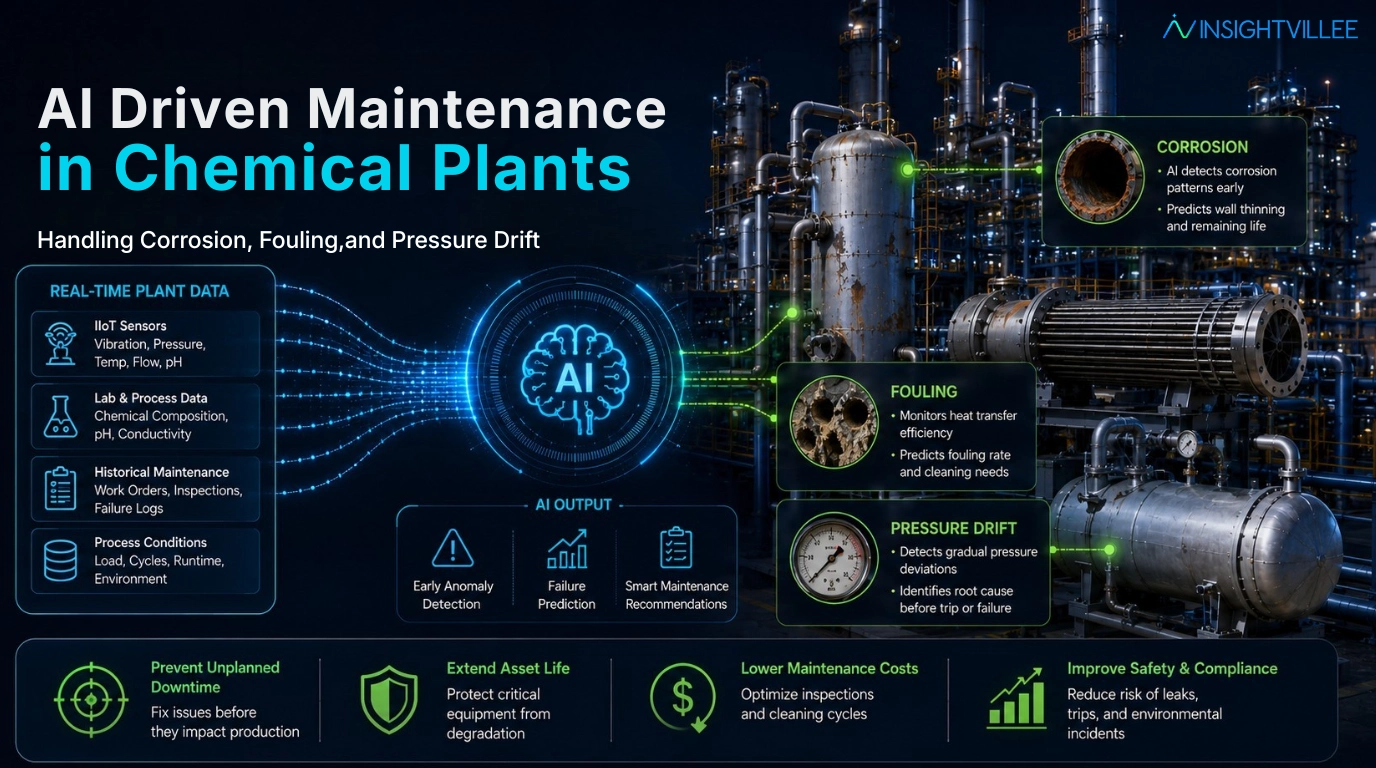
AI Maintenance in Chemical Plants: Corrosion, Fouling, Drift
AI driven maintenance in chemical plants helps teams detect slow equipment changes before they become safety, quality, or production problems.
In a chemical plant, a small pressure drift is not always small. A little fouling inside a heat exchanger can reduce output. A small corrosion sign in the wrong area can become a serious reliability and safety risk.
The problem is that these issues often develop quietly. They do not always cross alarm limits early. They may appear across pressure, flow, temperature, vibration, and process data together.
NIST notes that advanced maintenance approaches can help manufacturers reduce downtime, defects, and maintenance cost when implemented well [NIST, 2021]. Siemens reported that unscheduled downtime costs the world’s 500 biggest companies 11% of annual revenues [Siemens, 2024].
What Is AI-Driven Maintenance in Chemical Plants?
AI-driven maintenance in chemical plants uses equipment data, process conditions, maintenance history, and failure records to detect risk before breakdowns or process failures happen.
It studies assets such as reactors, pumps, heat exchangers, compressors, mixers, valves, pipelines, and distillation units.
The goal is not only to detect machine faults. The goal is to understand how equipment condition affects process stability, safety, quality, and output.
ISO 13374 gives guidance for condition monitoring and diagnostics of machines, including how machine condition information can be processed and presented [ISO, 2003]. For chemical plant maintenance, the important point is that raw readings must become useful decisions.
Why Is Chemical Plant Maintenance More Complex Than Standard Machine Maintenance?
Chemical plant maintenance is more complex because equipment behaviour is connected with pressure, temperature, material properties, batch conditions, safety limits, and process stability.
A mechanical issue is rarely isolated.
A pump issue can affect flow stability. A heat exchanger issue can affect temperature control. A pressure drift may point to fouling, leakage, blockage, valve behaviour, or compressor problems.
Maintenance teams need equipment data and process context together before deciding action.
Human angle: In many plants, maintenance and production teams are not fighting over intent. They are looking at different parts of the same problem. One sees asset health. The other sees process impact.
This is why [Link: how AI learns machine behaviour patterns that manual analysis cannot detect → /blog/ai-learns-machine-behaviour-patterns] is relevant in chemical manufacturing.
Why Are Corrosion, Fouling, and Pressure Drift Hard to Detect Early in Chemical Plants?
Corrosion, fouling, and pressure drift are hard to detect early because they develop slowly and often show weak signals across several process and equipment readings.
Corrosion may affect wall thickness, leakage risk, or equipment integrity before visible failure appears.
Fouling may slowly reduce heat transfer, flow, or process efficiency. Pressure drift may look minor until it affects stability or batch output.
A single reading may still look acceptable. But the pattern may already be changing.
Chemical plants need pattern-based detection, not only fixed thresholds.
Where Does Insightvillee Fit Into AI-Driven Maintenance in Chemical Plants?
Insightvillee provides an AI driven maintenance system for large manufacturing plants that need earlier visibility into machine risks, downtime threats, and maintenance priorities.
For chemical plants, this means corrosion, fouling, and pressure drift are not judged as separate data points. They are connected with process conditions, maintenance history, asset criticality, and production impact.
Insightvillee supports this through its smart factory operations platform, where predictive maintenance works with OEE monitoring, batch traceability, safety and compliance automation, and one real-time intelligence layer across machines, lines, and systems.
How Does AI-Driven Maintenance Help With Corrosion Risk in Chemical Plants?
AI-driven maintenance helps with corrosion risk by connecting inspection records, operating conditions, process exposure, pressure behaviour, temperature patterns, and repeated maintenance findings.
Corrosion can be influenced by material properties, chemical exposure, moisture, temperature, pressure, flow conditions, and operating history.
AI can study patterns that suggest corrosion monitoring needs attention. These may include unusual pressure behaviour, repeated leakage indicators, abnormal equipment performance, or inspection findings linked to certain operating conditions.
For example, if a pipeline section repeatedly shows pressure instability after specific process runs, the system can help flag it for inspection before risk becomes critical.
Expert angle: Corrosion risk is not always missed because teams ignore it. It is often missed because the evidence is scattered across inspection logs, process trends, maintenance records, and operator notes.
How Does AI-Driven Maintenance Help With Fouling Detection in Chemical Plants?
AI-driven maintenance helps with fouling detection by comparing pressure drop, flow rate, temperature difference, energy use, and process output over time.
Fouling happens when deposits build up on equipment surfaces. It is common in heat exchangers, reactors, pipelines, filters, and process lines.
A single pressure or temperature value may look normal. But the relationship between flow, pressure, heat transfer, and energy use may show early fouling.
How does AI identify fouling? It detects when the equipment starts needing more pressure, more energy, or more time to deliver the same process result.
This helps teams clean or service equipment before fouling affects product quality, throughput, or energy use.
How Does AI-Driven Maintenance Identify Pressure Drift in Chemical Plants?
AI-driven maintenance identifies pressure drift by comparing current pressure behaviour with normal patterns for the same process, batch, load, and operating condition.
What is pressure drift in chemical plants? It means pressure slowly moves away from its expected operating pattern.
Pressure drift may indicate blockage, leakage, fouling, valve issues, compressor problems, pump degradation, or unstable process control.
The Insightvillee AI driven maintenance system is part of a larger smart factory platform that connects machine data, maintenance history, and production context, helping teams understand whether pressure drift is normal process movement or an early maintenance risk.
AI can detect slow drift before it becomes a major deviation. This allows teams to investigate while the process is still stable.
Pressure drift monitoring in chemical plants is useful because small repeated movements can warn teams before a bigger process issue appears.
Why Are Threshold-Based Alerts Not Enough for AI-Driven Maintenance in Chemical Plants?
Threshold-based alerts are not enough because many chemical plant risks develop below fixed limits and only become clear when equipment data is connected with process context.
Fixed thresholds are useful for safety limits and critical process boundaries.
But a pressure value may stay within the safe range while still drifting abnormally. A heat exchanger may stay inside temperature limits while fouling slowly reduces efficiency. A pump may stay below vibration limits while flow and pressure behaviour suggest degradation.
This is where [Link: AI driven maintenance for rotating equipment pumps motors compressors and turbines → /blog/ai-driven-maintenance-rotating-equipment] also matters, because many chemical plant risks involve rotating assets inside larger process systems.
What Data Does AI-Driven Maintenance Need in Chemical Plants?
AI-driven maintenance needs pressure, temperature, flow, vibration, current, batch, process, alarm, inspection, maintenance, and failure data connected to the right asset.
Useful data includes pressure data, temperature data, flow data, vibration data, current and power data, pH or chemical property data where relevant, batch and recipe data, process setpoints, alarm history, inspection records, maintenance history, work orders, failure records, cleaning records, operator logs, and asset criticality.
The most useful insights come when equipment data is connected with process conditions and maintenance outcomes.
Good data quality decides whether AI maintenance for chemical manufacturing becomes trusted or ignored. [Link: what data quality does an AI driven maintenance system actually need to work → /blog/data-quality-ai-driven-maintenance-system]
How Does AI-Driven Maintenance Connect Equipment Health With Process Stability?
AI-driven maintenance connects equipment health with process stability by linking machine trends with process deviations, quality results, safety risk, and production outcomes.
In chemical plants, maintenance decisions cannot be based only on machine condition.
Teams also need to know whether equipment behaviour affects batch yield, product quality, process control, safety, or throughput.
For example, a heat exchanger issue is not only a maintenance issue if it affects temperature control. A pump issue is not only a pump issue if it creates unstable feed flow.
As part of its predictive maintenance capability, Insightvillee works as an AI driven maintenance system that helps plant teams act before failures affect production, quality, or process stability.
This improves coordination between maintenance, production, quality, and EHS teams.
What Maintenance Decisions Can AI Support in Chemical Plants?
AI can support decisions on which asset needs inspection first, whether drift is normal, whether fouling is developing, and whether maintenance can wait until a planned stop.
It can help decide whether corrosion risk is increasing in a specific area.
It can show whether a process deviation is linked to equipment behaviour.
It can help decide whether repeated issues need root cause analysis.
How does predictive maintenance work in chemical manufacturing? It connects equipment signals with process behaviour so teams can act before the problem becomes downtime, quality loss, or safety exposure.
What Example Shows Pressure Drift Before a Chemical Plant Process Issue?
A useful example is a reactor feed line showing small pressure drift across several batches without crossing the alarm threshold.
The pressure does not trigger a standard alert.
AI compares the pressure pattern with flow rate, temperature, batch recipe, valve position, and past maintenance records. It finds that the drift repeats under specific process conditions.
The likely concern may be early fouling or partial blockage.
Instead of waiting for a batch deviation or line stoppage, the team can inspect and clean the affected section during a planned window.
The AI driven maintenance system inside Insightvillee helps maintenance teams prioritise risks, reduce avoidable breakdowns, and plan action before production is affected.
This is where plant trust grows. The system does not only say “pressure changed.” It explains why the pattern matters and when the team should act.
What Are the Best Practices for AI-Driven Maintenance in Chemical Plants?
The best practice is to start with critical process assets, connect equipment data with process parameters, and validate alerts with inspection and maintenance outcomes.
Start with reactors, pumps, heat exchangers, compressors, pipelines, valves, and utilities that affect safety, quality, and throughput.
Keep rule-based safety limits, but add pattern detection for early risk. Track corrosion, fouling, and pressure drift as separate failure patterns.
Connect maintenance data with batch, quality, and process history. Review AI alerts with maintenance, production, and process teams.
Feed confirmed failures, false alarms, and corrective actions back into the system.
This helps leaders measure value beyond avoided downtime. [Link: AI driven maintenance ROI what to measure beyond downtime reduction → /blog/ai-driven-maintenance-roi-beyond-downtime]
Conclusion
AI-driven maintenance in chemical plants helps teams detect hidden patterns, connect equipment health with process stability, and prioritise action before failures affect safety, quality, or output.
Corrosion, fouling, and pressure drift are difficult to manage because they often develop slowly and across multiple data points.
Basic monitoring can detect obvious deviations. But it may miss early process-linked equipment risks.
The real value is not only predicting equipment failure. It is turning plant data into maintenance intelligence that protects process performance.
Insightvillee is a smart factory transformation partner that includes an AI driven maintenance system for reducing unplanned downtime and improving maintenance planning.
Insightvillee supports this shift as a transformation partner for large-scale manufacturers through predictive maintenance, OEE monitoring, batch traceability, safety and compliance automation, and one real-time intelligence layer across machines, lines, and systems. Its locked outcomes include up to 40% reduction in unplanned downtime in relevant deployments. This is deployment-specific, not a universal guarantee.
Within the Insightvillee smart factory platform, the AI driven maintenance system connects equipment health with production impact, so leaders can make better maintenance decisions.
Key Takeaways
Chemical plant maintenance is complex because equipment health and process stability are closely connected.
Corrosion, fouling, and pressure drift often develop slowly before visible failure.
AI-driven maintenance helps connect equipment data, process conditions, maintenance history, and inspection outcomes.
Threshold alerts are useful for hard limits, but they may miss slow and context-based risk.
Plant teams should validate AI alerts with inspection findings, repair outcomes, and process history.