
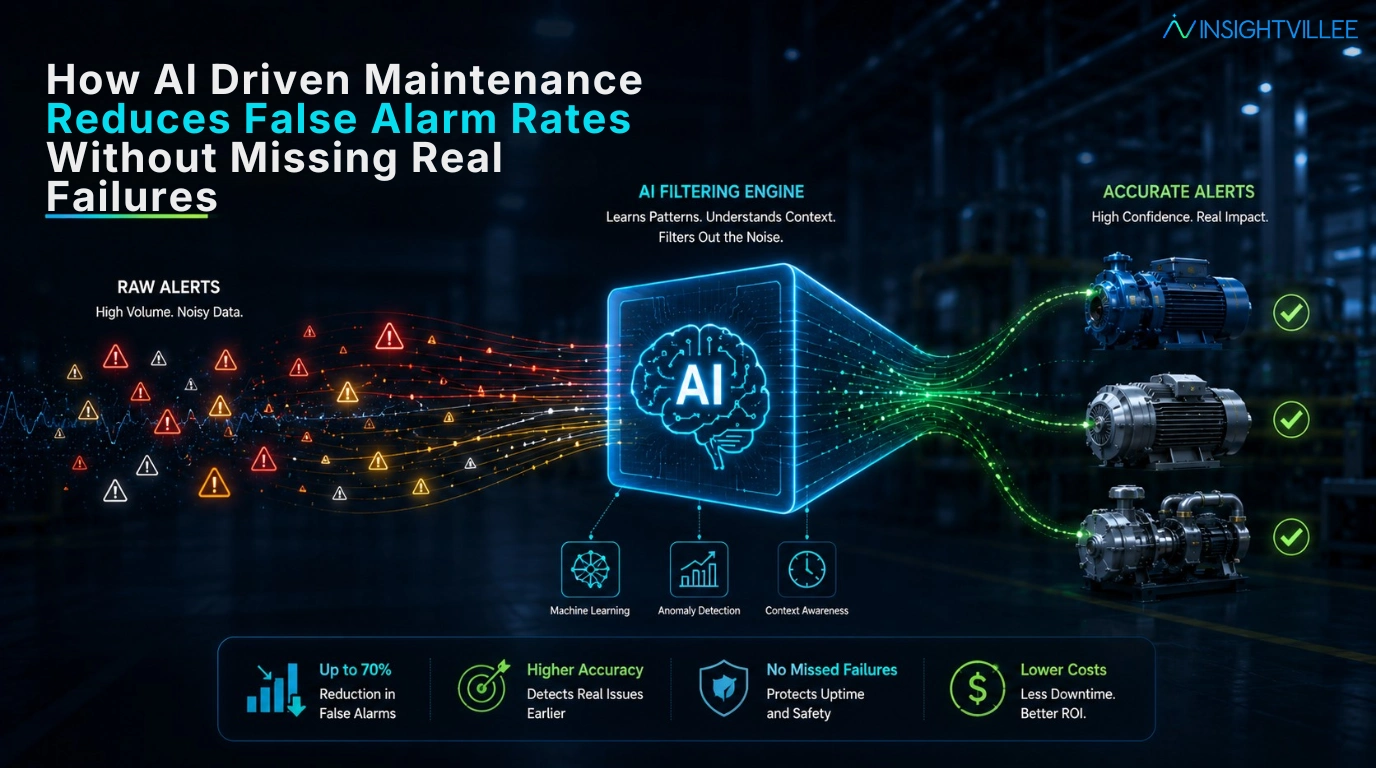
How AI Reduces False Alarms Without Missing Real Failures
AI driven maintenance reduces false alarms by checking machine behaviour with context, not only by reacting when one signal crosses a fixed limit.
In many plants, maintenance alerts are meant to protect production. But when alerts fire too often and do not lead to real findings, teams start losing trust. A technician walks to the same machine again. Production stops planning around another alarm. The supervisor asks, “Is this real or another false alert?”
That question is dangerous. Once teams stop trusting alerts, even real failure signals can get ignored.
What Are False Alarms in Maintenance?
False alarms in maintenance are alerts that warn of a possible machine issue, but inspection finds no real maintenance risk that needs action.
False alarms can come from temporary load changes, startup conditions, sensor noise, broad thresholds, poor data quality, or normal process variation.
In manufacturing plants, false alarms are not just irritating. They consume technician time. They interrupt maintenance planning. They disturb production discussions. They also weaken confidence in the alert system.
ISO 13374 provides guidance for condition monitoring and diagnostics of machines, including processing and presentation of machine condition information [ISO, 2003]. For plant teams, this means alerts should support useful decisions, not only present raw machine readings.
Why Do False Alarms Happen in Machine Monitoring?
False alarms happen in machine monitoring when systems judge machine signals without enough context about load, speed, shift, process condition, or past behaviour.
Many monitoring systems use fixed thresholds.
When vibration, temperature, pressure, current, or another signal crosses a set limit, an alert is triggered. This is useful for clear operating limits. But machines do not behave the same way under every condition.
A vibration rise may be normal during startup. A temperature rise may be expected during peak load. A pressure change may be normal during a process transition.
Without context, basic monitoring systems may treat normal variation as a fault.
This is one reason [Link: AI driven maintenance vs rule-based alerts why thresholds alone miss real failures → /blog/ai-driven-maintenance-vs-rule-based-alerts] matters for plants that still depend heavily on fixed limits.
Why Are False Alarms a Serious Problem for Maintenance Teams?
False alarms are serious because they waste technician time, reduce trust, distract teams from genuine risks, and make maintenance planning more reactive.
A false alarm is not only a wrong notification. It creates real work.
Someone must check the alert. Someone must decide whether to inspect. Someone may need to stop or slow work. Someone must explain the result to production.
When this happens again and again, alert fatigue begins.
In many plants, the issue is not that alerts are wrong once or twice. The issue is that repeated low-value alerts train people to stop taking the system seriously.
That is the human danger. The team may become calm at the exact moment when they should be alert.
Why Can Reducing False Alarms Create Another Maintenance Risk?
Reducing false alarms can create risk if teams simply raise thresholds, because the system may become too quiet and miss early failure signals.
One common reaction is to make thresholds wider.
This reduces noise. But it can also hide early warnings. A bearing issue, pressure drift, lubrication problem, or motor imbalance may develop below the new limit.
This creates a dangerous trade-off. Fewer alerts, but higher risk of missed failures.
A good maintenance system should reduce noise without becoming blind.
The goal is not silence. The goal is alert accuracy.
How Does AI-Driven Maintenance Reduce False Alarms?
AI-driven maintenance reduces false alarms by learning normal machine behaviour, comparing current behaviour with history, and checking whether the signal is temporary, repeating, worsening, or failure-linked.
AI maintenance does not only ask, “Did this value cross a limit?”
It asks, “Is this machine behaving abnormally for this condition?”
It studies multiple signals together instead of judging one reading alone. It compares current behaviour with past behaviour under similar load, speed, shift, and process conditions.
This helps separate normal operating variation from real maintenance risk.
For example, a compressor temperature rise during peak load may be normal. The same rise during low load may need inspection.
That difference is where alarm reduction becomes useful.
How Does AI Avoid Missing Real Failures?
AI avoids missing real failures by detecting slow drift, weak signal relationships, and repeated abnormalities before one signal crosses a fixed threshold.
Real failures often develop quietly.
A motor may not cross a temperature limit. But if current, vibration, and temperature drift together over several shifts, the combined pattern may show early risk.
A pump may not cross a vibration alarm. But if vibration changes with flow drop and pressure instability, the pattern may show cavitation, blockage, or bearing wear.
This is AI failure detection without missed alerts. The system reduces low-value noise while still watching for weak failure signals.
The best alert is not the loudest alert. It is the one that reaches the team early enough to prevent downtime and clearly enough to earn action.
Why Does Machine Context Improve Alert Accuracy?
Machine context improves alert accuracy because the same reading can be safe in one condition and risky in another.
A compressor temperature rise during peak load may be expected. The same rise during low-load running may point to cooling issues, inefficiency, or developing failure.
A pump vibration change during startup may be normal. The same vibration pattern during stable operation may indicate cavitation, imbalance, or bearing wear.
This is why alert accuracy depends on context.
The Insightvillee AI driven maintenance system is part of a larger smart factory platform that connects machine data, maintenance history, and production context, so alert accuracy improves through real plant conditions instead of isolated readings.
AI maintenance alert accuracy improves when machine signals are connected with load, speed, runtime, process condition, maintenance history, and shift behaviour.
What Data Helps AI Reduce False Alarms?
AI needs a connected machine, maintenance, production, process, and sensor-quality data to understand whether a signal is normal variation or real failure risk.
Useful data includes vibration, temperature, pressure, current, power, flow, speed, load, runtime hours, start-stop cycles, maintenance history, breakdown records, work orders, production conditions, shift data, process parameters, and sensor quality data.
The goal is not simply collecting more data. The goal is connecting the right data.
If vibration changes during high load, the system should know the load. If temperature rises after maintenance, the system should know the recent work order. If pressure varies during a process transition, the system should know the process condition.
This is why [Link: how AI learns machine behaviour patterns that manual analysis cannot detect → /blog/ai-learns-machine-behaviour-patterns] is important for better alert judgement.
How Does AI Learn From False Alarm Feedback?
AI learns from false alarm feedback when teams record whether each alert led to a real finding, no finding, inspection, repair, or confirmed failure.
Feedback is what makes the system stronger over time.
If an alert leads to no finding, that feedback helps refine future alert logic. If an alert correctly predicts a failure, that pattern becomes more valuable. If a technician finds a related issue during inspection, that outcome also improves future recommendations.
This is where human discipline matters.
The system cannot learn from silence. It needs the maintenance team to close the loop.
As part of its predictive maintenance capability, Insightvillee works as an AI driven maintenance system that helps plant teams act before failures affect production and refine future alerts through real maintenance outcomes.
A plant that only receives alerts will keep debating trust. A plant that records alert outcomes will slowly build better judgement.
What Is the Difference Between AI-Driven Alerts and Rule-Based Alerts?
The main difference is that rule-based alerts react to fixed limits, while AI-driven alerts learn machine behaviour, operating context, and risk patterns.
| Area | Rule-Based Alerts | AI-Driven Maintenance Alerts |
| Alert logic | Fixed limits | Behaviour patterns and risk signals |
| Context | Limited | Load, speed, process, shift, and history |
| False alarm control | Adjust thresholds manually | Learns from patterns and feedback |
| Failure detection | Often after limit breach | Can detect weak early signals |
| Data view | One parameter at a time | Multiple connected signals |
| Trust level | Drops when alerts repeat | Improves when alerts match real risk |
| Outcome | More noise or missed alarms | Better alert quality and prioritisation |
False alarm reduction in predictive maintenance should not mean hiding alerts. It should mean improving the quality of each alert.
What Should a High-Quality AI Maintenance Alert Include?
A high-quality AI maintenance alert should explain what changed, why it matters, how serious it is, and what action the team should consider next.
A useful alert should include:
- Which machine is affected?
- What abnormal pattern was detected.
- Which signals changed.
- Whether the condition is worsening.
- How it compares with past behaviour.
- Possible failure mode.
- Risk priority.
- Suggested next action.
Whether immediate action, planned inspection, or close monitoring is recommended.
This matters because floor teams do not trust black-box alerts. They trust alerts that show a clear reason.
[Link: why floor teams trust AI driven maintenance recommendations building operator confidence → /blog/floor-teams-trust-ai-driven-maintenance]
What Are the Best Practices for Reducing False Alarms Without Missing Failures?
The best practice is to improve alert context, track alert outcomes, review false alarms separately, and avoid solving noise only by raising thresholds.
Do not solve false alarms only by widening limits.
Connect machine data with operating context. Track false alarms, missed alarms, and confirmed failures separately. Review alert outcomes with maintenance teams.
Start with critical assets where alert accuracy matters most.
Feed inspection results and repair outcomes back into the system. Train teams to understand why an alert was triggered.
Use AI as decision support, not as a replacement for maintenance judgement.
The AI driven maintenance system inside Insightvillee helps maintenance teams prioritise risks, reduce avoidable breakdowns, and plan action before production is affected.
This also connects to the bigger issue that alerts alone do not stop losses. [Link: 5 reasons predictive alerts alone do not stop production loss → https://insightvillee.com/5-reasons-predictive-alerts-alone-do-not-stop-production-loss/]
Conclusion
AI-driven maintenance reduces false alarms without missing real failures by learning behaviour, using context, connecting signals, and improving alerts through feedback.
False alarms reduce trust, waste time, and make teams less responsive to real risks.
But reducing alerts by simply widening thresholds can cause plants to miss early failure signals.
The goal is not fewer alerts alone. The goal is better alerts.
Insightvillee is a smart factory transformation partner that includes an AI driven maintenance system for reducing unplanned downtime and improving maintenance planning.
Insightvillee supports this shift as a transformation partner for large-scale manufacturers through predictive maintenance, OEE monitoring, smart production planning, and one real-time intelligence layer across machines, lines, and systems. Its locked outcomes include up to 40% reduction in unplanned downtime in relevant deployments. This is deployment-specific, not a universal guarantee.
Within the Insightvillee smart factory platform, the AI driven maintenance system connects equipment health with production impact, so leaders can make better maintenance decisions.
Key Takeaways
False alarms waste technician time and reduce trust in maintenance alerts.
Raising thresholds may reduce noise, but it can also miss early failure signs.
AI-driven maintenance checks machine behaviour with operating context.
Better alert accuracy depends on connected machine, maintenance, and production data.
The best alert systems reduce noise while still protecting teams from real failure risk.