
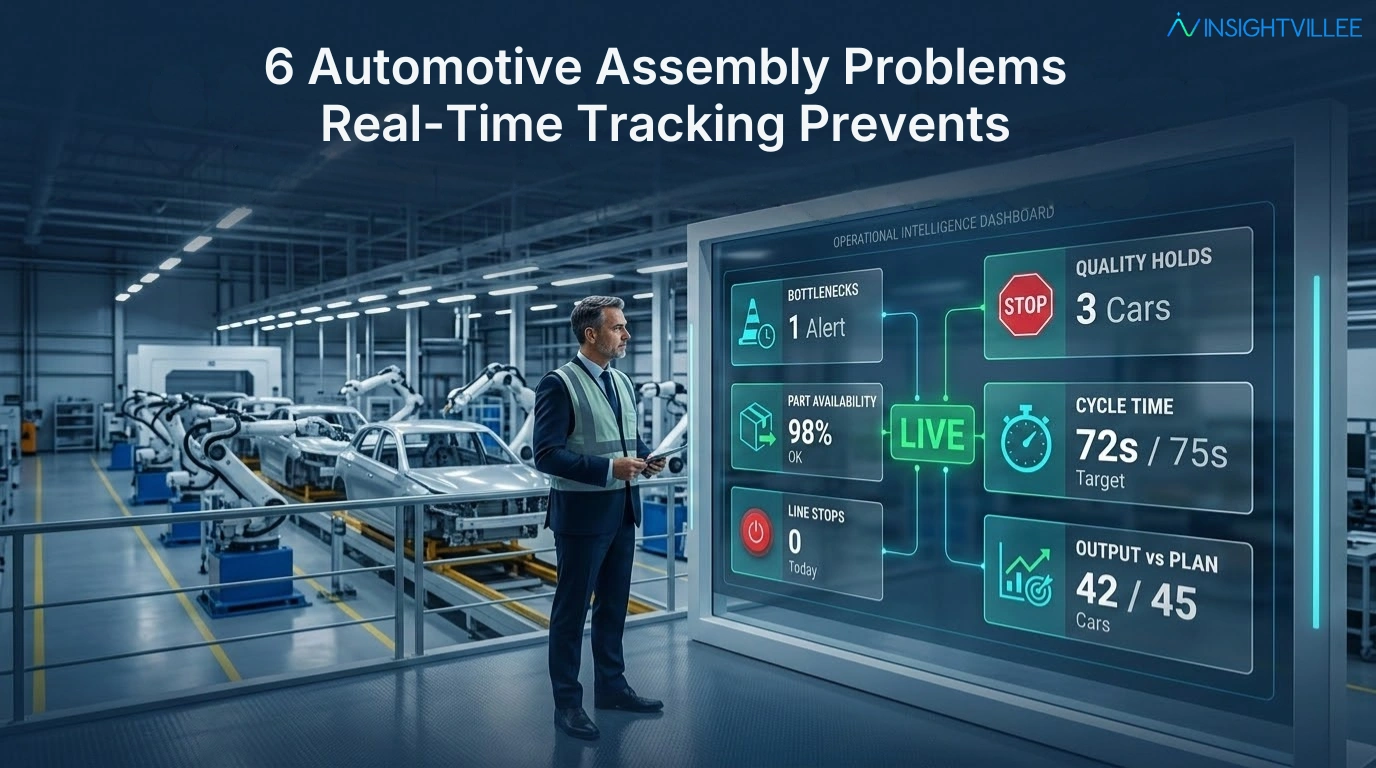
Why Automotive Plants Need Real-Time Assembly Tracking
Automotive plants need real-time assembly tracking because small delays can quickly turn into missed production targets.
In automotive assembly, every station depends on the station before it. If one station slows down, the next station waits. If a part is missing, operators adjust manually. If a quality issue moves ahead, rework increases. These issues may look small during the shift, but they reduce daily output.
Siemens reported that one unproductive hour costs automotive manufacturers around $2.3 million [Siemens, 2024]. The exact cost differs by plant size and product mix, but the pressure is real.
Smart Assembly Tracking in Automotive Plants: Protecting Line Output in Real Time
Key insight: most assembly line problems do not begin as major breakdowns. They begin as small delays that are detected too late.
What Is Real-Time Assembly Tracking?
Real-time assembly tracking means monitoring line activity while production is still running.
It shows station status, cycle time, part movement, operator progress, quality checks, tool availability, and stoppage reasons in a live view. This helps supervisors see where output is on track and where it is slipping.
For example, if Station 8 is crossing cycle time repeatedly, the team can check the reason during the shift. It may be a tooling issue, part fitment problem, operator variation, or material delay.
This is different from end-of-shift reporting. End-of-shift reports explain what happened. Real-time tracking helps teams act before the loss becomes final.
Problem 1: Missed Production Targets
How Real-Time Tracking Shows Output Gaps Early
Real-time tracking prevents missed production targets by showing output gaps before the shift ends.
A plant may plan 450 units in one shift. By mid-shift, the line may already be 25 units behind. Without live tracking, this gap may be noticed only during the production review. By then, recovery becomes difficult.
With production tracking, supervisors can see planned output versus actual output by hour, line, and station. This helps them act early. They can add support, check material flow, resolve bottlenecks, or adjust sequencing.
Deloitte noted that manufacturers continue to face supply chain risks, delays, and elevated costs [Deloitte, 2025]. In this environment, plants cannot afford avoidable output loss inside their own lines.
Key insight: daily output is protected hour by hour, not at the end of the shift.
Problem 2: Station-Level Bottlenecks
How One Slow Station Can Delay the Entire Line
One slow station can delay the entire line because assembly works on flow.
If one station takes longer than the planned cycle time, the next station waits or receives work unevenly. Operators may compensate manually. Supervisors may move people temporarily. The line may continue, but output suffers.
A common scenario involves one trim or fitment station slowing down during a specific model variant. Production teams may assume manpower is the issue. But the real cause may be part fitment, tool condition, layout, or work content imbalance.
Real-time monitoring helps identify the repeated slow station and the conditions under which it slows down.
Key insight: the slowest station often controls the real speed of the full assembly line.
Problem 3: Part Shortages and Material Delays
How Tracking Helps Teams Spot Missing Parts Before Line Impact
Tracking helps teams spot missing parts before they stop or slow the line.
Part shortages are one of the most common automotive production issues. A missing bracket, fastener, wiring harness, or trim component can hold up an entire station. In many plants, the part problem is discovered only when the operator reaches for it.
Real-time tracking connects part movement with station demand. It helps teams see whether the right parts are available at the right place before the line is affected.
For example, if a part bin is not replenished before the next sequence reaches the station, material teams can act before the operator waits.
Key insight: material delays become line delays when teams discover them at the station instead of before the station.
Problem 4: Quality Issues Moving Forward
How Defects Can Be Caught Before They Reach the Next Stage
Real-time tracking helps catch quality issues before they move to the next stage.
In automotive assembly, one missed quality check can create rework across multiple stations. A wrong fitment, missing torque confirmation, poor alignment, or incomplete inspection may not stop the line immediately. But it can create rework later.
IATF 16949 focuses on defect prevention and reduction of variation and waste in the automotive supply chain [AIAG, 2016]. For plant leaders, this means quality control should happen as close to the source as possible.
Real-time assembly tracking helps teams see failed checks, skipped checks, repeat defects, and rework movement faster.
Key insight: quality issues are cheaper to correct at the station where they start than at the final inspection area.
Problem 5: Operator and Shift-Level Variation
How Tracking Shows Where Performance Is Changing
Tracking shows operator and shift-level variation by comparing cycle time, stoppages, and quality results across shifts.
Many plants see different output from the same line on different shifts. The machine is the same. The layout is the same. The plan is the same. But performance changes.
The reason may be operator training, work method variation, material presentation, supervisor response time, or shift handover quality.
Real-time tracking helps leaders see where the variation appears. It does not blame operators. It shows where support, training, process standardisation, or layout improvement is needed.
Key insight: shift variation is often a process visibility issue, not only a manpower issue.
Problem 6: Delayed Maintenance Response
How Real-Time Data Helps Teams Act Before Downtime Increases
Real-time data helps maintenance teams act before small equipment issues become bigger downtime events.
A tool may start failing intermittently. A conveyor may slow down. A fixture may need repeated adjustment. A machine may generate alerts but continue running. If maintenance action is delayed, assembly line downtime increases.
NIST found that manufacturers using more preventive and predictive maintenance practices had 52.7% less unplanned downtime and 78.5% fewer defects compared with heavier reactive maintenance users [NIST, 2021].
5 Reasons Predictive Alerts Alone Do Not Stop Production Loss
Key insight: alerts help only when they lead to timely maintenance action.
Why Manual Tracking Cannot Prevent These Problems Fast Enough
The Limits of Paper Logs, Excel Sheets, and End-of-Shift Reports
Manual tracking cannot prevent assembly problems fast enough because it records issues after the loss has already happened.
Paper logs, Excel sheets, and shift reports are useful for review. But they are weak for real-time action. By the time the report is prepared, the missed output, rework, or downtime is already locked in.
A common example is repeated five-minute stoppages. No single stoppage looks serious. But across a full shift, they create meaningful production loss.
Key insight: manual tracking explains yesterday’s loss. Real-time tracking helps reduce today’s loss.
How Real-Time Tracking Protects Line Output
Better Visibility, Faster Action, and Fewer Surprises on the Shop Floor
Real-time tracking protects line output by helping teams see problems early, assign action quickly, and prevent surprises.
It connects assembly monitoring, production tracking, quality checks, station status, and downtime reasons into one view. This helps plant teams move from data to insight to action.
Insightvillee fits into this category as a manufacturing intelligence platform. It helps plant teams connect machine, line, and production data so they can identify bottlenecks, delays, and performance losses earlier. In relevant deployments, Insightvillee has recorded 15% OEE improvement. This is a deployment-specific outcome, not a universal guarantee.
The value is not more reporting. The value is faster operational decision-making during the shift.
Practical Steps to Start Real-Time Assembly Tracking
Simple Actions Automotive Plants Can Take First
Automotive plants can start real-time assembly tracking by focusing on the areas where output loss is most visible.
Start with these steps:
- Track planned output versus actual output by hour.
- Identify top bottleneck stations.
- Monitor cycle time misses.
- Track part shortages by station.
- Record quality holds and rework movement.
- Connect maintenance response with downtime events.
- Review shift-wise performance variation.
Plant Heads should ask one simple question: which assembly problems are we discovering too late?
That answer usually shows where real-time tracking should begin.
Conclusion
Real-time tracking helps plants protect daily assembly output because it gives teams visibility before small problems become large losses.
Automotive assembly is sensitive to timing. One slow station, one missing part, one missed quality check, or one delayed maintenance action can affect the full line.
Plants do not need more end-of-shift explanations. They need faster visibility during the shift.
Real-time tracking helps teams protect output, reduce assembly line downtime, improve automotive quality control, and increase line efficiency. Insightvillee supports this direction by helping manufacturers turn shop floor data into practical decisions.