
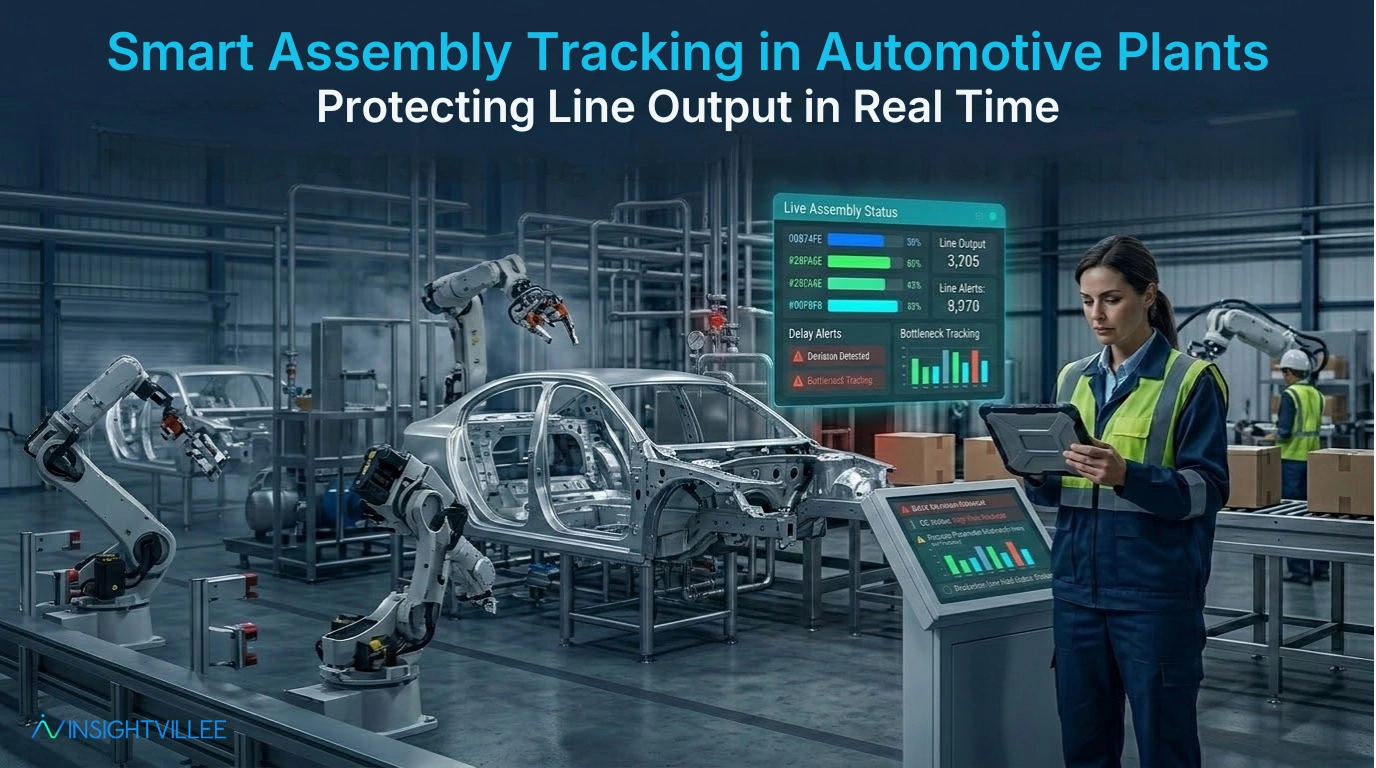
Why Automotive Assembly Lines Need Real-Time Tracking
Automotive assembly lines need real-time tracking because one small delay can reduce the output of the entire shift.
In automotive assembly, every station depends on the previous station. If the trim line slows down, final assembly waits. If a part is missing at one station, operators adjust manually. If a quality issue is found late, completed units may need rework. The problem is not always a major breakdown. Many plants lose output through small delays that are noticed only after the shift ends.
This matters because downtime is expensive. Siemens reported that one hour of downtime costs automotive manufacturers around $2.3 million [Siemens, 2024]. Even if the exact cost differs by plant, the direction is clear. Missed minutes on the line quickly become missed vehicles, delayed dispatches, overtime, and pressure on daily production targets.
What Is Smart Assembly Tracking?
Smart assembly tracking means tracking what is happening across the assembly line while production is still running.
It connects station status, part movement, operator progress, cycle time, quality checks, and line stoppages into one live view. The goal is simple: help plant leaders see where production is moving smoothly and where it is slowing down.
For example, a plant may track whether a part reached the right station, whether the operator completed the task within cycle time, whether a quality check passed, and whether the next station is waiting.
This is not only production tracking. It is production visibility. A common misconception is that tracking means counting output at the end of the day. In practice, useful tracking shows what is affecting output during the shift, when teams can still act.
Why Line Output Gets Affected
Common Reasons for Missed Targets, Delays, and Line Stoppages
Line output gets affected when small assembly line problems keep repeating without being detected early.
Common issues include part shortages, wrong parts at the station, slow cycle time, tool downtime, quality holds, operator absence, rework, and delayed material movement. Each issue may look small at station level. But when repeated across a full shift, it affects throughput.
Deloitte noted that manufacturers continue to face supply chain risks, delays, and elevated costs, which increases pressure on production stability [Deloitte, 2025]. In automotive plants, this pressure is felt directly on the line. If material arrives late, the line waits. If quality increases, finished output drops. If teams discover the issue only in the shift report, the lost output cannot be recovered.
6 Automotive Assembly Problems Real-Time Tracking Prevents
Key insight: most assembly losses are not invisible because plants lack data. They are invisible because the data reaches decision-makers too late.
What Happens When One Station Slows Down?
How One Small Delay Impacts the Entire Assembly Line
When one station slows down, the entire assembly line feels the impact because automotive production works on flow.
Consider a line planned for a fixed cycle time. If one station takes longer than planned, the next station waits or receives work unevenly. Supervisors may add manpower, move parts manually, or push rework to the side. These actions may help the shift continue, but they often hide the real bottleneck.
The data frequently reveals that the same station slows down during specific models, part combinations, or operator changes. Without real-time visibility, teams may treat the issue as a manpower problem when the actual cause is tool condition, part fitment, or material presentation.
Research on real-time bottleneck control in automotive assembly has shown that identifying constraints during production helps improve throughput compared with traditional delayed approaches [Li et al., 2009].
Key insight: the slowest station controls the pace of the line, even when most other stations are performing well.
What Should Be Tracked on the Assembly Line?
Parts, Operators, Cycle Time, Quality Checks, and Station Status
Automotive plants should track the factors that directly affect output, quality, and flow.
The most important areas are part availability, station-wise cycle time, operator assignment, quality check status, tool availability, rework movement, and line stoppage reasons. These are the signals that tell leaders whether the line is healthy or unstable.
Traceability also matters. IATF automotive quality requirements place importance on identification and traceability where required, including maintaining records across product realization [IATF, 2016]. For plant leaders, this is not only a compliance point. It helps answer practical questions: which part was used, where was it fitted, who completed the operation, and when was the quality check done?
Key insight: good assembly tracking does not track everything. It tracks the few signals that explain why output is being protected or lost.
Why Manual Tracking Is Not Enough
The Problem With Paper Logs, Excel Sheets, and Delayed Reports
Manual tracking is not enough because it explains what happened after the loss has already occurred.
In many plants, supervisors record stoppages on paper, operators update checklists, and production teams prepare Excel summaries at the end of the shift. These records are useful for review. But they are weak for real-time action.
A common scenario involves a station losing five minutes several times in a shift. No single stoppage looks serious. By the end of the day, the plant has lost meaningful output. The shift report shows the gap, but the chance to correct it is gone.
Manual reports also depend on accuracy and speed of entry. When the line is under pressure, teams focus on keeping production moving. Documentation often happens later. This creates a gap between floor reality and management visibility.
Key insight: delayed tracking turns production problems into reporting problems. Real-time tracking turns them into action points.
How Real-Time Tracking Protects Line Output
Finding Bottlenecks, Delays, and Quality Issues Before They Spread
Real-time tracking protects line output by showing bottlenecks, delays, and quality issues while teams can still correct them.
For example, if one station crosses cycle time repeatedly, the supervisor can check manpower, tools, part supply, or workstation layout during the shift. If quality checks fail at one point, rework can be contained before more units are affected. If parts are delayed, material teams can respond before the line stops.
NIST research found that manufacturers using more preventive and predictive maintenance practices had 52.7% less unplanned downtime and 78.5% fewer defects than those relying more heavily on reactive maintenance [NIST, 2021]. McKinsey also reported that real-time performance data helped one automotive company reduce cost per unit by 3.5% [McKinsey, 2022].
Insightvillee fits here as a real-time manufacturing intelligence platform. It connects line, machine, and production data so plant teams can see bottlenecks early, compare stations, and protect daily output. The value is not the dashboard. The value is faster decision-making on the plant floor.
Practical Steps to Improve Assembly Tracking
Simple Actions Automotive Plants Can Start With
Automotive plants can improve assembly tracking by starting with the few points where output loss happens most often.
Plant Heads can begin with five practical questions:
- Which stations miss cycle time most often?
- Which stoppage reasons repeat across shifts?
- Which parts cause the highest waiting time?
- Where does rework enter the line?
- How quickly does the team know when output starts falling behind plan?
Once these answers are clear, teams can decide what to track first. High-performing manufacturers usually start with bottleneck stations, critical quality gates, and part movement points. They avoid tracking too many things at once.
The best approach is simple: capture data, convert it into insight, and act during the shift. If tracking does not help the team make a faster decision, it adds noise.
Conclusion
Better Tracking Helps Protect Daily Production Output
Better tracking helps protect daily production output because it gives leaders visibility before small problems become full shift losses.
Automotive assembly is sensitive to flow. One missed part, one slow station, one delayed quality check, or one repeated stoppage can affect the entire line. Manual tracking may explain the loss later. Real-time monitoring helps prevent the loss while production is still running.
For Plant Heads and Operational Directors, the real question is not whether the plant has data. Most plants already do. The question is whether the right people see the right issue at the right time.
Automotive plants that improve assembly tracking will be better placed to protect output, reduce downtime, improve quality response, and run shifts with greater control. Insightvillee supports this direction by helping manufacturers turn production visibility into faster operational decisions.