
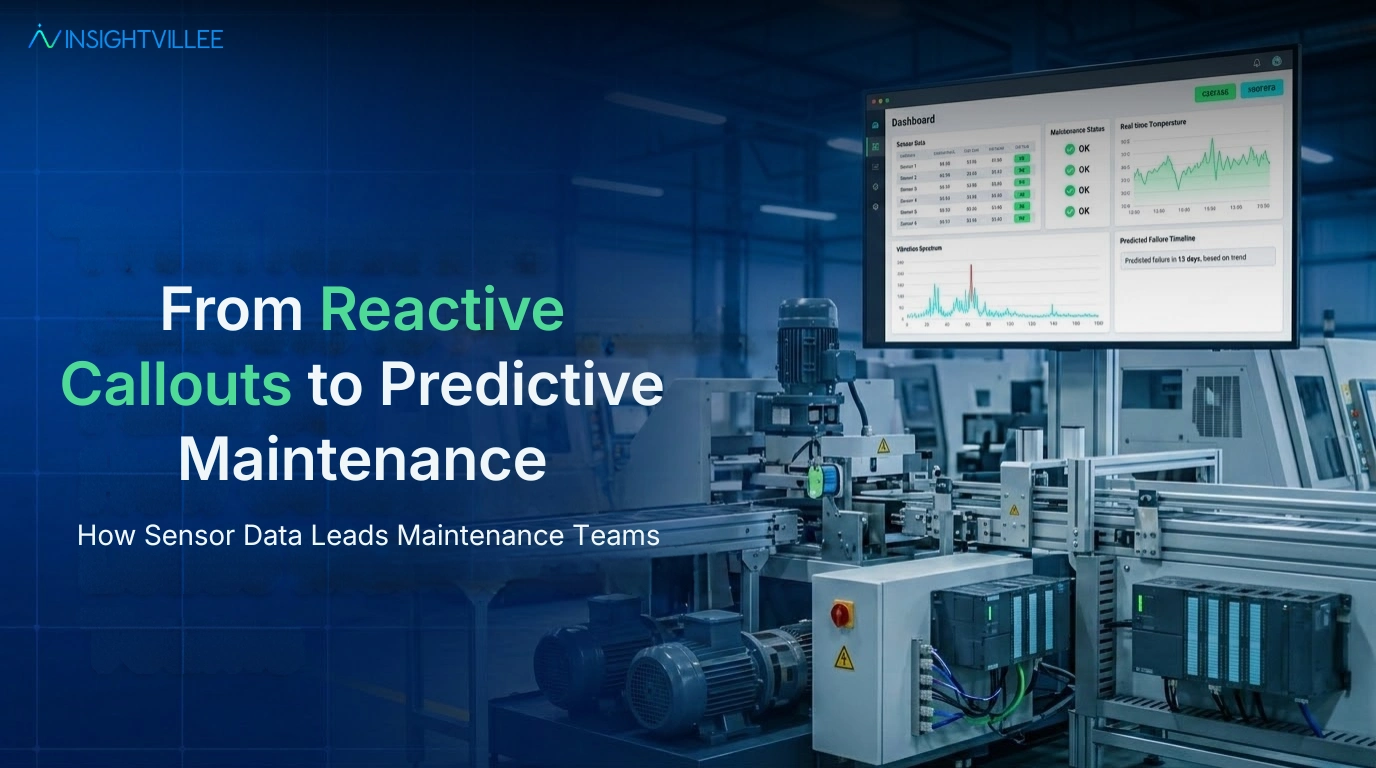
From Reactive Callouts to Predictive Maintenance: How Sensor Data Leads Maintenance Teams
Most plant maintenance teams still work the same way. A machine fails. Someone calls. The team rushes in to fix it. This is reactive maintenance, and it costs far more than it looks. The Full Cost of Unplanned Downtime breaks down exactly how large that bill becomes when you count both the visible and hidden losses.
Predictive maintenance changes this completely. Instead of waiting for failure, machines tell your team what is about to go wrong. This guide explains how sensor data makes that possible and how maintenance teams can start using it.
What Are Reactive Callouts in Plant Maintenance?
Definition and Practical Meaning
A reactive callout happens when a machine breaks down without warning and a technician is called in to fix it. No planning. No preparation. Just a broken machine and a team scrambling to get production back.
Why Reactive Maintenance Still Happens in Many Plants
Many plants simply do not have the tools to see problems coming. Without machine monitoring, every failure is a surprise. Teams fix what breaks and move on to the next one.
The Operational Pressure Created by Emergency Callouts
What a 2am Machine Failure Reveals shows what a single overnight breakdown looks like in practice. The pressure on maintenance teams, the ripple effect on production, and the cost that follows go well beyond what the repair bill shows.
Why Reactive Maintenance Is No Longer Enough
Rising Cost of Unplanned Downtime
Every unplanned stop costs more than a scheduled one. Emergency repairs carry premium prices. Lost production cannot be recovered. Customer deadlines slip.
Increased Stress on Maintenance Teams
When maintenance teams spend every day putting out fires, there is no time for planning, inspection, or improvement. The cycle repeats indefinitely.
Spare Parts and Emergency Repair Challenges
Parts ordered in a rush cost more and take longer to arrive. Without advance warning, the right spares are rarely on the shelf when they are needed most.
Impact on Production Schedules and Customer Commitments
One machine failure on a critical line can throw an entire week’s production schedule off. Customer commitments break. Replanning costs time that no one has.
What Sensor Data Reveals About Machine Health
Vibration Patterns
A machine with a failing bearing vibrates differently than a healthy one. Sensors measure these changes in fractions of a millimetre, long before the damage becomes visible or audible.
Temperature Changes
Rising temperature in a motor or gearbox is often the first sign that something is wrong. Sensors track this continuously, not just when someone checks manually.
Motor Load and Energy Consumption
A machine drawing more current than usual is working harder than it should. This is often an early sign of mechanical wear or process deviation.
Runtime, Cycles, and Operating Conditions
How long has this machine run since its last service? How many cycles has it completed? Sensor data tracks all of this automatically so maintenance schedules are based on actual use, not assumptions.
How Sensor Data Helps Predict Equipment Failures
Detecting Early Warning Signs
Machine failure rarely happens without warning. Vibration increases gradually. Temperature climbs slowly. Current draw creeps up over days. Sensors catch these shifts weeks before the machine stops.
Identifying Abnormal Operating Patterns
When a machine behaves differently from its own normal baseline, something has changed. Sensor data flags the deviation and tells the team where to look.
Comparing Current Performance With Historical Baselines
Every machine has a normal operating range. Sensor monitoring compares live readings against that baseline continuously. The further a reading drifts, the higher the risk of failure.
Connecting Machine Signals With Maintenance History
When the same failure pattern appears for the third time, the system recognises it. Maintenance history combined with sensor data helps teams understand not just what is failing but why.
From Data Collection to Maintenance Intelligence
Why Raw Sensor Data Alone Is Not Enough
Thousands of data points from dozens of machines produce noise, not insight. The value is not in collecting data. It is in knowing what the data means for maintenance teams making decisions on the floor.
Turning Machine Signals Into Actionable Alerts
A smart platform filters the noise and surfaces only the signals that matter. When vibration on a specific motor crosses a threshold, the right technician gets an alert with the machine name, the reading, and the recommended action.
Using AI to Prioritize Maintenance Risks
Not every alert is urgent. AI-powered platforms rank maintenance risks by severity so teams focus first on the machine most likely to fail and cause the biggest disruption.
Helping Teams Decide What to Fix First
When three machines show early warning signs at the same time, which one gets attention first? Connected intelligence answers that question based on failure risk, production impact, and asset criticality.
Key Metrics Maintenance Teams Should Track
MTBF
Mean Time Between Failures measures how long a machine typically runs before it breaks down. A falling MTBF is an early sign that asset health is declining.
MTTR
Mean Time To Repair measures how quickly your team restores a machine after a failure. High MTTR points to gaps in parts availability, skills, or process.
Asset Health Score
A single number that combines all sensor readings and maintenance history into a health rating for each machine. Easy to track. Easy to act on.
Maintenance Cost per Asset
Tracking what each machine costs to maintain over time reveals which assets are draining the budget and whether predictive maintenance is reducing that spend.
Real-World Example: Predicting Failure Before a Breakdown
The Early Warning Signal
A sensor on a large cooling pump in a chemical plant showed a slow but steady increase in vibration over nine days. The machine was still running normally by all visible checks.
What the Maintenance Team Initially Saw
Nothing. The pump looked fine. No noise. No visible damage. Without sensor data, the team would have had no reason to inspect it.
What Sensor Data Revealed
The vibration trend matched a known bearing wear signature. Cross-referencing with maintenance history confirmed the bearing had not been replaced in 14 months, two months past the recommended interval.
Preventive Action Taken
The bearing was replaced during a planned weekend shutdown. Total cost: Rs 18,000 in parts and two hours of technician time.
Production and Cost Impact
An unplanned failure of the same pump would have meant four to six hours of unplanned downtime, emergency procurement, and Rs 3.5 lakh in lost production value. The sensor paid for itself many times over.
How Plants Can Start Moving Toward Predictive Maintenance
Start With Critical Assets
Identify the five machines that cause the most damage when they fail. Start monitoring those first.
Install Sensors Where Failure Risk Is Highest
Focus on bearings, motors, compressors, and cooling systems. These are the most common sources of unplanned breakdown in large plants.
Define Failure Indicators and Thresholds
Before setting up alerts, decide what an abnormal reading looks like for each machine. Thresholds should be based on manufacturer specifications and your own maintenance history.
Connect Sensor Data With Maintenance Records
Sensor readings alone do not tell the full story. Linking them to past failures and service history makes the intelligence much sharper.
Build a Data-Led Maintenance Workflow
Alerts are only useful if they trigger action. Define who receives each alert, what they do, and how quickly they respond. Make it a process, not a dashboard.
Common Mistakes to Avoid
Monitoring Too Many Assets Too Early
Starting with 200 machines creates data overload. Start with 10 critical assets and expand once the process is working.
Collecting Data Without Clear Maintenance Goals
If your team does not know what problem they are trying to solve, more data will not help. Define the goal first.
Treating Predictive Maintenance as Only a Technology Project
Technology is the enabler. The outcome is a more reliable plant. Keep the focus on maintenance results, not platform features.
Conclusion: From Emergency Response to Intelligent Maintenance
Reactive callouts will always exist in some form. But when they are the default response to every machine failure, the cost compounds quietly across every shift, every week, and every quarter.
Sensor data gives maintenance teams the ability to see problems coming and act while there is still time to prevent them. When that data flows into a connected platform alongside production and maintenance history, the whole plant runs smarter. Smart Factory Operations: What Changes When Every System Feeds One Intelligence Layer shows what that looks like at scale.