
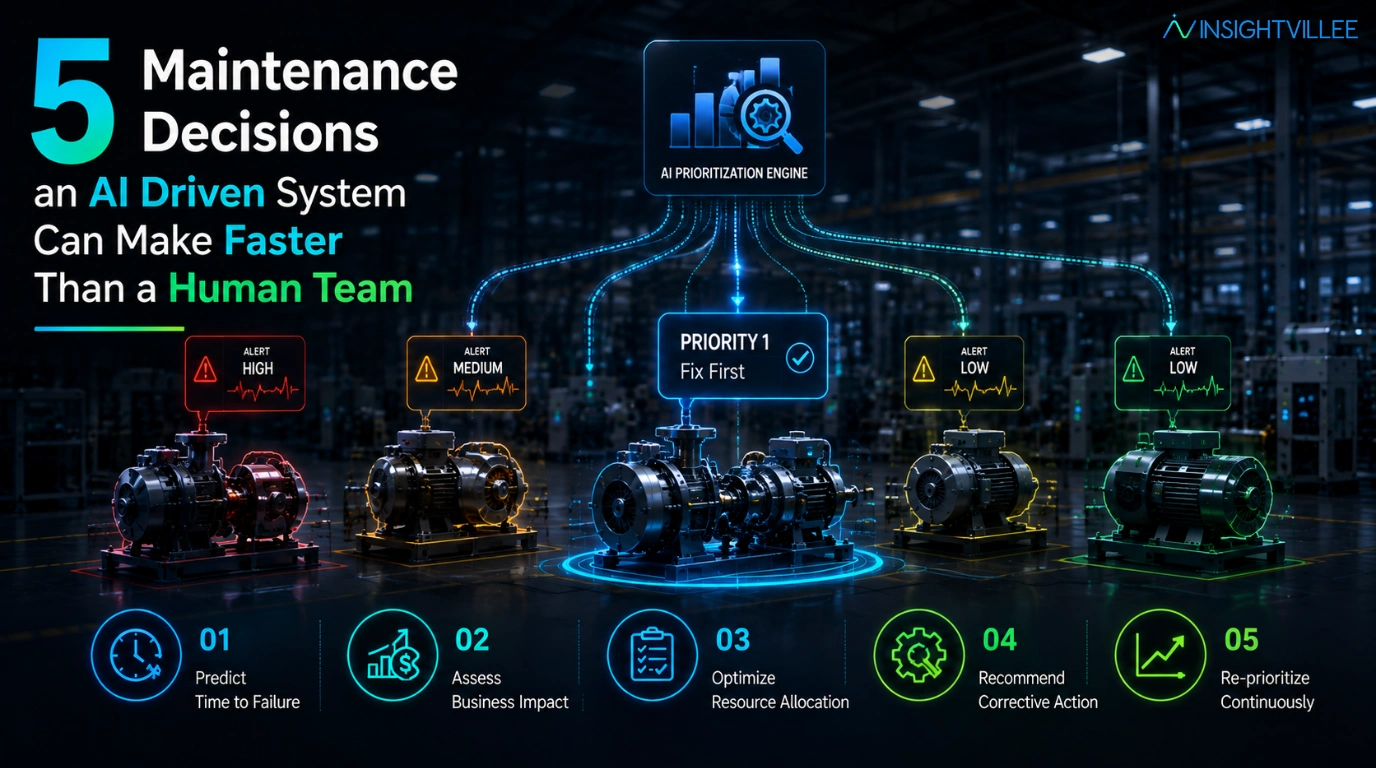
5 Maintenance Decisions AI Systems Make Faster in Plants
Maintenance decisions become difficult when five machines show abnormal signals at the same time and production is waiting for one clear answer.
A maintenance head does not only ask, “Which machine has an alert?” He asks, “Which machine can stop production first? Which alert is serious? Which repair can wait? Which problem will repeat if we only do a quick fix?”
Human teams bring experience. But they cannot manually analyse every vibration, temperature, pressure, current, runtime, maintenance history, and production condition in real time.
Advanced maintenance approaches help manufacturers reduce downtime, defects, and maintenance cost when they are implemented well [NIST, 2021]. Siemens also reported that unscheduled downtime costs the world’s 500 biggest companies 11% of annual revenues [Siemens, 2024].
What Is an AI-Driven Maintenance System?
An AI-driven maintenance system uses machine data, sensor signals, maintenance history, failure records, operating conditions, and production context to support faster maintenance decisions.
It does not only monitor machine health. It learns machine behaviour, detects abnormal patterns, prioritises risks, and supports maintenance decisions before failures affect production.
The goal is not to replace maintenance teams. The goal is to help them make better decisions faster.
ISO 13374 provides guidance for condition monitoring and diagnostics of machines, including processing and presentation of machine condition information [ISO, 2003]. In plant language, this means machine readings must become useful maintenance information, not only raw data.
Why Do Maintenance Decisions Become Slow in Large Plants?
Maintenance decisions become slow because large plants have too many machines, alerts, records, production pressures, and manpower limits for teams to compare manually in real time.
A large plant may have pumps, motors, compressors, conveyors, turbines, gearboxes, utilities, and process equipment running across many lines and shifts.
When several alerts appear together, teams must compare machine criticality, spare availability, inspection records, production schedule, manpower, and downtime risk.
The problem is not always lack of data. The problem is too much disconnected data.
Human angle: In many plants, the maintenance team is not sitting calmly with one alert. They are answering calls from production, checking spares, sending technicians, handling safety permits, and explaining delay risk to leadership. In that pressure, decision speed matters.
[Link: how AI driven maintenance prioritises which machine to fix first when multiple alerts fire → /blog/ai-driven-maintenance-prioritises-machine-alerts]
What Are the 5 Maintenance Decisions AI Can Make Faster?
The 5 maintenance decisions AI can make faster are machine priority, alert urgency, likely failure mode, maintenance timing, and whether the issue is isolated or recurring.
The five decisions are:
Which machine needs attention first.
Whether an alert is urgent or low priority.
What failure mode may be developing.
When maintenance should be scheduled.
Whether the issue is isolated or recurring.
These are the maintenance decisions AI can make faster because it can connect signals, history, production context, and risk priority at the same time.
Decision 1: Which Machine Needs Attention First?
AI can identify which machine needs attention first by comparing asset criticality, failure probability, machine health trend, production impact, and current operating condition.
When multiple alerts appear together, human teams often depend on visible severity, experience, or whoever calls first.
But the loudest alert is not always the most dangerous one.
For example, a high vibration alert on a non-critical auxiliary motor may be less urgent than a small vibration drift on a compressor feeding a critical production line.
AI maintenance can rank risk by looking at the asset’s role in production, past failure pattern, current behaviour, and likely impact if it stops.
Expert angle: In many plants, the most dangerous alert is not always the loudest alert. It is the one connected to the highest production, safety, or delivery risk.
Decision 2: Whether an Alert Is Urgent or Low Priority?
AI can judge whether an alert is urgent or low priority by comparing current behaviour with past machine behaviour under similar load, speed, shift, and process conditions.
Not every alert needs immediate shutdown or emergency maintenance.
Some alerts happen during startup. Some appear during temporary load changes. Some are linked to product change, process adjustment, or short disturbances.
This is where AI driven maintenance decision making helps. It can check whether the current signal is normal for that operating condition or whether it is moving away from the machine’s usual pattern.
For maintenance leaders, this reduces panic decisions. Teams can separate routine variation from real risk.
It also helps reduce alert fatigue. When teams receive too many low-value alerts, they slowly stop trusting the system.
[Link: how AI driven maintenance reduces false alarm rates without missing real failures → /blog/ai-driven-maintenance-reduces-false-alarm-rates]
Decision 3: What Failure Mode May Be Developing?
AI can support failure mode decisions by comparing signal patterns with known equipment behaviour linked to bearing wear, misalignment, imbalance, lubrication issues, cavitation, fouling, and pressure drift.
A human team may see rising vibration or temperature and know that something is wrong.
But the next question is harder: what exactly is developing?
For example, rising vibration alone may mean imbalance, misalignment, bearing wear, looseness, or foundation issue. A pressure drift may point to fouling, leakage, or process instability. A current change may relate to load, motor health, or electrical imbalance.
Predictive maintenance becomes useful when it moves the team from general inspection to targeted action.
Human angle: A technician walking to the machine without context may check everything. A technician walking with a likely failure mode can check the right area first. That saves time during production pressure.
Decision 4: When Maintenance Should Be Scheduled?
AI can support maintenance scheduling by estimating whether the risk needs immediate action, next-shift inspection, next planned stop, or a scheduled shutdown window.
Maintenance teams must balance machine risk with production demand.
Taking a machine down too early can reduce output unnecessarily. Waiting too long can create breakdowns, emergency repairs, overtime, and dispatch delays.
An AI maintenance planning system can compare risk progression with production schedules, downtime windows, asset criticality, and maintenance history.
This supports better maintenance planning because production and maintenance teams can discuss timing with clearer context.
The human angle is simple. A Plant Head does not want maintenance to stop production for every alert. But he also does not want a critical machine to fail during peak output. Better timing protects both uptime and production flow.
Decision 5: Whether the Issue Is Isolated or Recurring?
AI can check whether an issue is isolated or recurring by finding if the same behaviour has appeared before on the same machine, shift, line, load condition, or similar asset.
A single alert may look like a one-time event. But the same pattern may have appeared earlier.
For example, the same vibration pattern may happen every time a machine runs a specific product. The same pressure drift may appear after every cleaning cycle. The same current variation may repeat during night shift.
Manual review may miss this because the records are spread across logs, shifts, work orders, and reports.
Automated maintenance decisions in plants become more useful when the system shows repeated behaviour clearly.
This helps leaders decide whether to close the issue after repair or start root cause analysis.
Why Does AI Make These Maintenance Decisions Faster Than Human Teams?
AI makes these maintenance decisions faster because it continuously compares large volumes of machine data, history, alerts, production context, and risk priority together.
Human teams often review signals separately. One person checks vibration. Another checks inspection notes. Another checks production pressure. Another checks spares.
AI connects these signals faster.
It compares current behaviour with historical patterns. It identifies abnormal trends before they become obvious. It ranks risks by urgency, probability, and production impact.
But the final call should still stay with the maintenance team. AI supports judgement. It should not replace plant experience.
This is how a faster maintenance response with AI becomes practical. The team spends less time searching for meaning and more time acting on the right issue.
What Data Does AI Need to Support Maintenance Decisions?
AI needs machine health data, maintenance records, failure history, work orders, production schedules, process conditions, and asset criticality to support useful maintenance decisions.
Important data includes vibration, temperature, pressure, current, power, speed, load, runtime hours, breakdown records, maintenance history, work orders, production schedules, process conditions, and asset criticality.
The stronger the connection between machine data and plant context, the more useful the recommendation becomes.
A vibration change without load context may confuse teams. A temperature rise without production context may lead to wrong urgency. A failure prediction without maintenance history may stay incomplete.
The practical rule is simple. Better connected data gives better maintenance decisions.
How Should Maintenance Teams Use AI Recommendations?
Maintenance teams should use AI recommendations as decision support, review the reason behind each alert, verify with field inspection, and record the final action taken.
AI should support experienced teams, not remove them from the process.
Teams should review why the system flagged a risk. They should compare recommendations with inspection results. They should capture the action taken after each alert.
They should also feed outcomes back into the system. Was the alert correct? Was it a false alarm? Did the inspection confirm the likely failure mode? Did the maintenance action prevent downtime?
This builds trust.
[Link: why floor teams trust AI driven maintenance recommendations building operator confidence → /blog/floor-teams-trust-ai-driven-maintenance]
Expert angle: Floor teams trust recommendations when they can see the reason behind them. If the system only says “risk high,” teams may ignore it. If it shows the pattern, history, and likely impact, teams are more likely to act.
Where Does Insightvillee Fit Into Faster Maintenance Decisions?
Insightvillee provides an AI driven maintenance system as part of its smart factory operations platform for large manufacturing plants that need earlier visibility into machine risks, downtime threats, and maintenance priorities.
This matters because faster decisions need connected context. A machine alert alone is not enough. Plant teams need to see machine behaviour, maintenance records, production impact, and risk priority together.
The Insightvillee platform supports this through predictive maintenance, OEE monitoring, smart production planning, and one real-time intelligence layer across machines, lines, and systems.
Conclusion
AI-driven maintenance helps teams make faster maintenance decisions when machine data, alerts, and production pressure become too complex to review manually.
The 5 key decisions are which machine to fix first, whether an alert is urgent, what failure mode may be developing, when to schedule maintenance, and whether the issue is recurring.
The value of AI is not replacing maintenance teams. It is helping them act faster, with better context and less guesswork.
Modern maintenance depends on turning machine data into timely decisions before failures affect production.
Insightvillee is a smart factory transformation partner that includes an AI driven maintenance system for reducing unplanned downtime and improving maintenance planning.
As part of its predictive maintenance capability, Insightvillee works as an AI driven maintenance system that helps plant teams act before failures affect production.
Insightvillee supports this shift as a transformation partner for large-scale manufacturers through predictive maintenance, OEE monitoring, smart production planning, and one real-time intelligence layer across machines, lines, and systems. Its locked outcomes include up to 40% reduction in unplanned downtime in relevant deployments. This is deployment-specific, not a universal guarantee.
Key Takeaways
AI can support faster maintenance decisions, but human teams should still make the final call.
The 5 decisions are priority, urgency, failure mode, maintenance timing, and recurrence.
AI helps by connecting machine behaviour, maintenance history, production impact, and asset criticality.
Maintenance automation is most useful when it reduces search time and improves action quality.
Plant teams should track whether alerts turn into completed maintenance action before downtime happens.